True Crime Chronicles: Bill Doolin- From Johnson County roots to an outlaw legend in Boot Hill
- Dennis McCaslin

- Oct 20, 2025
- 3 min read


William Marion "Bill" Doolin was born in 1858 on a modest farmstead in Pilot Rock Township, Johnson County.
This quiet corner of Clarksville, the county seat, cradled his early years, planting the seeds of a restless spirit that would catapult him into the annals of America’s Wild West as a notorious outlaw.
The son of Michael Doolin, an Irish-American sharecropper, and Artemina Beller Doolin, Bill grew up in a hardscrabble household alongside siblings, including half-brother Barton and sisters like Melinda.
The 1860 U.S. Census captures their simple life: a family toiling on borrowed land, tethered to the rhythms of cotton and corn in a post-Civil War Arkansas still raw with possibility.

Johnson County, established in 1833, was a tapestry of small farms and pioneer ambition, its rolling hills alive with the dreams and struggles of settlers. Young Bill, raised in this tight-knit community, learned to ride horses and handle firearms, skills honed in the Ozark wilds that would later define his outlaw prowess.
Local lore, preserved by the Johnson County Historical Society, paints the Doolin's as hardworking but unremarkable, their farm near Clarksville a hub of chores and neighborly ties. Yet, the frontier’s lawless undercurrent stirred something in Bill.
By his teens, the monotony of plowing fields clashed with tales of cowboys and open ranges drifting in from the West, igniting a wanderlust that would pull him from his roots.
At 23, in 1881, Doolin left Johnson County for Indian Territory, trading the plow for a cowboy’s saddle at the H-X Bar Ranch along the Cimarron River. Ranch owner Oscar Halsell took a liking to the lanky Arkansan, teaching him to read and write and promoting him to informal foreman.

Doolin thrived herding cattle under vast skies, but the frontier’s darker temptations beckoned. By the late 1880s, minor run-ins with the law drew him into the Dalton Gang, a crew of bank and train robbers led by brothers Bob, Grat, and Emmett Dalton.
Doolin’s Johnson County upbringing. where survival demanded grit and guile, had unknowingly prepared him for this pivot to crime.
In 1891, Doolin’s outlaw career exploded. He rode with the Daltons on daring heists across Kansas and Oklahoma, earning a reputation as a sharp-eyed planner who preferred cunning over bloodshed. When the Daltons met their doom in the 1892 Coffeyville, Kansas, bank robbery with four gang members gunned down, Doolin, being sidelined by a “lame horse,” escaped fate.
Seizing the moment, he formed the Wild Bunch, recruiting outcasts like George “Bitter Creek” Newcomb and Bill Dalton. Over four years, they looted banks, trains, and stagecoaches, amassing roughly $165,000, a fortune in the 1890s.
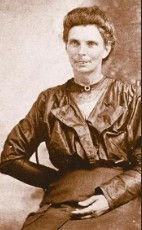
A bullet to the foot in an 1893 posse chase left him limping, a constant reminder of the life he’d chosen
Amid the chaos, Doolin found solace in family. In 1893, he married Edith “Etta” Maria Ellsworth, a 22-year-old from a Kansas family, in a clandestine ceremony.
Edith, fiercely devoted, followed him through hideouts, bearing their son, Jay, in a remote cabin on April 26, 1894.
She mended wounds and shielded Jay from the shadow of his father’s $3,750 bounty. But the Wild Bunch crumbled under relentless pursuit.
By 1895, betrayals—, most infamously by the Dunn brothers, claimed Newcomb and others. Doolin, captured by Marshal Bill Tilghman in Eureka Springs in January 1896, escaped from a Guthrie jail that July, scaling a fence in a rainstorm with Edith and Jay waiting nearby.

His freedom ended on August 25, 1896. Bathing in the Cimarron River to ease rheumatism, Doolin was ambushed by Deputy U.S. Marshal Heck Thomas’s posse. Raising his hands to surrender, he was cut down by 20 buckshot wounds, dead at 38.
Some whispered of a back-shot murder, fueling family outrage.
His body, displayed in Guthrie for identification, drew gawkers; Edith sold photos for burial funds.
He was laid to rest in Summit View Cemetery’s Boot Hill, his headstone a stark epitaph: “Bill Doolin, Died Aug. 25, 1896, Age 38 Years.”

Edith, widowed at 25, filed a $50,000 wrongful death suit against the Marshals, to no avail.
She remarried rancher James L. Meek in 1902, raising Jay as Jay D. Meek in Ponca City far from his father’s infamy. Jay died quietly in 1980 at 86; Edith passed in 1928, buried under her new name.
Though Doolin’s grave lies in Oklahoma, his legend is tethered to Johnson County, where museums and historical markers recall the farm boy who became an outlaw.
As the Encyclopedia of Arkansas notes, his 1896 death “marked the end of mounted outlaws,” closing a chapter born in the fields of Clarksville. In Johnson County, where his story began,
Bill Doolin remains a symbol of the wild heart that once beat in the Ozarks.


