Stone Gardens: Echoes of Revolution -The family migration that resulted in a pioneer woman's grave near Maysville




In the quiet, overgrown McCraw Cemetery near Maysville in Benton County, a weathered marker stands at the foot of larger family stones. It marks the final resting place of Nancy Rollins Bookout, born August 16, 1815, in the young American republic and died April 7, 1897, at age 81.
A farmer’s wife, mother of at least eight children, and widow who outlived her husband by more than a quarter-century, Nancy embodied the restless westward push of 19th-century Southern families. Her life--spanning Georgia farmsteads, a brief Texas interlude, and final settlement in the Ozark foothills--mirrors the broader American story of migration and land-seeking that watered the roots of American history.

Yet her story begins deeper, in the colonial hills of North Carolina, where her parents’ generation bridged the Revolutionary War era and the expanding frontier.
Nancy was the eldest known daughter of George Washington Rollins (1766–December 1850) and Elizabeth Arnold Rollins (ca. 1783–after November 1850). The couple married around 1820 in North Carolina and raised their family first in the Tar Heel State before relocating to Murray County, Georgia, by the 1830s.

George, already in his late forties when Nancy was born, had come of age in the turbulent post-Revolutionary decades. Born in 1766--just nine years before the first shots at Lexington and Concord--he belonged to the first generation of Americans who knew only the promise of independence. Census and family records place the Rollins household among the hardworking yeoman farmers of North Carolina’s western counties, where land was opening after the Revolution and families cleared fields amid lingering threats from British-allied tribes and the economic chaos of the new nation.
George and Elizabeth followed the classic Southern migration path: from North Carolina to the newly available lands in northern Georgia opened after the Cherokee removals of the 1830s. By 1850, George died in Murray County, Georgia; Elizabeth survived him briefly and was buried in Reed Family Cemetery, Chatsworth, Murray County.

Their union produced at least three documented daughters—Nancy, Dorcas Jane (1821–1910), and Emaline (ca. 1824–1908)—though earlier children from George’s possible prior marriage may exist in scattered records.
Elizabeth Arnold Rollins herself carried the lineage directly into Revolutionary times. Born about 1783 in North Carolina, she was the daughter of Jacob Butler Arnold (born ca. 1758) and Elizabeth Hughes. Jacob, a North Carolina man of the Revolutionary generation, was roughly 17–25 years old during the war years (1775–1783). While specific military service records for this exact Jacob Butler Arnold remain tied to user-contributed trees rather than verified pension files, his birth year and North Carolina roots place him squarely among the thousands of Carolina frontiersmen who supplied militia, guarded western settlements, or fought in the southern campaigns under leaders like Nathanael Greene.

The Arnold family, like many in the region, navigated the brutal backcountry warfare, Tory raids, and post-war land grants that rewarded Patriot service. Elizabeth Hughes, Jacob’s wife, completed the household; though her exact birth year shows discrepancies in some digital trees (likely transcription errors), she too belonged to the Hughes lines that populated colonial North Carolina. Their daughter Elizabeth’s 1820 marriage to the older George Rollins united two North Carolina farming clans just as the cotton boom and Indian removal opened Georgia lands.

George Washington Rollins’s own paternal line, though less precisely documented in primary sources, traces through North Carolina Rollins (sometimes spelled Rawlins or Rawlings) families who had settled the colony by the mid-1700s. Multiple genealogical compilations link men of similar age and name to earlier William Edward Rollins or related branches in the Carolinas--families that arrived in the 1740s–1760s from Virginia or Pennsylvania stock.
These were the same generations whose fathers and grandfathers had crossed the Atlantic in the great Scotch-Irish and English migrations, cleared land under royal governors, and then took up arms or provided supplies when Revolution came.
By George’s birth in 1766, the Rollins name already appeared in North Carolina tax lists and early court records, symbols of the hardy settler class that formed the backbone of the Patriot cause in the South.
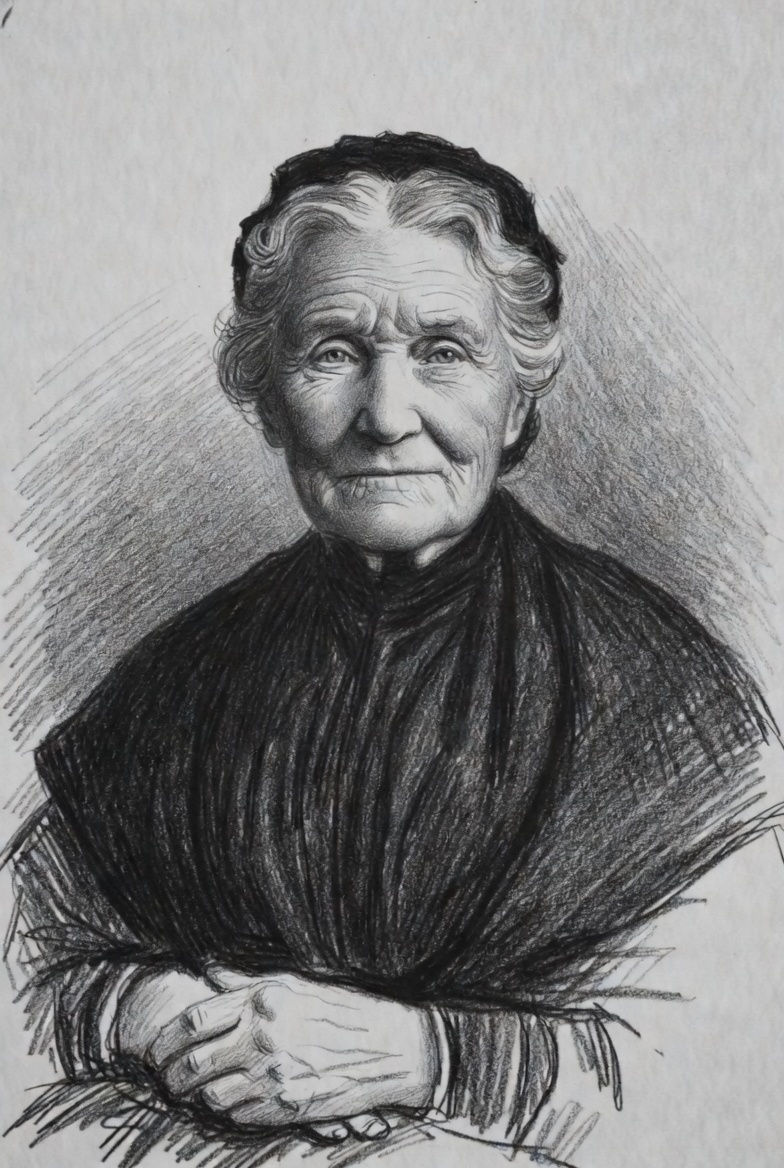
Nancy Rollins grew up in this world of post-Revolutionary expansion. By the time she married William E. Bookout around 1834 (likely in Georgia), the couple continued the family pattern: farming in Murray and Cherokee Counties, Georgia, through the 1840s and 1850s, a brief 1860 stint in Hill County, Texas, and final settlement by 1870 in Round Prairie Township, Benton County, Arkansas.
William, born ca. 1810 and died ca. 1869–1871 in Arkansas, left Nancy a widow who appeared in the 1880 census as head of a small household. Their children--Martha Jane (who married Achilles Foster), Jesse D., John Solomon “J.S.,” Lewis, and others—--spread across Arkansas, Texas, and beyond, carrying the Rollins-Bookout bloodline into the 20th century.
The McCraw Cemetery plot where Nancy rests, roughly 3–4 miles east of Maysville, on private land, lies near the graves of her daughter Martha Jane and son-in-law Achilles Foster.
The stone, simple and unadorned, speaks quietly of a life lived between two centuries: born when Thomas Jefferson was still alive and the memory of Yorktown was fresh in elders’ stories, and dying as the United States stood on the brink of global power. Her parents and maternal grandfather were the living bridge to the Revolutionary generation--men and women who had known British rule, fought for liberty (or endured its hardships), and then claimed the fertile western lands their sacrifice had secured.

In tracing Nancy Rollins Bookout’s lineage, one sees the unbroken thread of American expansion: from the Carolina backcountry patriots and settlers of the 1750s–1780s, through the Georgia cotton frontier of the 1820s–1850s, to the Arkansas homesteads of the post-Civil War era.
It is a quintessentially American tale--not of generals or statesmen, but of farming families who cleared fields, raised children, buried loved ones, and kept moving west under the same restless spirit that had won a nation’s independence a generation earlier.
Nancy’s descendants still dot the Ozarks and beyond, living proof that the frontier dream forged in Revolutionary times endured for well over a century.


