Cold Case Files: Shadows in the Secluded Spot - A forgotten tragedy from the Ozark hills of Scott County


In the raw, early spring of 1900, the dense timber and deep hollows of Scott County still kept the hard, unchanging pulse of frontier Arkansas." Farmers like Cyle Seburn Leonard--known to neighbors simply as "Sebe" ---worked the thin soil, raised modest crops, and kept to themselves in the remote settlements near Waldron and the area locals called Egger.
At sixty years old, Sebe was a man of the old Ozark stock: a Masonic lodge member, a farmer who had seen the county grow from raw frontier to settled farmland. He had buried one wife already. His second, Virginia A. Egger Leonard, was barely twenty-seven--young enough to be his daughter.
On a night in early March, something in that quiet household shattered.
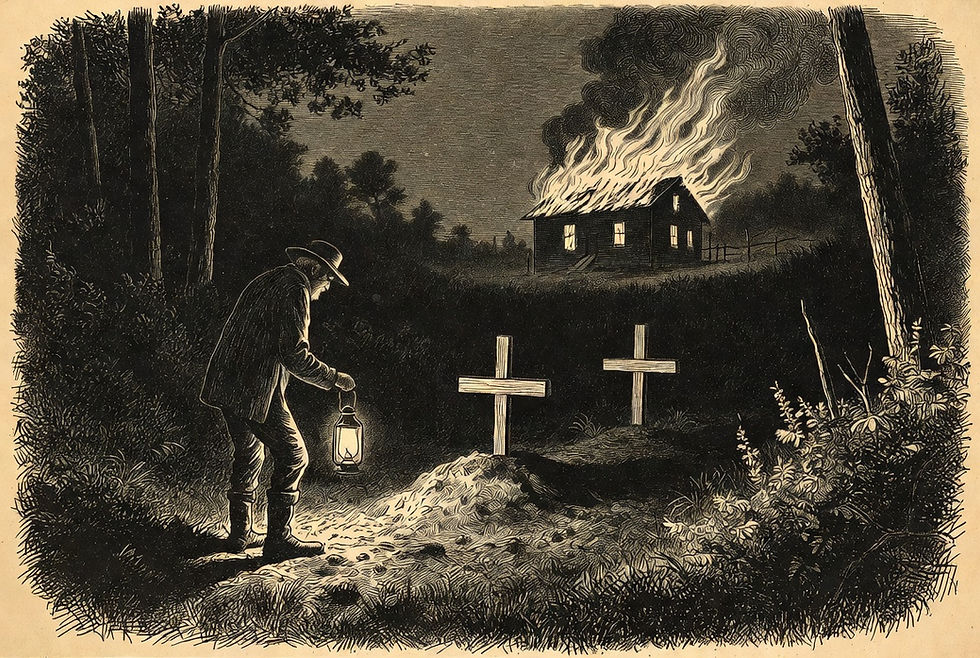
According to the few details that ever reached the outside world, Sebe took his young wife and their four-year-old son to a secluded spot in the woods. There, he shot them both. He buried their bodies where they fell. Then he walked back to the farm, set his own house ablaze, and disappeared into the timber. T
The next morning, neighbors Ross Ford and A. W. Furr rode in with the news that would stun the county: a double murder and suicide. Searchers later found Sebe’s body in the woods, his own pistol beside him. He had ended his life near the same lonely ground where he had buried his family.

The Mena Star broke the story on March 9, 1900. The St. Louis Republic carried it two days later under the stark headline “ARKANSAS TRAGEDY. Double Murder and Suicide in Scott County.” Newspapers across the region repeated the same spare facts. Jealousy, they said, was the cause. A sixty-year-old man with a wife less than half his age--urely that was explanation enough.
But the deeper truth, if there ever was one, vanished with the smoke from the burned farmhouse and the echo of those final shots.
No letters were found. No witnesses came forward to describe an argument, a rival, or a breaking point. No one in the tight-knit Scott County community could--or would--say what had pushed a respected farmer, a man who carried a Masonic emblem on his stone, to such calculated horror.

The age gap between Sebe and Virginia was obvious, yet many older men in the hills had young wives without tragedy following. Was there a secret lover? A financial ruin no one knew about? A long-simmering grudge tied to land, family honor, or something darker that the Ozarks preferred to keep buried?
The house was gone. The bodies lay in hasty graves. Sebe himself was laid to rest in Lyons Cemetery, not far from the spot where he died--his stone still visible today, the Masonic compass and square carved above his name.
Virginia and the little boy were buried elsewhere, (Cherry Hill Cemetery, Polk County,), their markers simple, their story reduced to a single line in county lore.
For more than a century the woods around that secluded spot have kept their silence.

Neighbors whispered for a while, then life moved on. The official record calls it jealousy. But in the way of true frontier tragedies, the full measure of what happened that March night remains a mystery--sealed not by evidence, but by the man who carried every answer into the trees with him and never came out.
The Leonard tragedy is one of those rare, half-forgotten episodes that still whispers across the hills of Scott County. A farmer, a young wife, a small child. A burned house. Three graves.
And a question that no newspaper ever fully answered:
What secret was worth erasing an entire family to protect?


