True Crime Chronicles: The Fahnestock brothers’ brief, bloody 1929 stand in Picher left one officer with just a flesh wound
- Dennis McCaslin

- May 5
- 4 min read


In the rough-and-tumble zinc-mining camp of Picher (Ottawa County) on a warm Saturday afternoon in April 1929--just months before the stock market crash would plunge the nation into the Great Depression--two Missouri brothers with a taste for stolen cars nearly turned a routine police pickup into a fatal shootout.
The episode, reported in the Miami Daily News-Record on April 13, 1929, involved Archie and Victor Fahnestock, a pair of small-time auto thieves from Rich Hill, Missouri, and three local lawmen: Picher Police Chief Joe Nolan, Cardin special officer Joe Anderson, and Picher policeman Herman Brewer.
What began as a quiet questioning escalated into gunfire, a flesh wound, and a quick disarming that likely prevented worse. Though the incident faded from headlines almost immediately, it offers a vivid snapshot of Depression-era opportunistic crime in the Tri-State mining district, where transient grifters mixed with hardscrabble miners and under-resourced police.

The Fahnestock brothers--Archie (age 29) and Victor (age 27)--had been under surveillance by Picher police for five days. They drove flashy new vehicles: Archie in a Hupmobile roadster with Kansas plates, Victor in a Dodge sedan with Oklahoma plates. Both cars had been stolen in Kansas City, Missouri, less than two weeks earlier.
The pair had rented a modest two-room house on Columbus Street and gave their home address as Rich Hill, Bates County, Missouri. Their suspicious behavior—cruising the boomtown streets in fresh hot rods--prompted Chief Nolan to act.

On April 13, the officers spotted them inside the Central Tailoring shop at 218 East Second Street and asked them to come to the jail for questioning. The brothers agreed without resistance. A search turned up nothing.
They piled into Anderson’s car: Nolan at the wheel, Victor beside him in front; Archie sandwiched between Anderson and Brewer in the back. As the car rolled toward jail, Archie reached into his right-hand coat pocket, produced a hidden .25-caliber automatic pistol, and ordered Nolan to stop.
Anderson lunged, knocking the gun hand down and grappling with the shooter. The pistol fired once.
The bullet tore a flesh wound into Anderson’s right side—painful but not life-threatening. Chaos erupted in the confined space. Chief Nolan seized Archie’s gun hand and wrenched the weapon away.

Brewer, pistol already drawn and aimed at Archie to shield his wounded partner, held fire only because Nolan had regained control. Anderson was rushed to the American Hospital in Picher, where doctors removed the bullet; he was later released to his home in nearby Cardin. A subsequent search of the brothers’ rented house uncovered yet another pistol.
Background checks that same day painted a clear picture of repeat offenders. Missouri authorities confirmed the cars were stolen. Archie Fahnestock was wanted in Kansas City on multiple car-theft charges plus “several lesser counts.”
He had already served four and a half months at the federal penitentiary in Leavenworth, Kansas, as a World War I Army deserter. Victor had done 14 months in the Missouri State Penitentiary at Jefferson City for a prior car theft in Butler, Missouri (Bates County, near their hometown).

Chief Nolan told reporters he believed the pair had come to Picher “planning some major crime,” though no specific plot was ever uncovered or charged locally. The brothers announced they would fight any extradition back to Kansas City.
No follow-up newspaper stories, court dockets, or prison records from Ottawa County, Oklahoma, detail a local trial, sentencing, or prolonged incarceration for the shooting or assault on an officer. The Miami Daily News-Record crime index for 1929 lists the April 13 incident but contains no subsequent entries tied to the Fahnestocks--no mentions of hearings, extradition fights, or releases.
Other 1929 Picher crime reports (home-brew raids, dice games, mine thefts) show Nolan and Anderson remained actively on duty through July, arresting suspects in equipment thefts and recovering stolen wire--suggesting the Fahnestock case did not tie them up long-term.
Speculation on extradition, grounded in 1929 legal norms: Auto theft across state lines was a serious interstate offense, and Missouri had active warrants on Archie. Oklahoma authorities routinely honored extradition requests for felonies like this, especially when the stolen property (the two cars) had already been recovered. The local Oklahoma charge--assault during an escape attempt--was secondary.

Given the brothers’ public statement of resistance, Missouri likely filed formal requisition papers with Oklahoma Governor William J. Holloway. In an era before modern databases, such transfers often happened quietly within weeks if the requesting state covered costs and the fugitive had no powerful local allies.
The complete absence of any Oklahoma trial coverage, combined with Victor Fahnestock’s documented return to Missouri (he lived in the Rich Hill/Independence area, married Leatha Corene Hackworth in 1951, and died in Rich Hill on January 10, 1968, at age 68), strongly suggests the pair was extradited without fanfare.
Any Missouri sentences for the car thefts appear to have been relatively short or concurrent with priors; neither brother surfaces in later crime reports.
The Fahnestocks were never linked to any other documented crimes beyond their known priors and this single Oklahoma scrape. They were not “Depression-era bandits” in the mold of Pretty Boy Floyd or Bonnie and Clyde--merely opportunistic car thieves who got sloppy in a mining town full of similar drifters. P
icher itself was a classic boomtown: transient, hard-drinking, and plagued by petty theft, bootlegging, and gambling, as dozens of other 1929 clippings attest. The brothers’ rented house and flashy cars fit the profile of grifters blending into the zinc-dust haze.
No Find a Grave memorials appear for the three lawmen involved (Chief Joe Nolan, Officer Joe Anderson, or Herman Brewer) in readily available digitized records, nor for Archie Fahnestock (whose death is sometimes listed circa 1932 in family trees but unconfirmed).
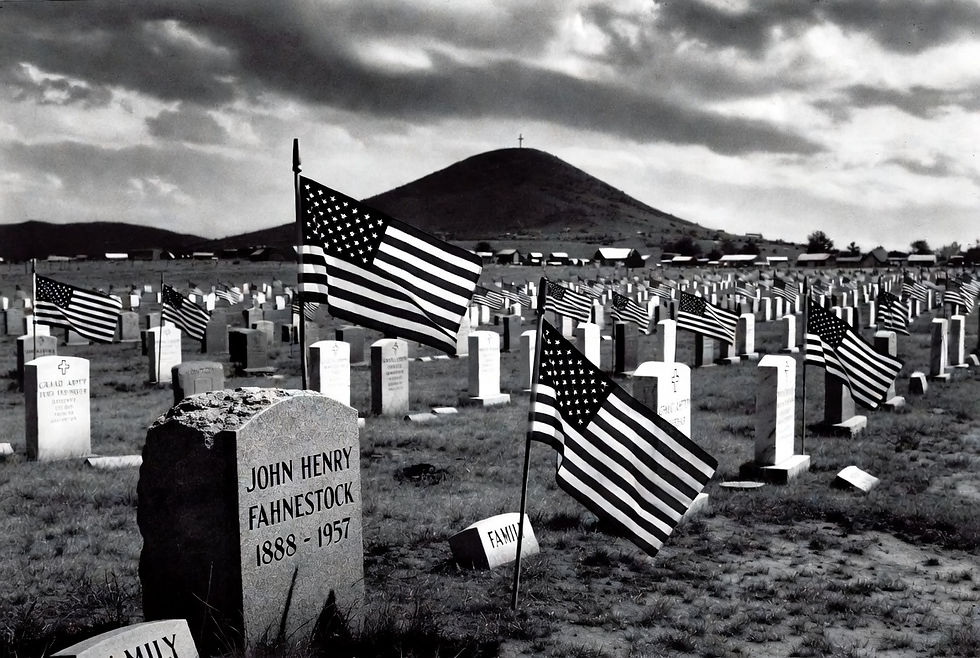
Victor Hugo Fahnestock rests in Rich Hill, Missouri (burial confirmed via family and census records, though no public memorial page exists). Extended family members, including relative John Henry Fahnestock (1888–1957), are buried in Grand Army of the Republic Cemetery, Miami, Oklahoma, and Papinville Cemetery, Bates County, Missouri.
In the end, the April 13, 1929, incident was a footnote: one minor wound, two disarmed suspects, and a case that slipped quietly across state lines. It never made national headlines or spawned legends--precisely because it ended before it could become one. Y
Yet in the dusty streets of Picher, it stood as a reminder that even small-town cops could face sudden, hidden danger from men who lived and traveled by the stolen wheel.


