True Crime Chronicles: A Fourth of July encounter led to to convictions of a father and son for Capital Murder
- Dennis McCaslin

- 4 hours ago
- 5 min read


On

the Fourth of July in 1989, a holiday crowd gathered at Clear Creek Bridge near Mena for an Independence Day celebration that ended in a killing the Arkansas Supreme Court would later recount in spare, clinical detail.
Late in the day, Radford Cox Jr., known around Scott County as Little Rad, was setting off fireworks. Freddie Harrison, a war veteran, told him the explosions made him nervous and asked him to stop.
Little Rad refused. Harrison shoved him. Radford Cox Sr., known as Big Rad, warned that if they did not stop, somebody was going to get hurt.
Harrison knocked Little Rad to the ground. Big Rad reached into a nearby van, pulled a .25 caliber pistol, and fired three to five shots into Harrison’s chest and side. Harrison fell near the road, still breathing.

A bystander named Jonathan Cox tried to help. Little Rad kicked him away, dragged Harrison off the road into brush about two car lengths distant, walked back to the van, and said it was not over yet and they had to finish it.
Big Rad handed him the pistol. Little Rad went into the brush. Witnesses heard three more shots. He came back and returned the gun.
When officers found Harrison’s body, he had been shot six times. Three wounds were in the chest and side. Three more, fired from only a few inches away, were in the head, one between the left eye and the left ear, one in the left forehead, and one above the right ear.

Four bullets recovered from the body were matched by a firearms examiner to Big Rad’s pistol. The state medical examiner, Dr. Fahmy Malak, testified that Harrison died of the six wounds, which entered the brain and internal organs and caused fatal internal bleeding, and that the torso wounds alone would have been enough to kill him.
Public records say little else about Harrison beyond that he was a veteran and that fireworks unnerved him. That single fact sits at the center of the case. A holiday crowd, a small pistol, a refusal to stop a celebration, and a man whose wartime past made the sound of fireworks intolerable.
The argument was brief. The shooting was not. After Harrison was already down and breathing, the younger Cox moved him out of sight and, according to later testimony, described the head shots as putting him out of his misery.

The Coxes were Scott County people with ties to Waldron, the county seat. Big Rad had worked in logging for Arkansas Kraft and, after a 1983 back injury near Wister, Oklahoma, collected workers compensation as permanently and totally disabled. His wife, Goldie Cox, lived in Waldron.
After the shooting, Big Rad told Jessie Hooks that if word got out, Hooks would end up the same way Freddie was. He told eyewitness Joann Cox to keep her mouth shut or she would get the same thing. He told Carl Duramus that if Duramus knew what was good for him he would keep his mouth shut and know nothing about nothing.
Joann Cox later quoted Little Rad as saying he shot Freddie Harrison to get him out of his misery.
Police recovered the body and the gun evidence. Investigators from Scott County and Polk County, a Mena officer, and criminal investigator Bobby Walker worked the case. The file became Scott County Circuit Court case 1989-36.

About eight months after the killing, while Big Rad sat in the Scott County jail awaiting trial, he approached another inmate, Arnold Shores, and offered roughly two thousand dollars to go to Duramus’s house, threaten his family, force a written statement claiming Duramus had committed the murder, then shoot Duramus and make it look like a suicide with an untraceable gun.
Shores, then twenty-four and already carrying a long record of theft, breaking and entering, aggravated robbery, criminal mischief, and terroristic threatening, did not carry out the plan. He later gave a statement and testified.
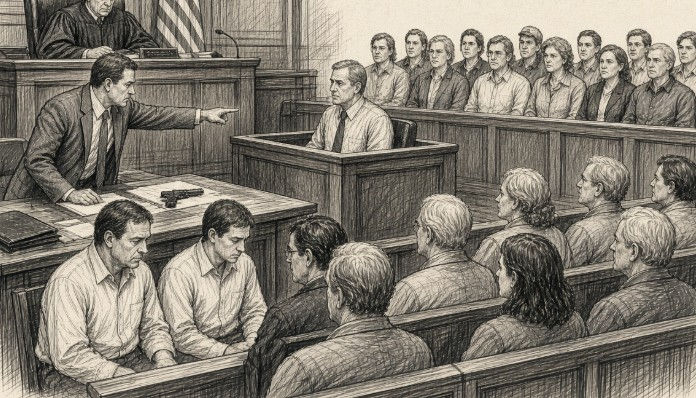
Father and son were tried together in April 1990. The state sought the death penalty against both. On April 23, 1990, a jury convicted each of capital murder and sentenced each to life in prison without parole.
Three days later, on April 26, 1990, Radford B. Cox, was received into the Arkansas Department of Correction. Court records identify the pair as Radford Cox Sr. and Radford Cox Jr.
The inmate now listed under that ADC number is a Caucasian male born November 22, 1956, five feet ten inches tall, two hundred four pounds, brown hair, blue eyes, with scars on the left forearm, right thigh, right knee, and lower spine.

They appealed. In Cox v. State, decided April 22, 1991, the Arkansas Supreme Court affirmed. Justice Robert H. Dudley wrote that premeditation and deliberation could be inferred from the use of the weapon, the manner of the shooting, the wounds, and the conduct that followed.
Circumstantial evidence against Little Rad was strong and inconsistent with innocence. Causation was established because both sets of shots contributed to death. The trial court did not abuse its discretion in refusing to sever the defendants.
Shores’s late disclosed testimony was admissible as an admission of guilt. Claims of ineffective assistance, including failure to cross-examine the medical examiner and investigators, failure to offer intoxication as a defense, and failure to seek a mistrial over the prosecutor calling them killers, did not warrant reversal.
The sentences stood.
Big Rad later filed a federal habeas petition in the Eastern District of Arkansas. In Cox v. Norris, decided in 1996, the court denied relief. The petition attacked sufficiency of the evidence, the Shores testimony, the joint trial, witness sequestration issues, and an alleged conflict because trial counsel Wayland A. Parker had also represented Shores.
The district court found no actual conflict that adversely affected the defense and no basis for a writ.
As of September 8, 2026, the Arkansas Department of Corrections lists Radford B. Cox, ADC 064015, at the Cummins Unit. His custody classification is C4. His good time class is I-C. Parole eligibility and total time are recorded as life without parole. He has one ADC incarceration. The sentence history shows capital murder, sentenced April 23, 1990, Scott County case 1989-36, entered as 999 years, 999 months, and 99 days, the department’s way of recording life. He is approaching seventy.
He has been in custody more than thirty six years. There is no release date.

His father, known as Big Rod, apparently died in custody, although the department does not acknowledge deceased inmates on the public site. Cursory searches reveal no obituary or Find a Grave entry for the elder Cox.
The killing was not a planned assassination in the usual sense. It began as a drunken holiday quarrel over fireworks and became an execution after the victim was already wounded and helpless in the brush. Arkansas law treated the combination of shots as capital murder.
A jury declined to impose death and chose instead the sentence that still holds: life without the possibility of parole. Freddie Harrison’s public record ends at the bridge. The Coxes’ record did not. One of them remains at Cummins. The other was convicted on the same day of the same crime. The Fourth of July crowd went home. The case file did not.


