Stone Gardens:A heroic act by a Creek teenager saved the life of a Geoirgia soldier and created a legacy
- Dennis McCaslin

- 2 hours ago
- 8 min read


A Creek woman who stepped between a bound prisoner and the rifles aimed at him and primed for execution was honored by a special act of Congress. In 1844 the United States voted her a medal and a yearly pension for saving a Georgia militiaman’s life.
She never received either. Consumption took her first. What remains of that story now rests, if family memory is right, in a small private ground north of Muskogee rather than under any public stone.
The Jobe Family Cemetery sits in
A Creek woman who stepped between a bound prisoner and the rifles aimed at him and primed for execution was honored by a special act of Congress. In 1844 the United States voted her a medal and a yearly pension for saving a Georgia militiaman’s life.
She never received either. Consumption took her first. What remains of that story now rests, if family memory is right, in a small private ground north of Muskogee rather than under any public stone.
The Jobe Family Cemetery sits in Section 12, Township 15 North, Range 18 East, north of Muskogee in Muskogee County, a family plot recorded in 1992 for the county cemetery survey and named in later memorials as the presumed resting place of Milly Francis.
It is not a municipal burying ground with gates and mapped rows. It grew on Jobe and Sells land after those families came west with the Creeks in the late 1830s.
Lewis Jobe’s parents, Leroy Jobe and Syracuse Sells Jobe, were laid in the family cemetery on the farm. Their descendants still pointed to that neighborhood into the twentieth century. Florence and Mary Jobe, who lived in the old family house on Harris Road a half mile east of the Main Street intersection, said Milly’s unmarked grave was among those burials.

The plot is modest, a handful of family interments rather than hundreds of named stones, and it has always stood a little apart from town, on private ground a mile or so north of the later Jobe home and well north of Bacone College and downtown Muskogee. Visitors looking for it start in Muskogee, work north toward the old Agency and Harris Road country, and accept that the exact grave is tradition, not a carved name.
Milly Francis was born about 1802 or 1803 along the Alabama River just below the meeting of the Coosa and Tallapoosa, near what became Montgomery. Her father was Josiah Francis, Hillis Hadjo, Francis the Prophet, son of a white silversmith and trader and a Creek mother. Her mother appears as Polly Moniac or Hannah Moniac, kin to the Moniac and Weatherford lines.
For her first years the household was well off by Creek standards. Josiah owned stock, farm buildings, and enslaved people, and the Upper Towns still held an uneasy peace with the United States. That peace broke in 1812 and 1813. Prophets among the Creeks, stirred by Shawnee teachings tied to Tecumseh and Tenskwatawa, called for a return to older ways and an end to accommodation with whites.

Josiah joined them as a religious leader. He burned or abandoned his cabin, barns, and livestock as a sign of that turn, then helped found a new settlement on the south side of the Alabama, between present Selma and Montgomery.
The place was called Econochaca, Holy Ground. There he raised the red war club, the traditional sign of war. His followers took the name Red Sticks. Holy Ground became their war capital. What began as a fight among Creeks became the Creek War after the clashes at Burnt Corn and Fort Mims brought United States troops into the field.
As American columns closed in, women and children were sent out of Holy Ground. After the settlement fell, Josiah rejoined his family among Red Stick refugees who had fled south into Spanish Florida. They camped first along the Apalachicola, then on the Wakulla above the Spanish fort of San Marcos de Apalache. He later sailed for England with the British to plead the refugees’ case.
Milly stayed with her mother and sister.
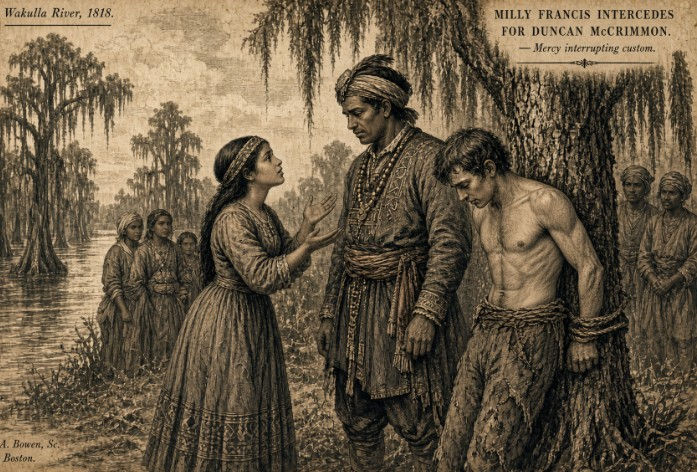
The children carried English names. Later writers guessed Malee was her Creek name. The stronger reading is that Milly was the name she was given. She spoke English and Creek.
In March 1818 Duncan McCrimmon, a private in Captain Joseph Watters’s company of the Second Regiment of Georgia militia, attached to Jackson’s army, slipped away from Fort Gadsden on the Apalachicola to fish and was lost for days. Two warriors from Francis’s town took him and brought him to the Wakulla village.
.Under Creek practice, the captors held the right of life or death. They stripped him naked and bound him to a tree. One of them had lost two sisters in the Creek War and meant to take blood. Milly and her elder sister were playing on the riverbank when they heard the war cry that meant a prisoner had been taken.

They ran to the spot. Years later she told Lieutenant Colonel Ethan Allen Hitchcock what she saw: the white man doubling himself to hide from the gaze of the crowd, looking around as if to ask whether anyone would speak for him.
She first begged her father. He said the law put the decision with the warriors, not the chief, but he did not stop her from speaking. She told the captor the soldier was young, that he had not chosen the war of his own judgment, and that killing him would not bring the dead sisters back.
The warrior yielded on conditions. McCrimmon’s head would be shaved except a scalp lock, which they would ornament with feathers. He would take village paint and dress and remain with them. Milly translated. He thrust his head forward and said Yes, cut it all off if you choose. The intended execution turned into a frolic of adoption.
Within days, with Jackson’s army reported on the move, the Creeks delivered him to the Spanish at San Marcos de Apalache for seven and a half gallons of rum. Jackson’s men took the fort in early April and recovered him.

The same campaign ended her father’s life. McCrimmon, once free, told Jackson that Francis was nearby. Officers lured the prophet onto the schooner Thomas Shields under a false British flag. Later tellings have Francis, facing McCrimmon, saying this is what I get for saving your life, and McCrimmon answering that it was the daughter who saved him.
Josiah Francis was hanged at St. Marks on 8 or 9 April 1818 without trial. Family memory says Milly saw it. One story has her paddling out to look at the ship and returning fire when the deck shot at her canoe. No one stepped forward for her father as she had stepped forward for McCrimmon.
The family and others of the town surrendered and were ordered to Fort Gadsden, then back toward the Creek Nation in Alabama. Word of the rescue ran through the army.

Lieutenant Colonel Matthew Arbuckle put it in writing for a Milledgeville paper. The Milledgeville Journal of 3 November 1818, drawing on McCrimmon himself, said he had a due sense of the obligation he owed the woman who saved his life at the hazard of her own, that he had left town to seek her and, if she would consent, to make her his wife and live with her in the settled parts of Georgia.
Citizens of Milledgeville took up a purse and sent it after him. Papers across the United States, and some in Britain, called her a new Pocahontas. Census records later showed hundreds of baby girls named for her. She was already something of a celebrity when she reached Fort Gadsden.
McCrimmon arrived there that fall. On 1 December 1818, Arbuckle wrote the Journal that Duncan McRimmon was there, that Milly said she had saved his life, or used such influence as she possessed to that effect, from feelings of humanity alone, and that she would have rendered the same service to any other white man similarly circumstanced, and was therefore not disposed to accept his offer of matrimony, which had been made as an acknowledgment of gratitude.
She accepted the donation presented through Arbuckle. To Hitchcock she later put the refusal more sharply: "I did not save you for that. I do not want any man".
By 1819 she was at Tschabitscher on the Tallapoosa. She married the Creek warrior Cochar Hoboithley, also written Cochan Hoboithley. The 1832 Creek census listed her with him and three children. Five more followed. Of eight, three lived to adulthood.
Some later notices say she became a Baptist. In 1836, after a short Creek uprising was crushed, she and the children were forced west with Tuckabatchee Hadjo’s party, twenty miles a day on short rations. Witnesses later said they saw her pass through Little Rock in November 1838. She reached Fort Gibson in the winter of 1838 and 1839 and settled in a dirt floored cabin on ground that became Bacone College at the north edge of Muskogee.
Her husband had gone the other way, enlisting in a Creek regiment of mounted volunteers for Florida. When his term ended he started west and died at Pass Christian, Mississippi, in July 1837.
In January 1842 Hitchcock, sent to investigate frauds on newly arrived emigrants, heard that the Prophet’s daughter lived near the Arkansas River and sent for her. She came in dressed somewhat on the order of white women

She told him she had come to that country many years before, that her husband was dead, as were her mother and sister, that two sons and a daughter lived of eight children, the eldest a boy of fourteen, and that she was poor, the children too young to help much.
Hitchcock thought her still a good-looking woman of about forty who must have been a beautiful girl. He used as a pretext a claim involving eight enslaved people said to be among the Seminoles. On 13 April 1842 he wrote Secretary of War John C. Spencer the story from her own mouth.
.On 16 April Spencer forwarded it to the House Committee on Indian Affairs and recommended a pension of eight dollars a month for life, arguing that her case resembled the romantic scene of early history and that such bounty might induce others to spare captives.

Representative James Cooper’s committee reported on February 28, 1843 that the act of this Indian woman presented a proper case for the gratitude and bounty of the government and that the example might teach humanity.
The first bill died with the session. A second passed and was signed June 17, 1844 as Statute I, Chapter CLIV, an act granting a pension to Milly, an Indian woman of the Creek nation.

She was to receive ninety-six dollars a year, retroactive to September 1843. Section 2 directed the Secretary of War to procure and transmit a medal with appropriate devices, of a value not exceeding twenty dollars, as an additional testimonial of the gratitude of the United States.
William Medill was still circulating copies of the act in 1847. A warrant for twenty dollars to pay for the medal was issued in March 1848.
Milly learned of the honor only as she was dying. She died of consumption on May 19, 1848, and received nothing. Sums then due were to go through an Indian agent for her children. A scholar later called the medal a treasured artifact to her descendants but offered no proof.
The piece has never been photographed. Its location, if it was ever struck, is unknown.

Bacone’s senior class of 1933 set a stone on campus saying she is buried somewhere in that vicinity. A marker and a water oak went up at Spaulding Park the same season. Other markers stand at San Marcos de Apalache and at Fort Gadsden, now Prospect Bluff.
On March 7, 2019 Alabama inducted her into the Alabama Women’s Hall of Fame in the same ceremony that honored Nelle Harper Lee, author of To Kill a Mockingbird. Kathryn Braund of Auburn presented Milly.
The pairing put a Creek girl from the Alabama towns beside the state’s most famous novelist, one remembered for mercy in war, the other for a novel about justice.
The Jobe sisters’ claim does not give her a carved stone. It only keeps her name on a small family ground north of Muskogee, where a Creek woman who earned those congressional honors for mercy was laid without them


