Stone Gardens: Johnson County soldier saw action on both sides of the Civil War betwwen 1861 and 1864
- Dennis McCaslin

- 3 hours ago
- 3 min read


Sgt. John William “Jack” Watson drew his first breath on May 13, 1820 in Wake County, North Carolina.
He forged a remarkable path as a Mexican War volunteer, a Civil War soldier who served in both Confederate and Union forces, and the devoted father of eleven children before his death on March 29, 1898 in Johnson County.
Family lore identifies him as the son of Ethelbert “Burt” Watson and Mary Frances Jones Watson, though this rests mainly on oral tradition. It appears he may have been orphaned as a child and came to Arkansas as a youth with extended relatives of his mother's family
. His early education was limited, typical of farm life in early 19th-century North Carolina.
In his youth, Watson volunteered for service in the Mexican-American War. He joined Captain Singleton’s Company in the 1st Regiment, North Carolina Volunteers. This unit formed in 1846–1847 and performed occupation duty, guard service, and support roles in Mexico following major campaigns.
Watson’s experience as a young enlisted man provided valuable military training and familiarity with campaign life that later influenced his Civil War roles.
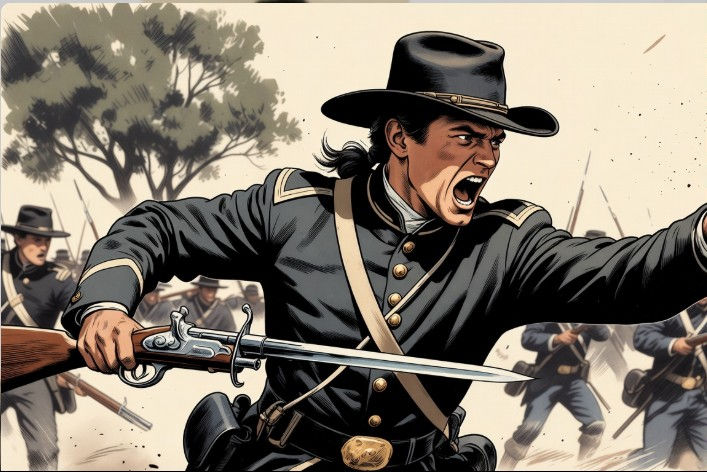
He returned home with an honorable discharge and veteran status he would later note on his gravestone.
By the 1850s Watson had relocated to Johnson County where he married Sarah Cooper around May 1854. They had four children before Sarah died
in 1864. At age 42, in October 1861, he enlisted at Clarksville as 1st Sergeant in Company C, 16th Arkansas Infantry Regiment. The regiment organized near Rogers and wintered at Elm Springs before marching into action.

Watson’s unit fought at the Battle of Pea Ridge in March 1862, suffering heavy losses in the Confederate defeat. It then crossed east of the Mississippi River and took part in the Iuka-Corinth Campaign, seeing action at the Battle of Iuka and the Second Battle of Corinth, where casualties mounted
. Later assigned to Beall’s Brigade, the regiment moved toward the Siege of Port Hudson. Watson advanced to 3rd Lieutenant in December 1861 but was reduced back to 1st Sergeant by May 1862 before receiving his discharge on July 2, 1862.
In March 1864 he switched sides, enlisting in the Union 4th Arkansas Infantry and later transferring to the 2nd Arkansas Infantry. No personal letter or statement from Watson survives explaining his decision, but the timing and local conditions in Johnson County strongly suggest a combination of pragmatism, disillusionment, and survival.
Watson left Confederate service relatively early, possibly due to health, family needs, or dissatisfaction after heavy losses in early campaigns. By 1863–1864 broader Confederate setbacks, including the fall of Vicksburg and Port Hudson, signaled a losing cause. Johnson County experienced intense guerrilla warfare, with bushwhackers preying on civilians. Union forces occupied Clarksville, using it as a base to combat guerrillas

. In April 1864, Union troops under Lt. Col. Gideon M. Waugh conducted operations against guerrillas near Clarksville, and skirmishes continued in the area later that year. Union troops burned parts of Clarksville, including churches and other buildings, to deny resources to Confederates.
The breakdown of law and order, threats to property, and pressure on families likely pushed Watson--then in his mid-40s with young children--to align with the occupying Union forces for protection and stability. Many Ozark-region soldiers had weak Confederate loyalty.
Economic hardship, the class-biased Twenty Negro Law, and Union amnesty offers made switching practical. Enlisting locally in Clarksville allowed him to serve near home, perform detached commissary duty, and support his family amid the turmoil.

In short, Watson’s switch was likely driven by practical survival rather than sudden ideological conversion.
After the war he married Caroline Carter and raised seven more children. The family farmed in the Harmony community. Watson endured personal losses, including two children’s early deaths, but remained a respected patriarch.
He rests in Watson Cemetery, a small historic family burial ground in the Harmony community of Johnson County. The cemetery contains graves of Watson family members, including Jack, his second wife Caroline Carter Watson, and several children.
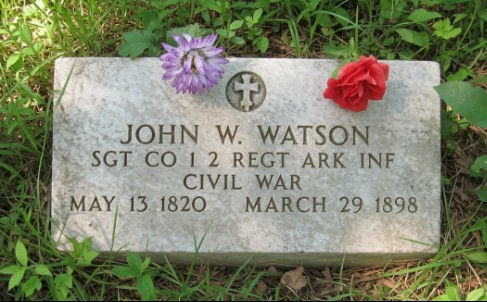
His gravestones explicitly notes service in the Mexican War, Confederate Army, and Union Army. The cemetery reflects the quiet family legacy of many rural Arkansas pioneers and Civil War veterans.
Jack Watson’s life embodies the era’s divisions: from North Carolina volunteer in a distant war, through Arkansas’s turbulent battlefields and homefront struggles, to a large family legacy preserved in a peaceful hillside cemetery. His story highlights personal sacrifice and the difficult choices faced by ordinary men in extraordinary times.


