Stone Gardens: Bantamweight boxer, wine merchant, died of pneumonia in Prairie Grove at the age of 41
- Dennis McCaslin

- Apr 29
- 3 min read


In the quiet rows of historic Evergreen Cemetery in Fayetteville, among governors, senators, architects, and Medal of Honor recipients, lies a modest stone marking the final resting place of a local fighter who once thrilled crowds in smoke-filled theaters across Northwest Arkansas and eastern Oklahoma.
Thomas Beaty “Trigger” Holt, a bantamweight boxer whose lightning-quick hands earned him his nickname, represents the gritty, small-town athletic spirit of the 1920s Ozarks as a workingman’s champion whose story is largely forgotten outside the county he called home.

Thomas Beaty Holt was born on January 1, 1900, in Westville, Adair County, Oklahoma (then Indian Territory), just across the Arkansas line. He was the son of John Earl Holt (born about 1880) and Anna Parker Beaty (1877–1968).
Through his mother’s Beaty family line, he carried Native American heritage and was a great-grandson of Redbird , a Cherokee tribal ancestor.
Holt grew up in the borderlands where Cherokee, frontier, and settler families intermingled. As a teenager he worked in a Westville drugstore. By 1920 the 20-year-old had moved to Fayetteville, where he launched his boxing career.
Standing about 5-foot-4 and weighing 118–120 pounds, Holt possessed the speed and aggression that defined successful bantamweights of the era. He made his professional debut on March 9, 1920, at the Ozark Theatre in Fayetteville, fighting Ray Sowder to a four-round draw.
Two weeks later, he scored a dramatic first-round knockout over Happy Wilhelm. Local newspapers hailed the “119-Pound Pride” of Northwest Arkansas.
Though his career was short --just nine documented bouts between 1920 and 1924, with three wins, four losses and two draws -- he fought across the region in Oklahoma City, Tahlequah, Joplin, Missouri, and Kansas City.
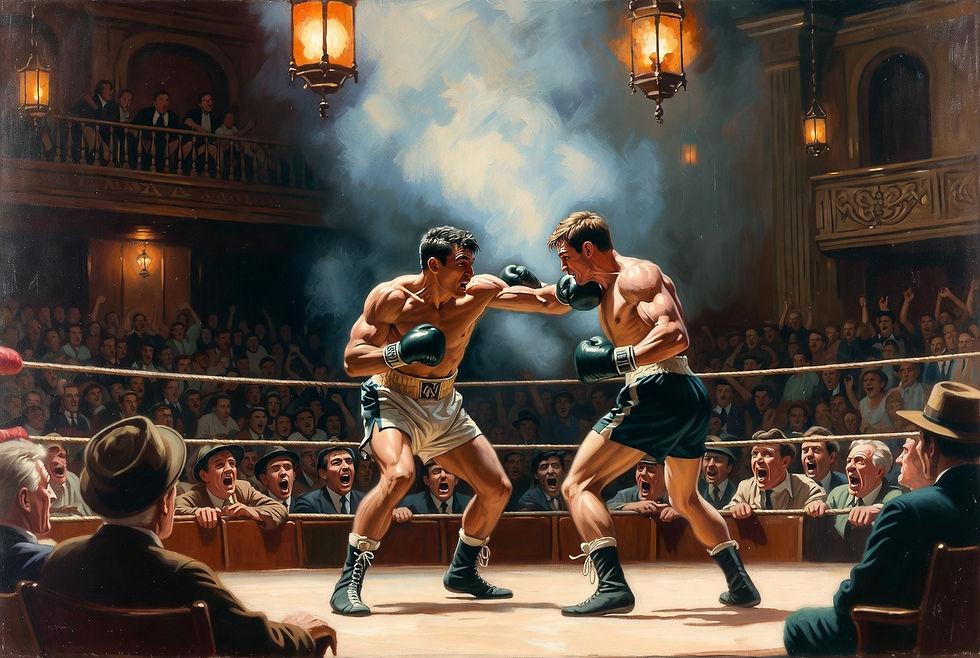
Holt’s final bout came on March 24, 1924, at the Battery B Armory in Joplin, Missouri. Facing the veteran Bat Stewart in what would be the last fight of his short professional career, the 24-year-old Trigger Holt stepped into the ring for a scheduled six-round contest..
Stewart’s experience proved too much for the Fayetteville bantamweight. In the fifth round, Holt was stopped by technical knockout, bringing his nine-fight career to a close with a record of three wins, four losses, and two draws.
The loss at the Battery B Armory marked the end of his time as a professional boxer. He would never fight again.

After leaving the ring in the mid-1920s, Holt settled permanently in Fayetteville. By the 1930s he had become a familiar local figure as a wine merchant. He was married (his wife is referred to in some records as Bert), though details of children are limited in public sources.
He remained connected to family, including a brother named Jack Holt. Contemporary accounts also noted him as a friend of former heavyweight champion Jack Dempsey.

On November 11, 1941, at the age of just 41, Thomas “Trigger” Holt died at Elizabeth Hospital in nearby Prairie Grove after a short battle with pneumonia. His obituary remembered him as both a “former bantamweight boxer” and a “local wine merchant.”
Funeral services were held at Central Methodist Church in Fayetteville on November 16, 1941. He was laid to rest in Evergreen Cemetery, where his grave sits among other Washington County sports figures, including major league baseball players Roy Wood and Sid Benton.
Trigger Holt never fought for a world title or earned national fame. Yet in the early 1920s he brought excitement and pride to local fight fans during an era when professional boxing offered one of the few affordable escapes from everyday hardship.

In many ways he embodied the spirit of the region -- tough, quick, determined, and deeply rooted in the community he served both inside and outside the ropes.
Holt a small-town fighter with rich family roots in the Arkansas-Oklahoma borderlands, left his mark on Washington County. His modest stone in Evergreen Cemetery stands as a quiet reminder that local heroes t-- the ones who fought in converted theaters, poured wine for their neighbors, and carried the bloodlines of frontier families -- are every bit as worthy of remembrance as those whose names echo through national history.
Here, among the gardens of stone, Trigger Holt’s legacy endures.


