Stone Gardens: A survivor of the Native removals from Mississippi gave birth to three Choctaw Nation Chiefs


Today in Fort Smith has already given Jackson Frazier McCurtain, Edmund Aaron McCurtain, and Greenwood McCurtain their own turns
. The three brothers held the principal chieftainship of the Choctaw Nation across more than thirty years, from Jackson's term in 1880 through Green's dea
th in office on December 27, 1910.
Their houses, their elections, and their graves have been written up one man at a time. The woman who bore all three of them has not. Her name was Mahayia, called Amy in the family and set down in the records as Me Hi Ye, Mahogia, and Mehiga.
She was a Belvin by her father's name and, in one family telling, a Nelson. She died on October 10, 1872, and the stone that carries her name stands in San Bois Cemetery east of Kinta, in the same ground where her youngest chief-son was later laid.

No other Choctaw mother of the removal generation can match that record. Cornelius McCurtain, her husband, was himself district chief of the Moshulatubbee District from 1850 to 1854.
Their sons then took the national office in succession'.

Jackson, born in Mississippi on March 4, 1830, served from 1880 to 1884 and died on November 14, 1885. Edmund, born at Fort Coffee on June 4, 1842, followed him from 1884 to 1886 and died on November 9, 1890, at Skullyville on the road home from council. Green, born at Skullyville on November 28, 1848, and named for Greenwood LeFlore, held the office from 1896 to 1900 and again from 1902 until his death.
Between them, the brothers covered the last hard years of the old Choctaw government, the allotment fight, and the end of elective chiefship. A nephew, Allen Cornelius McCurtain, later sat in the same chair.
McCurtain County took the family name at statehood in 1907. The source of those terms was a woman born on April 30, 1806, at Cole Creek on the Natchez Trace, in what was then Mississippi Territory

Her people were already a braid of nations before she was born. Don Martini's register of southern Indians puts her father, John Belvin, born June 20, 1781, as a white man living among the Choctaw. In 1805 he married Miyahoke Cole, a daughter of Sho-ma-ka, also written Shumaka and Shamoka. Sho-ma-ka was Chakchiuma.
After the destruction of that small tribe, she was taken in by the Choctaw, and about 1770 she married Roscoe Cole, a white trader later killed by Shawnees. Their children included Robert Cole, a Choctaw chief who died in 1842, and the Cole women who tie this line together.
Peter J. Hudson of Tuskahoma, writing in the Chronicles of Oklahoma in September 1935 from what Jane Austin McCurtain had told him, identified Mahayia as Sho-ma-ka's granddaughter. Jane, who died on October 27, 1924, had been Jackson's wife, his secretary, and later superintendent of Jones Academy.

Hudson trusted her account even where it cut against the older story that Mahayia was of French extraction and that Nelson, not Belvin, was her maiden name. Both versions have lived on. The Chakchiuma adoption is the one the family closest to the brothers chose to keep.
The McCurtain side was no simpler. Cornelius was born March 5, 1803, in the Choctaw towns of Mississippi, son of Daniel McCurtain and Hannah Cole. Daniel's father was an Irishman of the same name, out of County Cork, who had come into Spanish Florida on a crown grant, traded, and married a Choctaw woman. Hannah Cole's mother was the same Shamoka. If both accounts hold, Cornelius and Amy were kin through the Cole women as well as husband and wife.
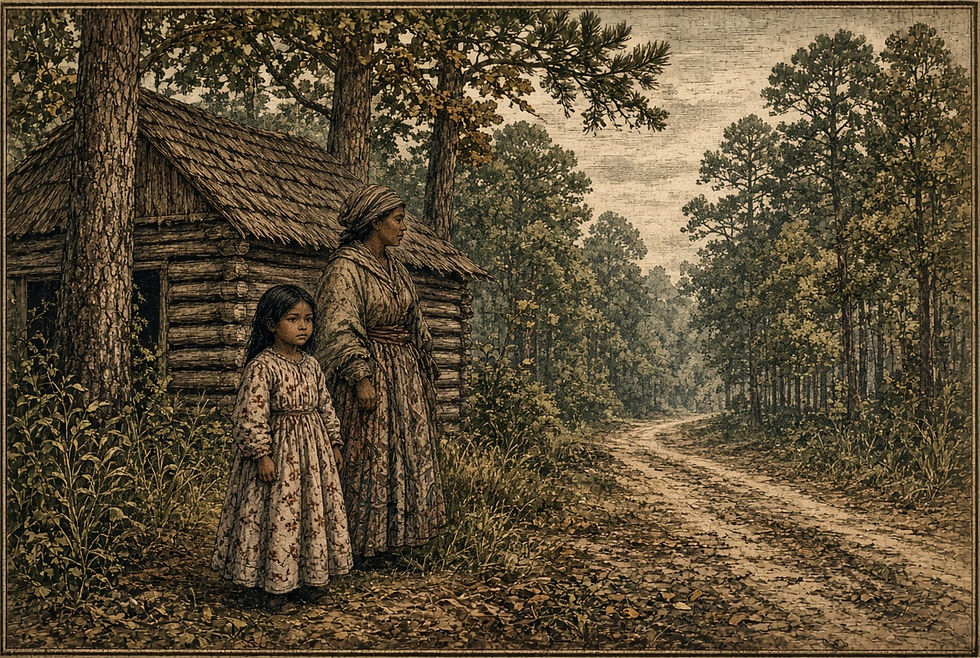
They married about 1826. The children usually named are Jackson, Isabelle, Sina, Elsie, David, Edmund, Green, and a younger son, Robert, shot dead by a cousin in 1874 at about twenty.
Six or seven of them lived to be counted. Three of the sons became chief.
Jackson was already a small child when the family came west in the removal of the early 1830s. Edmund and Green were born after the landing, at Fort Coffee and Skullyville, in the new Moshulatubbee District. Amy kept that household while Cornelius rose from local affairs to the district chieftainship.

She outlived him by a year and a half. He died on March 5, 1871. She died at Fort Coffee on October 10, 1872, and said she wanted to lie beside him. High water in the streams stopped the carry to Skullyville. The 1935 Chronicles account, again from Jane Austin McCurtain, says the effort was abandoned and that Amy rests in an unknown and unmarked grave on the old George Riddle farm between Wilburton and Red Oak, in present Latimer County.
The farm belonged to the family of her daughter Elsie, who had married George W. Riddle in 1873 after the death of her sister Isabelle, and who herself died on February 1, 1875.
That is not the only grave the records give her. San Bois Cemetery, on N4415 Road about a mile north and three miles east of Kinta, carries a stone transcribed as Amy Mahayia Belvin McCurtain, 1806 to October 10, 1872.
Chief Greenwood McCurtain and his wife Kate Spring McCurtain, who died May 18, 1934, are in the same ground, along with a grandson, Napoleon B. McCurtain, who died January 19, 1888.
Find a Grave treats the Latimer County plot as the burial and the Kinta stone as a cenotaph, a marker set in memory rather than over the body. Both claims can be true. A family that could not cross high water in October 1872 could still, years later, cut her name into a stone beside the son who came home to Sans Bois to die.
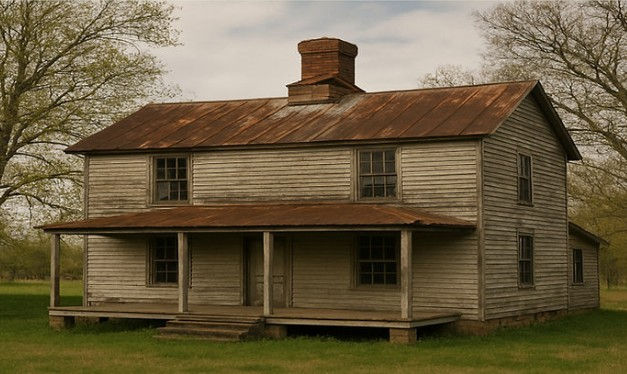
The honest reading is that her bones may lie unmarked on the Riddle place, and that the stone the public can find is the one east of Kinta.
That stone is not in a town cemetery. Kinta itself was a railroad town, laid out after the Fort Smith and Western bypassed the older Choctaw settlement of Sans Bois. The cemetery sits off the section roads in the Sans Bois hills, the same ridges old-timers on the Whiskey Trail called the Seven Devils.
An intersection sign stands about half a mile south of the gate on the east-west road. Past that, the ground is pasture, timber, and family plots, easy to miss if the light is wrong. Green McCurtain's National Register house is northeast of Kinta. Edmund's 1866 ranch house, also on the register, is in the same country. The mother is the one whose marker, if the traveler finds it, explains why those houses are still standing.
The name Sans Bois is itself a trap. Haskell County has three burying grounds that wear it.

San Bois Cemetery east of Kinta is the McCurtain ground, the one with Green and the Amy stone. Little Sans Bois Cemetery lies in the northeast part of the county, toward Stigler, a separate neighborhood yard with its own Bond, Cass, and Garland stones and no claim on the chiefs. Old San Bois Cemetery, the one local notes mark as old, sat with the abandoned town of Sans Bois east of Stigler, on the road that ran from Whiskey Trail Crossing along Sans Bois Creek toward Robbers Cave.
Infants from the old town were said to have been laid there. The town died when the railroad chose Kinta. The three grounds share a name, a creek, and a county, and almost nothing else. Only one of them holds the stone of the woman who mothered the dynasty.
She did not hold office. She did not sign a treaty. What she did was rarer. Out of a Chakchiuma captive's line, an Irish trader's line, and a removal cabin at Fort Coffee, she raised the last three brothers who would be elected to lead the Choctaw Nation under its own laws.
Jackson is at the old capitol cemetery east of Tuskahoma. Edmund is at Skullyville, where grave robbers once tried his coffin. Green is at San Bois, under a stone his neighbors can still read.
Their mother is the one this social media website had not yet put at the front of the story. The terms those sons served began with her.