Cold Case Files: A 1912 train robbery three miles northeast of Poteau is unsolved in more ways than one

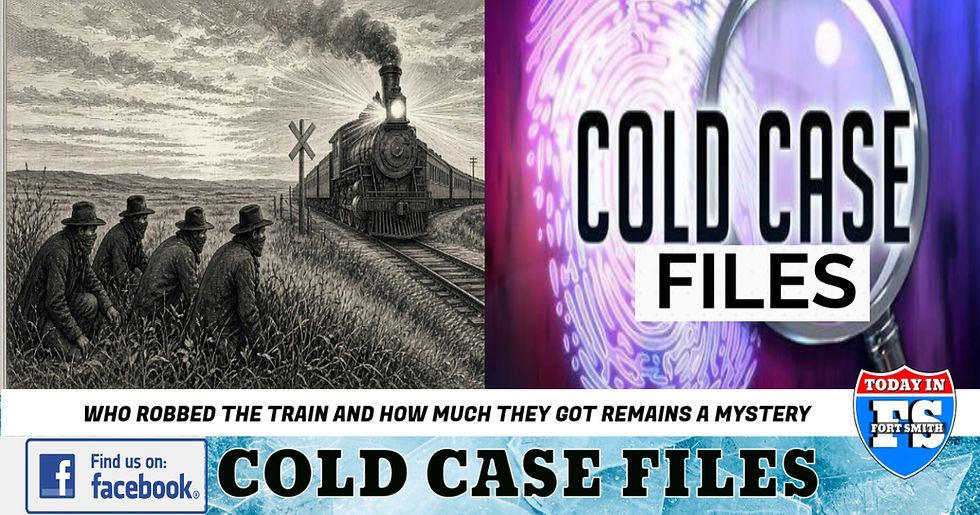


On the evening of Friday, October 4, 1912, Kansas City Southern passenger train No. 4 was northbound out of Poteau when it slowed at a crossing on Tarby Prairie, about three miles northeast of town. Four masked men were waiting. Two of them crawled over the tender and put revolvers on the engineer and fireman. The others went for the express and mail. They had nitroglycerine, and they used it.
The express safe was blown. In the mail car they demanded the through registered pouches, refused to believe the clerks when the clerks said there was nothing of the kind, and tore through the sacks anyway. Passengers were left alone. When the work was done the bandits ordered the train ahead and told the crew not to look back.

A boy named William West had seen them board and shouted a warning. Nobody on the cars paid him any mind. Two farmers, J. M. Murray and Arthur Deshiort, later told a Fort Smith reporter that the men rode off on the train itself. The first wire out of Westville said something else: that the robbers vanished into the woods along the right of way.
By Saturday, posses were combing the Cavanaugh Mountains and had nothing to show for it. No names. No horses found. No arrests that the papers ever tied to Tarby Prairie.

The money was the part the papers could not agree on. The Daily Oklahoman of October 6 put eighty thousand dollars in the headline and then, in the same breath, admitted that railroad and express officials would not confirm it. The New York Times, working from a Westville dispatch filed the night of the holdup, put the take at forty-five dollars and ten or twelve registered letters thought to be nearly worthless.
Both versions can be true in the way robbery stories often are. Somebody in Fort Smith heard a payroll rumor and wired it. Somebody closer to the car counted what was actually gone. The safe was opened. That part is not in dispute. What came out of it is.
By 1912 the old named gangs were mostly gone, and the ones still alive do not fit this job.

The Daltons had been finished at Coffeyville twenty years earlier. Bill Doolin was long dead. Ben Kilpatrick, the Tall Texan out of the Wild Bunch, had tried a Southern Pacific express car at Baxter's Curve in West Texas that March and been killed for it, along with his partner Ole Hobek, by an express messenger with an ice mallet.
Henry Starr, the Cherokee bank robber who would later claim more banks than any man in America, was still in the Colorado penitentiary in October 1912. He would not be paroled until the fall of 1913, and when he came back to Oklahoma he robbed banks, not trains.
Al Jennings was a free man and a celebrity by then, pardoned and telling his story, not crawling over tenders outside Poteau.

What the method does suggest is a working crew of four who knew the Kansas City Southern and knew nitroglycerine. They boarded at a scheduled slowdown, split the engine from the express, blew a safe, ignored the coaches, and got off the line before a posse could form. That is professional work even if the safe was thin.
The same railroad had been hit this way before. In June 1899 the southbound Cannon Ball, then running as the Kansas City, Pittsburg and Gulf, was robbed a mile and a half south of Shady Point, the next station down the line. Those men were coal miners out of the camps in the Cavanaughs, John Burns, Jim Tate, and a Swede named Peterson, and they were caught within days because they went back to the boarding house. The 1912 men did not make that mistake, or if they did the papers never printed it.

A week later the same railroad was hit again, this time on northbound train No. 2 between Hatfield and Mena, Arkansas, in the early hours of October 12. Four men bungled that one.
Express messenger Merrill Burgett of Kansas City was working his car when they smashed the glass and came through the side door firing. He hid the valuable packages, shot it out from behind the baggage until his ammunition was gone, and wounded one of them with a last shot.
The others beat him, searched the car, and ran when the conductor came forward with a lantern. Burgett was taken to a hospital in Mena and was expected to recover. The man he shot was left behind.
A posse of fifty or more found him about an hour later near Potter, between Hatfield and Potter, and carried him to Mena as well. The Fort Smith wire said he would probably die.

The wounded man himself was never named in the dispatches. No alias, no hometown, no later identification turned up in the accounts that survive. Nobody ever proved the Hatfield crew and the Tarby Prairie crew were the same four men.
The timing, the railroad, the number, and the taste for the express car make it the cleanest speculation available. If they were locals, they were locals who had learned from the Shady Point miners and from a generation of express blowers: masks, nitro, no passengers, and the hills before daylight. If they were drifters, they were drifters who had studied this particular line.

The eighty thousand dollars, if it was ever on that train, did not leave with them in any accounting the company would sign. The registered letters may have been the whole of it.
Posses walked the Cavanaughs all day Saturday and came down empty.
The four men who stopped No. 4 on Tarby Prairie were never named in the surviving dispatches. The one man taken alive a week later, on the Arkansas side of the same railroad, was not named either.
That is the part of the story that still sits in the gap between the Oklahoman's headline and the Westville wire: a safe blown open on a prairie three miles from Poteau, and nobody left to say what was in it.