Stone Gardens: A quiet Golden City community cemetery in Logan County is the place of final rest for fallen sailor


The government stone at Golden City Cemetery, about nine miles southeast of Booneville, sits among family names that have been buried in that ground for generations. It is not a large marker.
The inscription is spare: Leonard Ode Blagg - EM2C, US NAVY, WORLD WAR II. The dates on the stone and the dates in the Navy’s files do not quite agree. The family and the birth record put Leonard Ode Blagg in the world on December 17, 1917. The service jacket says July 17, 1917, the same month and day he would later use when he raised his hand in San Francisco and became a sailor.
Either way he was twenty-four when the after battery of an old fleet boat filled with smoke off Panama, and either way the boy from Booneville never came home alive.

He was the son of Ode Otis Blagg, a carpenter, and Myrtle Ann Halford Blagg, and he grew up in a house that kept filling with children. The 1920 census still has the family in Boone Township. By 1930 they are in Moore, Oklahoma, one more Depression-era household chasing work across a state line.
Booneville itself was a railroad town in those years, a second county seat planted on the Rock Island line, cotton and corn coming in from the surrounding farms, the state tuberculosis sanatorium on the edge of town employing people when the fields would not. Drought and the collapse of cotton prices emptied farms. Young men left. Leonard left farther than most.
He enlisted in the Navy on July 17, 1935, in San Francisco, service number 3757147. He was not yet eighteen by the December birthdate. He reenlisted in Los Angeles on September 30, 1939. The muster rolls that survive put him, before the war, through a string of old boats and workaday ships: the S-class submarines S-34, S-29, S-20, and S-22; the little R-2; the heavy cruiser Louisville; the ammunition ship Nitro.
Some of those assignments were brief enough to look like training or transit. All of them were the ordinary grind by which a farm-country boy became an electrician’s mate. On October 26, 1940, he reported to USS Bass, SS-164, as an electrician’s mate second class.

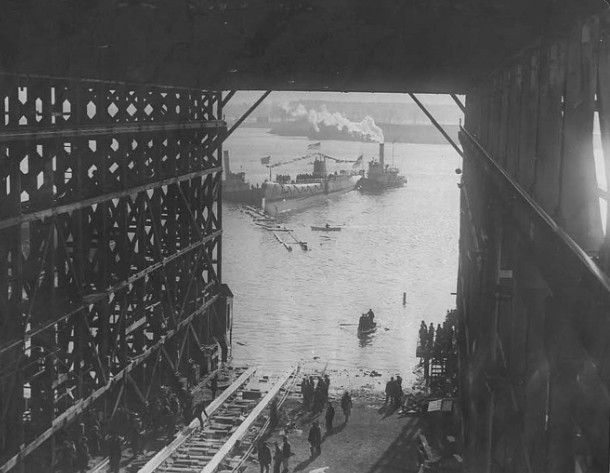
Bass was already an old ship. She had been laid down at Portsmouth in 1921 as V-2, one of the first true fleet submarines, a long, awkward boat meant to run with battleships at twenty-one knots on the surface.
She was 341 feet overall, more than two-thousand tons on the surface, six torpedo tubes, a crew that in design ran to eighty enlisted men and a handful of officers. The Navy commissioned her in September 1925.
She worked the Atlantic and the Caribbean, then the West Coast, Hawaii, and the Canal Zone. In 1931 she received the name Bass and the hull number SS-164. In 1937, worn and already outclassed by newer construction, she went into reserve at Philadelphia.
War changed the arithmetic. On September 5, 1940, at Portsmouth, New Hampshire, the Navy put her back in commission.

Blagg came aboard six weeks later. Through 1941 Bass worked the New England coast and made two runs to Bermuda. On November 24 she arrived at Coco Solo, on the Atlantic side of the Panama Canal.
Two weeks later the Japanese struck Pearl Harbor. The canal was suddenly one of the most valuable pieces of water in the world, and the old Barracuda-class boats, too slow and too clumsy for the far Pacific, were given the job of watching the approaches.
From March to August 1942, based at Coco Solo and attached to Submarine Division 31, Bass made four war patrols in the Pacific off Balboa. She received no credit for sinkings. She was not that kind of boat anymore. She was a picket, a presence, a hull that could still dive.
On the morning of August 17, 1942, her batteries were fully charged and she made a trim dive. A boatswain’s mate who survived the day, Jack Stevenson, later wrote down what happened next. An electrician taking readings in the after battery heard a gurgling in the battery blower, put a flashlight on the intake, and saw smoke
He shouted fire in the after battery and hit the lights to wake the men sleeping in the berthing space directly above the cells. Batteries at the forward end of the compartment began to explode. Men tried to drag sleepers aft toward the after torpedo room. Smoke and heat filled the after spaces and then the starboard main motor.
The commanding officer, Lieutenant Commander Anthony H. Dropp, ordered the boat to the surface. When the after torpedo room loading hatch came open, pressure and smoke shoved men toward the ladder. Crew in rescue breathing apparatus worked in rotation because the heat would not let anyone stay long. Twenty-seven men were pulled out and given artificial respiration and oxygen for hours.
Two revived. One more man was found in the after battery after the fire was beaten down. Twenty-six enlisted sailors were dead of asphyxiation.

Leonard Ode Blagg was among them. So were a chief electrician’s mate, another electrician’s mate, torpedomen, a radioman, a yeoman, a cook, a baker, firemen, seamen, a coxswain, gunner’s mates, motor machinist’s mates.
The after battery of a submarine is a steel room packed with lead-acid cells. When those cells fail they do not merely burn. They make gas and heat and a darkness that fills every space connected to them.
The men who died that morning did not die under Japanese depth charges. They died in the machinery that was supposed to keep the boat alive.
The next day the submarine tender Antaeus reached them and escorted Bass into the Gulf of Dulce, Costa Rica. The dead were carried below and laid in a small berthing space above the generators in the forward engine room until they could be taken off.

On August 21, 1942, the twenty-six were buried at Corozal American Cemetery in Panama. Bass, unable to dive safely, went on to Balboa, then, weeks later, north on the surface toward the Philadelphia Navy Yard. She would be rebuilt, her main engines pulled out in a failed conversion to a cargo submarine, and sent later to New London for secret work off Block Island. She would never again be a fighting boat.
On March 3, 1945, she was decommissioned at New London. Days later the Navy expended her as a target in the water south of Block Island, where the wreck still lies in two pieces in about 155 feet of water.
Eight of the men who lived through the fire would later die on other submarines before the war ended. That is the kind of arithmetic the silent service kept.
The Navy brought Leonard home after the war. On March 18, 1948, he was reinterred at Golden City Cemetery, a country burying ground maintained by the families whose people lie there. His parents would be buried in the same ground.
The stone does not tell the story of the after-battle. It does not mention Bass, or Balboa, or the twenty-five other enlisted men who died in the same smoke. It gives the rate, the service, the war. That is what the government put on thousands of stones.
What the stone cannot hold is the long road that led to it. A carpenter’s son from Logan County walking into a recruiting office in San Francisco in the middle of the Depression. Years in the S-boats and on a cruiser and an ammunition ship, learning the trade that would put him in the after battery of an obsolete fleet boat off Panama.
Four patrols that never made the newspapers. A trim dive on a charged battery. A blower that gurgled. A shout in a compartment no wider than a hallway. Then the long silence, the grave in Panama, the later journey back to the country where the family already knew how to keep a cemetery.
Submarine losses in the Second World War are usually told as boats that never came back, hulls that remain on the bottom with their companies still inside. Bass came back. The men in her after spaces did not.
Leonard Ode Blagg’s war ended in a fire that never saw an enemy, on a ship already past her prime, in water the Navy had assigned her because newer boats were needed somewhere else. That does not make the death smaller. It only makes it particular.
At Golden City the particular is what remains: a rate, a war, a name, and the ordinary Arkansas ground that finally received him.