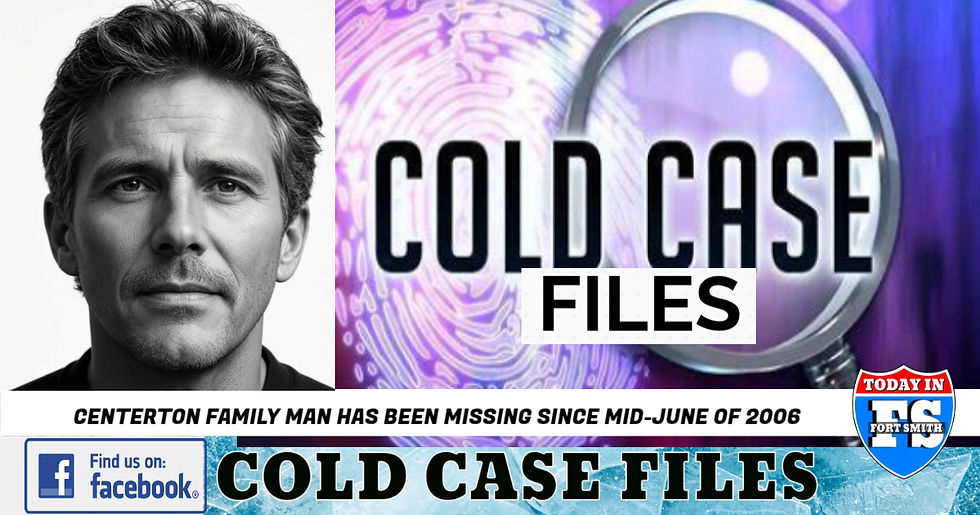
Cold Case Files: A mysterious phone call from Elgin, Illinois is the last trace of a then 31 year-old Benton County man

In

In the

middle of the last decade, a quiet current was already remaking northwest Arkansas.
Men and families from Mexico, Texas, California, and the industrial Midwest followed word of steady work at Tyson’s poultry lines in Springdale, at construction sites rising around Bentonville, and in the supplier offices that clustered near Walmart’s headquarters.
Between 1990 and 2000 the Fayetteville Springdale Rogers metro recorded one of the fastest Latino growth rates in the country. By the early 2000s more than three-quarters of the production workers on some local chicken lines were Hispanic.
Centerton, a Benton County town that had counted only 2,146 people in 2000 and just over
4% Hispanic, was swelling into a bedroom community of new roofs and new surnames.

Jose Angel Fuentes Jr., known as Joe, was part of that movement. He was 31, six feet tall, about 180 pounds, a Hispanic man with black hair worn short, brown eyes, a mole at the center of his nose, and prescription glasses. He lived in Centerton with his wife, Rubianna.
On June 19, 2006, he called her and said he was in Elgin, Illinois, and that he was heading to Chicago to drop off a friend. No one who knew him has heard his voice since.
NamUs now lists 26,637 unresolved missing persons nationwide, 333 in Arkansas, and 11 in Benton County. Fuentes is one of those eleven.
His file was not created in the system until June 22, 2011, five years after that last call, a lag that is common in adult disappearances that cross state lines and never produce a body.
Arkansas authorities still carry the case. The last place he is known to have spoken from is more than 600 miles from the house in the 72719 zip code.

The call itself is almost all investigators have of the man in motion. He told Rubianna he was in Elgin, a Fox River city west of Chicago with its own long history of Mexican and Central American neighborhoods, factory shifts, and weekend drives into the city.
He said he was going to Chicago to drop off a friend. The next day, June 20, 2006, his gold 1994 to 1996 Honda with Arkansas plates turned up in Rapid City, Illinois. Rapid City sits in Rock Island County on the Mississippi, roughly 150 miles west of Elgin, the opposite direction from downtown Chicago.

The car was accounted for. Jose was not inside it. Public case summaries still say few additional details are available. That single geographic contradiction, Chicago promised and a Honda recovered toward Iowa, is the hinge the file has never been able to close.
He left a precise inventory of what he was wearing and what he carried on his body, the kind of list that survives when a person does not. A size large white Hanes T-shirt. Size 32 by 34 blue Levi’s jeans. Size 11 white K-Swiss sneakers. A baseball cap. Prescription glasses. A silver Fossil men’s watch with a cubic zirconia bezel. A wedding band set with five small round diamonds, the letters RF engraved inside, Rubianna’s initials riding against his skin.

He had a tattoo of three dots on a middle finger, described in some records on the left hand and in others on the right. On his chest, a cross ringed by thorns or a cross and rosary. On his back, a naked male figure with wings, an angel inked over the shoulder blade. Those marks, the mole on the nose, the glasses, the short Afro, and the engraved ring are what any identification would still have to match.
Northwest Arkansas in 2006 was not a place that easily absorbed a vanishing. The region was loud with growth. Centerton’s population would more than quadruple between 2000 and 2010. Bentonville’s corporate campus pulled vendors from every state. Poultry plants ran shifts that started before dawn.

For a married man with a home in Benton County to fall silent after a phone call from Illinois was to drop out of a world that was otherwise filling in. Adult Hispanic men who travel for work, for family, or to return a favor are also among the missing persons least likely to generate sustained local coverage.
A child vanishing from a school route becomes a press conference. A 31-year-old who last spoke from another state becomes a one-paragraph circumstance note and a photograph that ages in a database.
The databases disagree on small points in the way cold files often do. NamUs lists last known location as Centerton and misspells Elgin as Elgen. The Charley Project and Illinois missing-person entries place the last contact in Elgin and the car in Rapid City the following day.
One compilation puts the three-dot tattoo on the right middle finger and the winged man on the right back. Another puts the dots on the left and the angel on the left shoulder. Texas missing-person records, which also carried the case, put the rosary and cross on the left chest and the winged man on the right shoulder blade.
None of those contradictions change the core: a husband called home from northern Illinois, said he was bound for Chicago, and never arrived anywhere that has been willing to say his name out loud again.
Twenty years later he would be 51. Rubianna’s initials are still the strongest personal artifact in the file. The friend he said he was driving to Chicago has never been publicly identified.
Whether that friend existed, whether the Honda was borrowed or taken, whether Jose ever reached the Chicago side of Elgin at all, remains outside the published record.
Arkansas Crime Information Center stil seeks information at 501-682-2222. Anyone who saw a tall Hispanic man in a white Hanes shirt and Levi’s near Elgin or Rapid City in mid-June 2006, anyone who later saw the tattoos or the diamond band with RF inside, is still the lead the case is waiting on.
The wave that brought families into Benton County did not pause when one of its men failed to come home. The plants kept hiring. The subdivisions kept going up. Centerton kept adding residents.
Fuentes’s NamUs page sits among the statewide 333 and the national 26,637, a Benton County case that is technically an Illinois last-contact case, a gold Honda recovered in the wrong direction from the city he named.
Cold cases like his survive on the chance that someone, after twenty years, finally decides the friend, the car, or the last hour on that Monday is no longer a private matter.


