Our Arklahoma Heritage: The legacy and lives that built the historic Muskogee County town of Porum
- Dennis McCaslin

- Jul 27, 2025
- 4 min read


In the quiet crossroads of Muskogee County sits a town whose name speaks volumes--Porum--Etched not from coincidence, but legacy. Its roots run deep into the dirt trails of cattle drives, Civil War battlegrounds, and the corridors of Cherokee governance.
This is more than a town; it's a living chronicle of frontier turmoil and tribal leadership, named for a man who embodied both: John Porum Davis.
Long before Porum boasted general stores and airplane landing fields, it was known as Porum Gap, a rugged natural pass used by cattlemen traversing the Sedalia Trail from Missouri to Texas.

The federal government formalized the area with a post office in 1890, and in 1903, the iron veins of the Midland Valley Railroad pierced through the region, bringing with it settlement and speculation.
A man named Walter R. Eaton laid out a new townsite, and by 1905, two communities—Porum Gap and neighboring Starvilla—merged to become the town of Porum, honoring a local Cherokee senator whose influence was felt long before any train whistle echoed across the prairie.
Born in 1826 in what was then the Mexican Territory--now Rusk County, Texas--Davis carried the Cherokee name Oo-la Sota, and later, many knew him as Poor Jefferson Porum Davis.
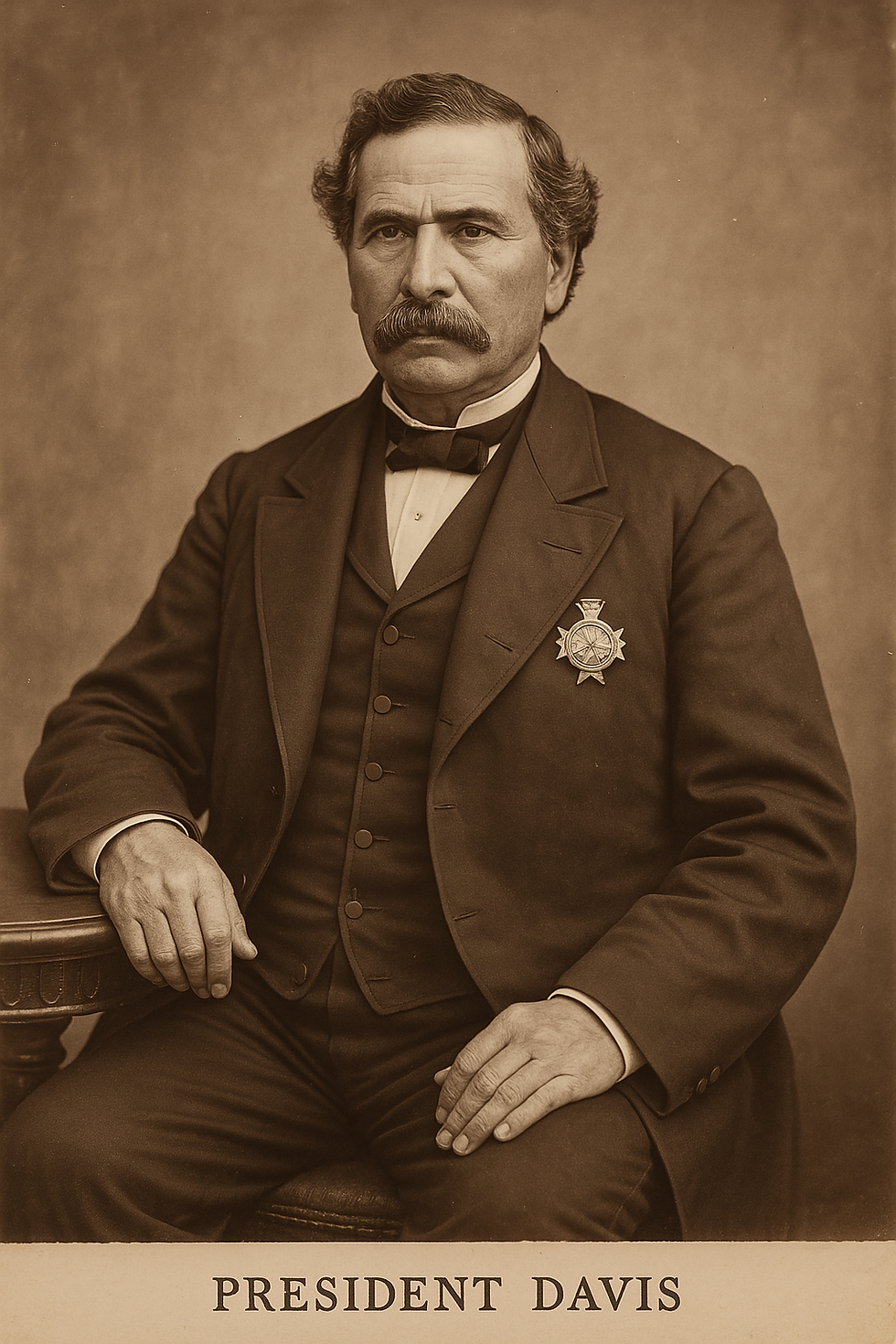
After relocating to the Canadian District of the Cherokee Nation, Davis built a career on service and resolve. He entered tribal politics in 1851 as a councilor, and from that moment, Cherokee governance had a new voice--one both principled and relentless.
He held numerous posts over three decades, becoming Solicitor, Sheriff, and eventually a Senator across multiple terms. Davis was chosen as a Delegate to Washington in 1867, championing Cherokee interests during tense negotiations with federal authorities.
By 1869, he was presiding as Chief Justice of the Cherokee Supreme Court, shaping tribal law during Reconstruction. In his final years, Davis ascended to President of the Senate, an apex of leadership he held until his sudden death in 1880.

He was buried just half a mile east of Texanna, Oklahoma, in an unassuming cemetery now nearly lost to time. A simple granite slab marks the grave, etched with a Masonic emblem and the words:"J. P. Davis Died November 22, 1880, Age 54."
Though quiet in death, his name endures==etched into maps, whispered in stories, and immortalized in the town of Porum.
Another name would come to shape the story of Porum just as powerfully as Davis: Starr.
The Starr family, too, traced its roots through the veins of Cherokee bloodlines, political struggles, and, eventually, frontier justice.

Tom Starr, a fierce Confederate scout and controversial Cherokee fighter, was among the first of his clan to settle near what would later become Porum.
Known as both a folk hero and feared enforcer during the internal Cherokee factional conflicts of the mid-1800s, Tom was a symbol of survival and early lore and his homestead near Briartown, just a few miles from Porum, became the base of operations for a new generation of Starrs.

His son, Sam Starr, stepped out of his father’s formidable shadow and into infamy of his own. In 1880, Sam married the notorious Bandit Queen, Belle Starr. Together, they established a hideout known as Younger’s Bend, a remote and rugged bend of the Canadian River. It became a safe haven for outlaws and a symbol of the region’s lawless edge.
Sam and Belle were arrested in 1882 for horse theft and served prison time. Their legend only grew in notoriety until Sam’s violent death in 1886 during a gunfight at a holiday gathering. Belle would follow just three years later, gunned down by an unknown assailant on a muddy trail near their home.
Though their lives were cut short, their mythos became inseparable from the wild identity of Indian Territory.
The Davis and Starr names lived on not just in town halls, but battlefields. Between 1906 and 1916, Porum became the backdrop for one of Oklahoma’s bloodiest feuds--the Porum Range War--a deadly conflict between the Davis, Starr, and Hester families. Davis’s sons--Jack, Bob, Sam, and Cicero—were at the heart of the violence.

On the opposing side stood members of the Starr clan, including Samuel “Pony” Starr, a younger-generation Starr said to be as sharp with his gun as his forebears. Known for his calm under pressure and deadly accuracy, Pony Starr was as much a legend among his allies as he was a threat to his enemies.
Ambushes, barn burnings, and shootouts claimed over 30 lives, culminating in the infamous Battle of Porum in 1911.
That night, as vigilantes surrounded the Starr homestead, Pony Starr and Joe Davis returned fire with fearless precision. The gunfight lasted ten harrowing minutes, lighting up the dark with muzzle flashes and the sound of vengeance. When the dust settled, among the dead was Cliff Hester, son of Judge Hester, signaling the feud’s bitter peak.
The Porum Range War wasn’t just a family dispute--it was a full-blown guerrilla conflict that left the town scarred but not broken.
Despite its tumultuous origins, Porum survived.
By the 1930s, it was shipping cotton, coal, and cattle. The town had 150 telephones, bustling schools, multiple churches, and even a public library—proof that peace had returned and taken root in a once lawless place.
Today, with a population of just 603 (2020 Census), Porum remains modest—but its story, like the granite over Davis’s grave or the outlaw tales whispered along the Canadian River, refuses to erode.
It is a place where Cherokee governance and frontier outlawry coexisted, where tribal senators shared ground with pistol-packing legends. In Porum, the line between hero and villain was often blurred—but the legacy is always clear.
This is Porum: a town where history rides hard and never dies.


