Our Arklahoma Heritage: Farmington-born rockabilly artist/DJ once held the world record for flagpole sitting
- Dennis McCaslin

- 4 hours ago
- 3 min read


Lonesome Long John Roller was born on February 1, 1930, in the Washington County community of Farmington, He embodied the restless ambition often found among those from the Ozarks region. His path from rural beginnings to becoming a disc jockey and record-breaking flagpole sitter stands as a quirky chapter in the state's cultural history.
Details of Roller's early years in Farmington are scarce. By the late 1950s, he had moved to Phoenix, Arizona, reportedly for health reasons and fresh opportunities. There he took on the stage name "Lonesome Long John," nodding to his Arkansas roots while billing himself as the "Arkansas Traveler."
His voice recalled Hank Williams, and his build resembled Tennessee Ernie Ford. He carved out a place in the growing rockabilly world as a disc jockey on KHAT radio, where he hosted programs mixing country records with his own live performances.
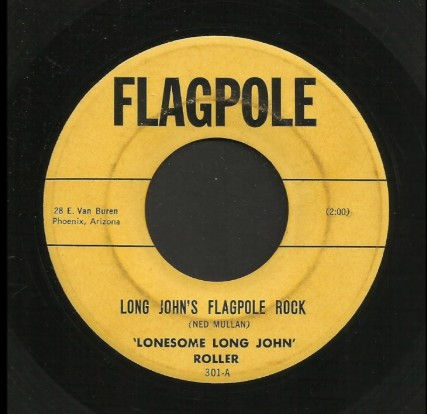
His recordings, though limited, captured a lighthearted style. In 1959 he put out "Long John's Flagpole Rock" on Flagpole Records, a novelty number directly tied to his headline-grabbing stunt. Guitarist Al Casey and his wife Corky backed the track, giving it the era's signature rockabilly bounce. He also released "Blue Am I" and "Hay Momma" that year, both highlighting his country-tinged singing, but neither gained broad attention.
The flagpole-sitting feat that defined his public life began in November 1958. Sponsored by KHAT and the Read Mullan Ford dealership in Phoenix, Roller climbed 40 feet up a pole fixed to a Ford Fairlane 500 Skyliner convertible.

The deal was straightforward: break the world record, and the car belonged to him. He broadcast live in 12-hour shifts, playing guitar, singing, and offering weather updates without the aid of a turntable or other studio gear.
Conditions on the platform were basic. He used a child's plastic pool for bathing at first, later switching to sponge baths with a bucket. Laundry dried on a makeshift line, and meals arrived by rope and pulley. His cat, originally named George and later Georgette after delivering four kittens while aloft, kept him company.

A $100 prize awaited anyone who could prove he came down early, emphasizing the challenge. Reports vary on the exact length--some say 211 days and 22 hours, others 244 days--but he broke the prior record on June 14, 1959. When he finally descended, he called the experience harder than war and swore he would never try it again.
He spent the following month resting back in Arkansas. The stunt drew curious families for low-cost entertainment and linked to the earlier flagpole-sitting craze led by Alvin "Shipwreck" Kelly.
Afterward, Roller slipped from the spotlight but remained active in the local music scene. Leveraging his KHAT connections and promotional savvy, he produced a rare regional compilation LP in the mid-1960s (circa 1963–1965) titled Sing A Song For A Souvenir Of Arizona on his own LJR Souvenir Records (catalog No. 114).
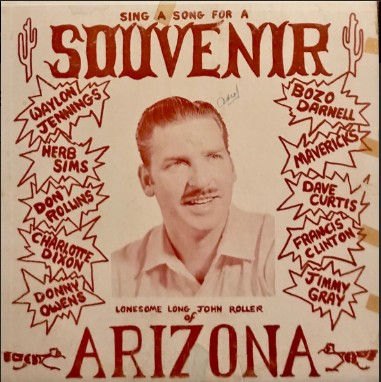
The album cover featured a prominent photo of Roller himself, tying it to his local celebrity. This faux-live, pay-to-play style souvenir record showcased various Arizona country and rockabilly-adjacent artists, capturing the Phoenix scene he helped foster.
It's most celebrated today for including one of the very first recordings by a young Waylon Jennings--a high-energy, rockabilly-flavored take on Buddy Holly's "Rave On," delivered in pure early rockabilly style with raw grit and twang.
This version, predating Jennings' mainstream releases, is exclusive to the LP and represents an ultra-rare glimpse of the future Country Music Hall of Famer in his Arizona days, before his outlaw sound fully emerged.

Roller introduced the track and chatted with artists (including Jennings) between songs, adding to its unique, radio-inspired charm. The album remains a prized, scarce collectible among rockabilly and Waylon enthusiasts.
Afterward, Roller slipped from the spotlight. His songs survive mainly in niche rockabilly archives, and the event is recalled as an example of 1950s promotional flair in Phoenix. Still, his Arkansas start ties him to the state's tradition of tough, colorful personalities
.His early life and even death may be shrouded in mystery because "John Roller" rOLLER AND was a stage name, and no records exist of his real name. Through extensive search no details were found on Roller's family life, including parents, siblings, spouse, or children.
Aslo, no confirmed information emerged on his death or burial. Given his birthdate, he would be 96 years old today
Readers who may know if he is still alive or have additional insights are encouraged to reach out to Today in Fort Smith.
oller's story remains a reminder of Arkansas's place in American folklore, showing how grit and a bit of flair could lift an everyday person into local legend.