Our Arklahoma Heritage: Anna Belle Mitchell took traditional pottery from the banks of the Illinois River to the Smithsonian
- Dennis McCaslin

- Apr 12, 2025
- 2 min read
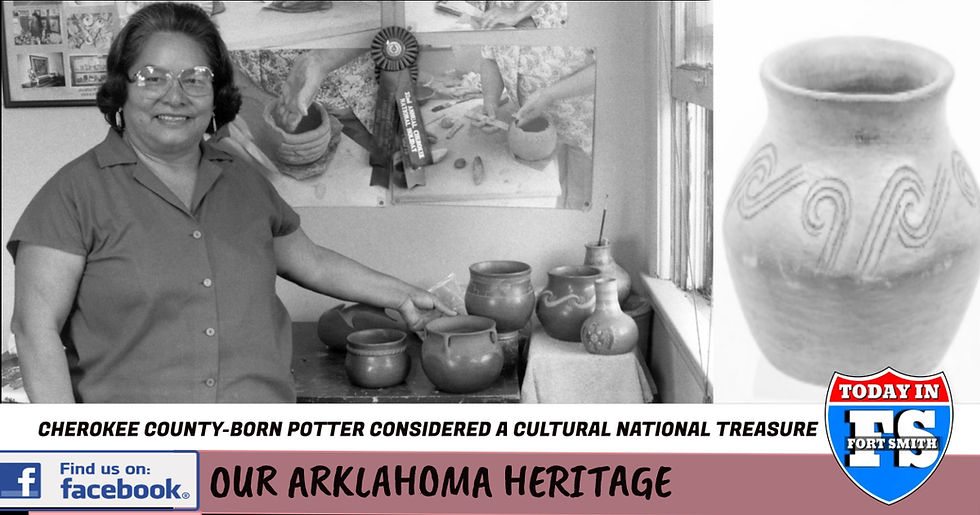


Anna Mitchell, born Anna Belle Sixkiller on August 25, 1926, in Sycamore, Cherokee County, was instrumental in reviving traditional Cherokee pottery.
In the 1960s, she researched pre-removal Cherokee pottery techniques at the Oklahoma Historical Society, teaching herself to create coiled, unglazed pots using local clay, river sand, and open-fire methods.
Her pottery followed traditional Cherokee practices, focusing on hand-coiled vessels with smooth, burnished surfaces often decorated with incised patterns like crosshatching or curvilinear designs.
She used natural materials, such as clay dug from the Illinois River banks near Sycamore, and tempered it with river sand or crushed mussel shells, firing the pots in open pits to achieve a distinctive smoky finish.
Her pieces ranged from small bowls to larger jars, typically 6 to 12 inches tall, and were functional yet deeply symbolic of Cherokee cultural identity.

By the 1970s, her work gained recognition from collectors and the Cherokee community for its authenticity and craftsmanship. She often collaborated with archaeologists to refine her techniques, ensuring historical accuracy, and her methods influenced pottery revival among other Southeastern tribes like the Catawba and Creek.
Mitchell’s dedication to teaching was significant—she held workshops at Northeastern State University and the Cherokee Heritage Center, training dozens of students in traditional methods.

In 1988, the Cherokee Nation named her a National Treasure for her role in preserving their heritage.
Her pottery is prominently displayed in several major institutions. The Smithsonian’s National Museum of the American Indian in Washington, D.C., holds a collection of her works, including a 10-inch coiled jar with incised geometric patterns, acquired in 1990.
Tulsa’s Gilcrease Museum also features her pottery, showcasing a series of her burnished vessels in their permanent Native American art collection.
Additionally, the Cherokee Heritage Center in Tahlequah, Oklahoma, exhibits her pieces as part of their cultural preservation efforts, with a notable 8-inch pot from 1985 often highlighted in their displays.

Mitchell married Robert Mitchell, raised five children in Vinita, Oklahoma, and worked as a secretary before focusing on pottery.
She passed away on March 2, 2012, and is buried at Fairview Cemetery in Vinita.
As of April 2025, her students and children continue her work, using the same river clay, ensuring her legacy endures in the Cherokee Nation.


