Our Arklahoma Heritage: Adair County transplant suffering with personal demons ended his own life at age 54
- Dennis McCaslin

- Aug 13, 2025
- 2 min read



The story of Thornton A. J. Blake, a man whose life journeyed from the hills of West Virginia to the frontier of the Cherokee Nation, offers a tragic glimpse into the turbulent and sometime mind-altering landscape of 19th-century America.
His life, marked by migration, family, and ultimately, personal tragedy, reflects the immense pressures and quiet hardships faced by countless settlers who pushed westward in search of a new beginning.
Born on October 10, 1856, in Barbour County, West Virginia, Thornton Blake was a product of an era defined by movement. His parents, Oscar Lewis Blake and Nancy Ann Moss, embodied this restlessness.

Oscar, born in Virginia in 1834, was part of a large family that migrated across the country, with his journey ending in Missouri, where he is buried in Old Lamine Cemetery. Thornton’s mother, Nancy, outlived her son by nearly two decades, passing away in Springdale in 1931, a testament to a long life that witnessed profound national change.
Their family’s dispersal across Virginia, West Virginia, Missouri, and Arkansas was a common narrative for Americans seeking opportunity beyond the Appalachian foothills.
Thornton’s own path continued the westward trajectory. He first married Eliza E. Hagar in Missouri in 1880 before wedding Sarah Rebecca Edson in Arkansas in 1887. With Sarah, he built a life in the Cherokee Nation, Indian Territory--the region that would become Oklahoma.

The 1900 census records them living in the territory with a large family, including their children Rebecca A. “Becca,” William Henry, Anna, Minnie E., Jacob Nelson, Eliza Nervie M., Ellen, and Dollie.
Life in the Cherokee Nation at the turn of the century was a complex tapestry of Native American and settler cultures. It was a time of intense change, as the traditional structures of the Cherokee government gave way to the pressures of American expansion and eventual statehood.
For families like the Blakes, living in what is now Adair County, it was a life defined by the hard work of frontier survival, resource competition, and navigating a shifting social landscape.
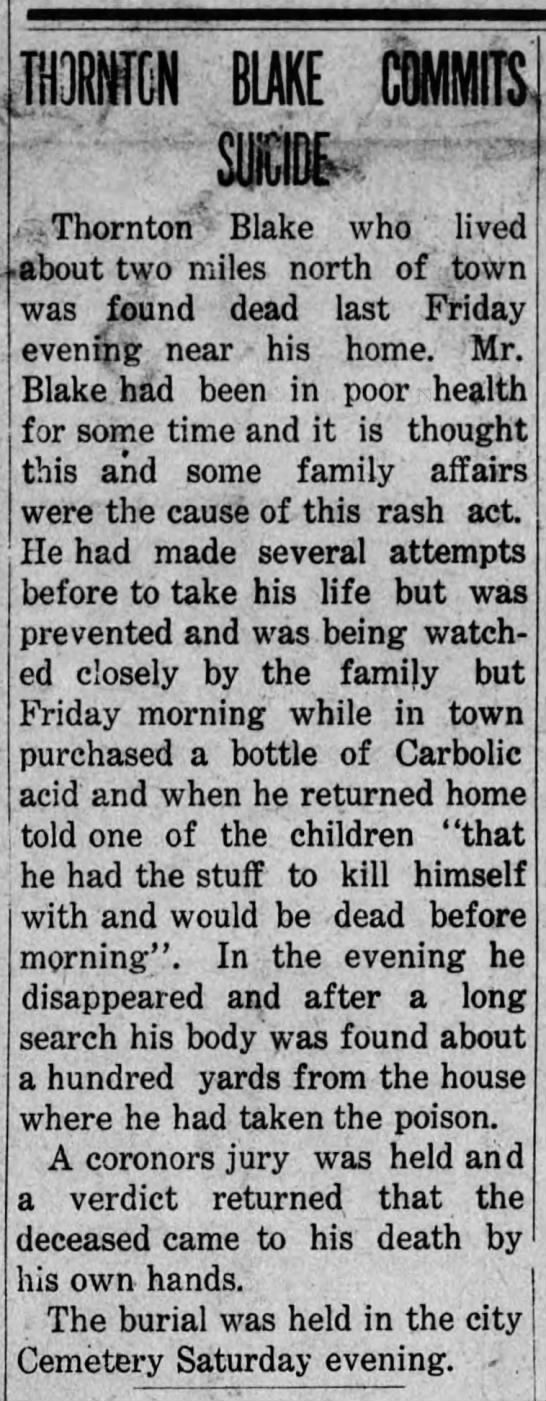
Despite the foundation of a large family, Thornton Blake’s later years were shadowed by personal turmoil. In a deeply somber event that struck the small community of Westville, his life came to a tragic end.
On Friday, June 14, 1912, Thornton was found dead just a hundred yards from his home.
According to a report in The Westville Record, a local newspaper, he had purchased carbolic acid earlier in the day and had spoke of his suicidal intent to one of his children.
A coroner's jury was convened, confirming the cause of death as suicide. He was laid to rest the following evening in Westville Cemetery.
The brief, stark newspaper account highlights the isolation and personal battles that often went unspoken on the frontier, where mental health struggles were little understood and heavily stigmatized.
His journey from the East Coast to the heart of Indian Territory encapsulates the hope and peril of westward expansion. His life represents the grit required to build a family on the frontier, while his tragic death serves as a solemn reminder of the hidden burdens carried by those who lived on the edge of a changing world.


