Our Arklahoma Heritage: WWI Medal of Honor and Purple Heart winner was born near Ozark on October 25 1882
- Dennis McCaslin

- Mar 17
- 4 min read


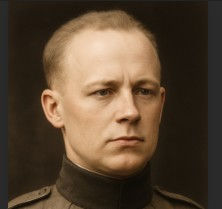
Oscar Franklin Miller was born on October 25 1882 in Franklin County Arkansas the third of eight children born to Andrew Jackson Miller and Adelia Rosette Stockton Miller. His father had come from the eastern United States and settled in the county after the Civil War to farm.
The family lived in the rural hills and fields near Ozark where land work and small community life defined daily existence. When Oscar reached age eight his father died. The household relocated to Bryant in Saline County.
There his paternal grandmother took in Oscar and four siblings named Ruth, Grace, Helen and Bill. The children grew up with the practical skills of rural Arkansas households.
Oscar completed only elementary school before he left home at seventeen.
In 1899 he traveled to Texas in search of steady income. He took a position as a printer assistant in Paris setting type and delivering papers. After a short visit back to Bryant he returned to Texas and worked as a waiter in Colorado City.
There he learned to speak Spanish which later proved useful in his jobs.

He enlisted in the United States Army on April 9 1901. Assigned to the Twenty Eighth Infantry Regiment he shipped to the Philippines during the Philippine American War. He served as company clerk and interpreter in Company A.
He sustained a wound in combat during operations against insurgents. After two years he transferred to Company G and completed his three year term. He received discharge on April 9 1904.B
ack in the United States he found work as a railway mail clerk with the postal service in Little Rock . While there he met Anna Conrad the daughter of the city police chief. They married and in 1907 their only child Oscar Franklin Miller Junior was born.
Miller soon clashed with postal supervisors over a misplaced mail sack. He bypassed the chain of command to write directly to a higher inspector. The dispute led to his transfer to a Memphis to Indian Territory route.

In the same year 1907 the family moved to Laredo Texas. Miller joined the Immigration and Naturalization Service as an inspector. For the next ten years he patrolled the United States Mexico border in Texas Arizona and California. He worked out of Laredo Nogales Tucson Amarillo and Los Angeles.
He apprehended groups of undocumented migrants including sixteen Chinese individuals and two smugglers in one pursuit. He used his Spanish to conduct interviews and assemble cases. Supervisors noted his efficiency and granted pay raises.
He advocated successfully in Washington for more patrol boats on water routes. The Millers maintained their household during these postings while Oscar Junior grew up.
In 1917 Miller resigned from the immigration service. He entered reserve officer training at the Presidio in California. He performed well enough to rank among the top two graduates and received promotion to major.
He joined the Three Hundred Sixty First Infantry Regiment of the Ninety First Division.

Training followed at Fort Lewis Washington. During a family reunion visit to Arkansas he told relatives there is no more glorious death than to die on the battlefield.
The regiment deployed overseas. Miller reached England in July 1918 then moved to France for final field training. By September his Third Battalion operated in the Argonne Forest.
On September 28 1918 near Gesnes the battalion attacked a fortified German position south of the village during the Meuse Argonne Offensive. After two days of constant advance through forest terrain Miller reorganized his exhausted men and ordered the assault.
Machine gun fire from front and flanks combined with artillery began to break the line on open ground. Miller positioned himself at the head between his forward companies. He led the renewed push on foot.

A bullet struck his right leg. He staggered onward at the front of the formation. A second shot hit his right arm. He kept moving and called encouragement to the troops through the fire. Just short of the objective a round struck his abdomen and dropped him.
He refused evacuation and directed the men to continue to the next ridge and leave him behind. The battalion pressed forward and took the position. Miller was carried from the field to a dressing station near Very.
He died from the combined wounds on September 29 1918 at age thirty five.
Miller received the Medal of Honor posthumously for the action. Additional recognition included the Purple Heart and mentions of a Distinguished Service Cross in some accounts

.His wife Anna and son Oscar Junior survived him. The family had maintained ties to Arkansas throughout his immigration postings and training period. Miller lies buried in the Meuse Argonne American Cemetery at Romagne sous Montfaucon France in plot F 10 36.
His story traces directly from the fields and elementary schoolrooms of rural Franklin County through self-taught skills and border patrols to command of infantry in the final major offensive of the war.
The same determination that marked his early departures from home and his clashes with bureaucracy carried him through three wounds to complete the attack his battalion delivered.

'


