Our Arklahoma Heritage: A Tulsa businessman and his wife built a sun=mmer camp for girls on the Illinois River


Along a bend of the Illinois River in southwestern Benton County, about five to seven miles south of Siloam Springs on the west side of Arkansas Highway 59, a cluster of pine-slab and board-and-batten buildings still sits under overhanging bluffs.
The Gypsy Camp Historic District, listed on the National Register of Historic Places on January 28, 1988,
is the last largely intact survivor of the private girls’ camps that opened in Arkansas in the 1910s and 1920s.

The land came into the story through a fishing trip. Around 1921, two sons of Tulsa businessman John H. “Mr. Mac” McAllister floated the Illinois where it crosses from Oklahoma into Arkansas and came home talking about the ravine, the bluffs, and the mile of riverfront. McAllister, a lumberman who had also served as Tulsa’s first city auditor and as postmaster, already wanted a summer camp for girls, with his wife as director.
He bought roughly 65 acres from Walter and Georgia Goforth, boarded briefly with the Goforths, and put up a sawmill so the cabins could be cut on site from local pine.

The director was Weesie Griffith McAllister. An artist who had lived in New York, Tennessee, and Oregon, she later directed the art department at the University of Tulsa and taught in Siloam Springschoolsss. Sources differ slightly on whether the couple were already married when the land was bought or married in the 1920s, but they agree she shaped the camp.
She had seen Romani encampments while traveling in Europe, and she borrowed that imagery for a theatrical summer place: named cabins, costumes, jewelry, and an end-of-session coronation. What began as an artists’ retreat was advertising as a public camp by 1922. Preserve Arkansas dates the shift to a camp for girls ages 8 to 17 at 1924. Sessions ran until 1978.

McAllister’s first building stacked three uses in one frame: family quarters and camp office below, lodging for sixteen campers and two counselors in the middle, kitchen and dining room on top. The floors were named Angel’s Alley, Devil’s Den, and Tree-Top Inn.
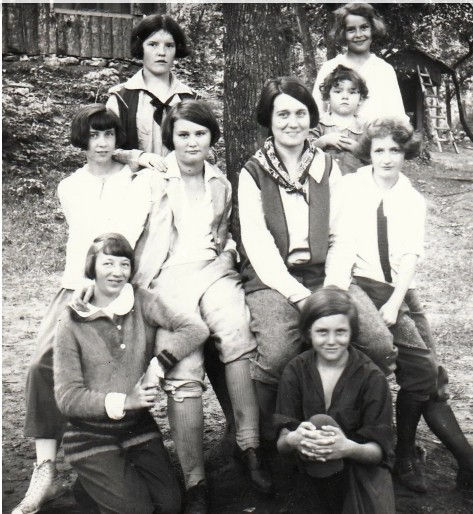
Between 1921 and 1928 he built enough sleeping space for about 120 girls; a typical summer drew 70 to 80, from Arkansas, Oklahoma, Texas, and farther off. Camper cabins carried the theme in their names: Romany Inn, Vagabond Villa, Upper and Lower Gypsy, Upper and Lower Rover’s Rest.
The 1925 Queen’s Tavern, sheathed in horizontal pine slabs, became the dining and recreation hall and held the nurse’s quarters. Treetop Lodge, also 1921, began as dining hall and recreation space and was later split between a craft shed above and sleeping quarters below. The Royal Hut, started in 1925 as a one-room log cabin and enlarged in 1928, was a year-round house for the founders.
The Coe House of 1928, stone below and frame above, replaced the Pole House, a log residence built in 1925 and lost to fire in 1927. Scottish immigrant David Gettes, later described as a great-uncle of owner Bob Coe, built the central rock arbor and retaining wall in 1921.

The oldest building on the place, the Indian House of about 1910, had been a gatehouse and residence; it was razed in 2011. A well house and canteen from about 1921 are also gone.
The program was heavier on instruction than a simple river camp. Girls swam, canoed, fished, rode, hiked the bluffs, shot archery, and played tennis. They also did calisthenics at dawn, wove baskets, studied nature, and made art. Water skiing came later.
Bob Coe remembered three hours of horseback riding a day, a pool and tennis courts on the grounds, and use of nearby Lake Frances. That lake was a separate resort story: in 1926 Tulsa businessman Julius K. Livingston and partners developed Forest Park on about 1,200 acres a few miles south of Siloam Springs, dammed the Illinois, and built a hotel, ballroom, and golf course; James Wallace Sloan renamed it Lake Frances in 1927. The dam failed more than once and the lake was drained for good in 1989.

Camp culture was built to last past August. Girls drew ribbons and joined clans, remembered by later campers as the Oranges and the Reds, and kept that affiliation for life. Points were counted, clan songs were sung against each other, and Wednesday night meant campfire in costume.
Names were painted or carved only in the cabin where a girl stayed. Local girls from Siloam Springs were eventually barred after boyfriends were caught sneaking in. Buses from Dallas were met with hugs at the start of a session and tears at the end.
Weesie McAllister died in 1933 at about 60. Daughters Bess Coe and Etta McAllister carried the camp, and in 1955 Bess’s son Bob Coe and his wife Daisy took it over and ran summer sessions until 1978. After that the family rented the grounds for church groups, reunions, and the annual gathering of former campers.
Governor Bill Clinton signed the letter placing it on the National Register. The district covers about 11.5 acres; the larger tract is the old 65-acre river property. It was listed under Criteria A and C, for recreation and architecture, as part of the Benton County Multiple Resource Area, reference number 87002425.
The decades after closure were hard on the buildings. Flooding, suburban growth along Highway 59, and the cost of keeping a bluff-and-river compound together put it on Preserve Arkansas’s 2006 most-endangered list. Local advocates had already pushed the 1988 listing against talk of condemnation.

In 2013 a Historic American Landscapes Survey of the camp, HALS AR-5, took third place in a national challenge on cultural landscapes associated with women. The survey called it the last largely intact example in Arkansas of the girls’ summer camp as a landscape type. The other three camps of that early wave did not survive in comparable form.
Bob Coe lived on the property until his death in 2017 at 96. The family had held it for nearly a century. That year Jerrid and Tracie Gelinas, with partners, bought it; Gypsy Camp & Canoe opened on June 30, 2018, as the only outfitter on the Illinois. Cabins have been stabilized, campsites added, and the old Coe house turned into the outfitter’s check-in.
Most of the sleeping cabins are not rented. Floats run upstream from the Siloam Springs Kayak Park and from Chamber Springs, with takeout at the camp, and newer whitewater trips continue downstream toward the Oklahoma WOKA park. Former campers still come back. Their names are still on the rafters.
One claim in the earlier draft should stay out. Preserve Arkansas notes that the bluffs and caves have prehistoric Native American significance, but no nomination, survey summary, or encyclopedia entry documents pottery dated to 1200 BC, or ties those finds to Mississippian settlement. Mississippian culture is centuries later.
The documented deep history here is the river terrace, the bluffs, and a girls’ camp that outlasted the resort era around it.


