Cold Case Files: John Marion Manning did his stateside duty in WWI before returning home to rural Haskell County
- Dennis McCaslin

- May 2
- 2 min read


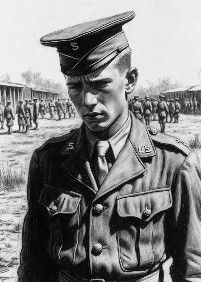
John Marion Manning (185–1947) was a World War I veteran who served in the U.S. Army’s 162nd Depot Brigade at Camp Pike, Arkansas.
He represents a classic American story of early 20th-century rural Southern-to-Oklahoma migration, and family dedication amid hardship, military service in a support role during the Great War, and postwar family life in eastern Oklahoma.
John Marion Manning was the sixth child of Martin Joseph “Jasper” Manning (1854–1911) and Francis Marion “Fannie” Sanford Manning (1861–1931). The family originated in Georgia (Haralson County area), where Jasper and Fannie married on December 8, 1878.
They migrated to Oklahoma (then Indian Territory), settling in the Haskell/Pittsburg County region near areas like Quinton and Brooken Township. Jasper’s parentage remains somewhat unclear in records, but the family raised a large brood in challenging frontier-to-rural conditions.
Siblings of John Marion included Elinder (Crawford), Mary Jane (McKee), William Jasper “Boss,” James Allen, Ada Louise (Kirby), Franklin Midran, and Madison Rhey Manning (1898–1954).
The Mannings were part of the broader wave of settlers in eastern Oklahoma, farming and building lives in communities tied to coal mining towns like Quinton and agricultural areas. John grew up in this environment, marked by the family’s relocation and the early death of his
ather in 1911.
John enlisted from Oklahoma and served in the 162nd Depot Brigade at Camp Pike, Arkansas, one of the major WWI training and receiving formations. Depot brigades handled critical home-front logistics: receiving recruits from draft boards, issuing uniforms and equipment, delivering initial military training, and processing soldiers for overseas deployment to France or for discharge upon return.
They were not frontline combat units but essential to the war effort’s manpower pipeline. The 162nd was based at Camp Pike and organized into battalions and companies. Like many in these units, John’s service nvolved stateside duties supporting the massive mobilization. He earned the World War I Victory Medal, awarded for service between April 6, 1917, and November 11, 1918 (or later for certain post-armistice roles).

Many such veterans returned home without overseas deployment but contributed meaningfully to the war machine.
On September 10, 1921, in Quinton, Pittsburg County, Oklahoma, John married Minion Marie Averett (1901–1990), daughter of Welborn James and Emma George (Johnson) Averett. They raised a family of seven children in the Quinton area, embodying the postwar rural Oklahoma life of farming, community, and family amid economic challenges like the Dust Bowl era and Depression.
Their children included Essie Faye (Brasher) 1922–1978, Wilma Louise 1923–1925 (died young), Leon Marion 1925–1992, Willard James 1926–2007, Elbert Leo 1929–1953, Donald Ray 1931–1993, and Richard Wayne 1939–1939 (infant death).

John passed away in 1947 (reports mention a Springfield, Missouri hospital), and Minion lived until 1990. They are connected to West Liberty Cemetery and family plots in the Haskell/Pittsburg County area.
John Marion Manning’s life traces larger patterns: Southern roots migrating to Oklahoma opportunities, service in a war that transformed America, and building a family amid 20th-century upheavals.
His WWI role in a Depot Brigade highlights the unsung support troops who enabled victory. Many descendants remained in Oklahoma and beyond, carrying forward the Manning-Sanford-Averett lines.
Families like the Mannings helped shape small-town communities in eastern Oklahoma through hard work, military service, and generational continuity.


