Cold Case Files: Despite one confession, 1997 Ottawa County murders remain on Oklahoma Bureau of Investigation list


In the early spring of 1997 a couple vanished from their home in Commerce, Oklahoma, and more than a week later their bodies turned up shot to death in the bed of a pickup truck parked inside a barn-style shed just four miles north of the state line near Melrose, Kansas.
The discovery immediately raised a practical problem that has dogged the investigation ever since: the victims lived in one state, the scene of recovery was in another, and no one could say with certainty where the actual killings occurred. Kansas authorities held primary jurisdiction because the bodies were found on their side of the line, yet early evidence pointed toward the possibility that the murders had taken place in Ottawa County,

That split forced coordination between the Kansas Bureau of Investigation, local Kansas deputies, and Oklahoma investigators who already knew the couple and the drug trade that surrounded them. Witnesses, records, and potential suspects sat on opposite sides of an invisible boundary, and every request for records or interviews required formal channels that slowed the work.
Years later, a former Ottawa County detective would note that the case was reopened in 2002 precisely because new information suggested the killings might have happened in Oklahoma, leading to several arrests that were later dropped for lack of evidence. The jurisdictional friction never fully disappeared.

Harmon Samuel Fenton was thirty-three. His girlfriend, Sarah Monique Palmer, was nineteen. They shared a house in Commerce, a small town in the northeastern corner of Oklahoma.
Fenton sold methamphetamine. In August 19,96 an Ottawa County Drug Task Force informant named Jeremy Bryan Jones bought a quarter-gram of the drug from him. Jones, then in his early twenties and living in nearby Miami, had worked as a confidential source on several controlled buys. Task force agents later described him as someone who played both sides, a con man who rolled over on others when it suited him.

The couple simply disappeared from their home. Family members, including Fenton’s mother Carolyn, reported them missing. For more than a week, there was no trace. Then, on March 5, someone found the pickup truck inside the isolated shed near Melrose. Both victims had been shot.
No detailed public account has ever described a crime scene inside the Commerce house itself, which left open the question of whether they were killed at home, taken across the line, or lured somewhere else.
The age difference and the drug connection shaped how investigators viewed the case from the start. Palmer had been born in Tarrant County, Texas, on May 22, 1977, the daughter of Roger Keith Palmer and Judy Ann Jones. She was young, living with an older man who dealt in a commodity that regularly produced violence.
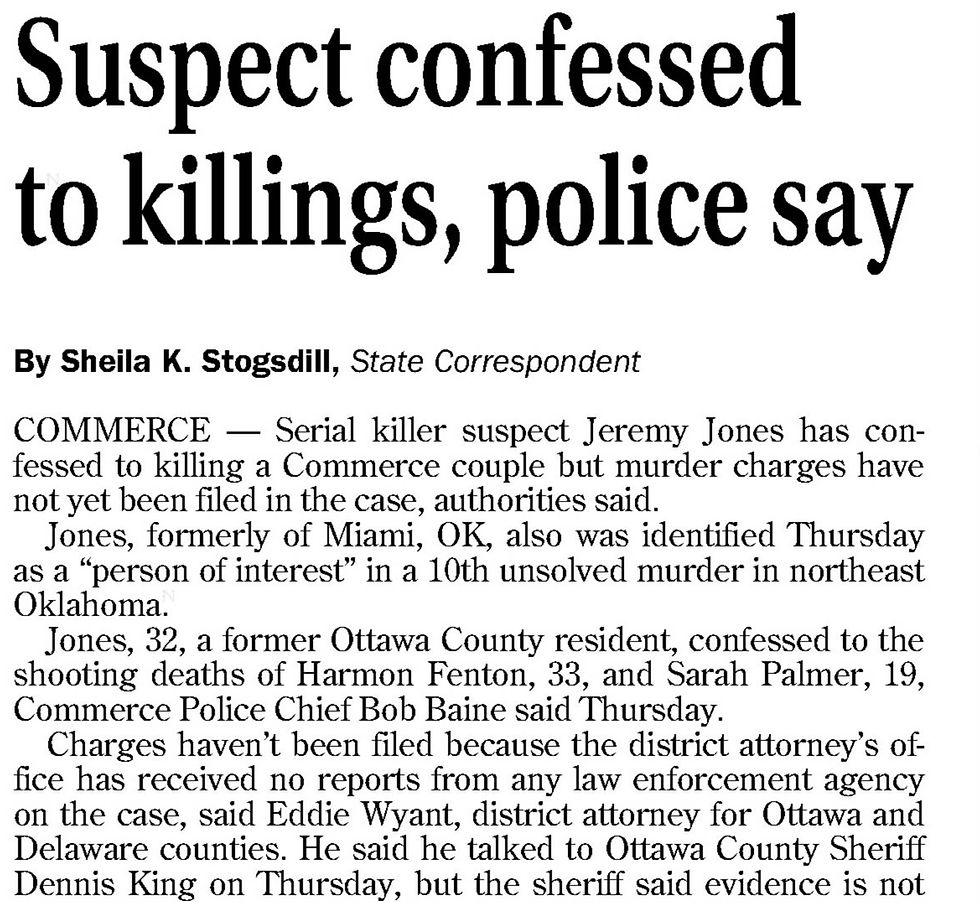
Fenton’s sales put him in contact with people who moved meth across the same rural stretch of border country. Jones’s name surfaced early. By 2005, after Jones had been arrested in Alabama for the rape and murder of a woman there and had begun confessing to killings in multiple states, Ottawa County Sheriff Dennis King publicly called him a person of interest in the Fenton and Palmer deaths.

Jones had already been linked by investigators to other unsolved Oklahoma cases, including the 1999 shootings of Danny and Kathy Freeman in Welch and the disappearance of their daughter Ashley and her friend Lauria Bible. He later claimed responsibility for a long list of murders stretching back years, yet many of those statements were recanted or lacked corroboration.
Investigators who dealt with him described a man who lied readily, sometimes to improve his conditions in custody. A note attached to Palmer’s memorial records the confession to these particular killings as not credible. No charges were ever filed against him in the Commerce case.
Jeremy Bryan Jones remains on Alabama’s death row. He was convicted in 2005 of capital murder for the 2004 rape and killing of Lisa Nichols in Mobile County and sentenced to death on December 1 of that year. He is held at Holman Correctional Facility in Atmor.
As of 2026 no execution date has been set. Jones has confessed to additional killings in several states, including some in Oklahoma and Kansas, but investigators have treated most of those statements as unreliable. He has not been charged in the Fenton and Palmer case.
In 2002, the investigation shifted again. Former Ottawa County detective Mike Eason was assigned to the cold case after evidence indicated the murders might have occurred on the Oklahoma side. Several people were arrested in connection with the deaths. The charges did not hold. Lack of evidence forced prosecutors to drop them. Jones’s name came up during that review as well, but Eason declined to elaborate.

Kansas authorities continued to hold the formal lead because the bodies had been recovered in Cherokee County. The Kansas Bureau of Investigation confirmed the case remained open and declined further public comment. Coordination across the state line meant that physical evidence, ballistics, and any potential DNA had to be shared through formal requests. Local knowledge of the Commerce drug scene stayed with Oklahoma officers who no longer controlled the file.
Public information about the victims’ final arrangements is limited. Palmer was cremated. No cemetery plot or traditional burial is recorded for her. No comparable public record has surfaced for Fenton’s disposition, which suggests the family kept those details private.
Carolyn Fenton is the only relative whose comments appear in contemporaneous news accounts, confirming the length of the disappearance and the shock of the discovery.
The case has stayed cold for nearly three decades. In 2022 it was selected for a deck of Kansas cold-case playing cards distributed inside state prisons and county jails, one of dozens of unsolved homicides chosen in the hope that someone already incarcerated might recognize a name or a detail.
The card noted the 1997 Cherokee County recovery of the couple’s bodies southwest of Columbus near Melrose. Oklahoma Cold Cases continues to list the matter and directs any tips to the Kansas Bureau of Investigation at (785) 296-8200.
No arrest has stuck, no confession has been accepted as reliable, and the original jurisdictional split between the place the couple lived and the place they were found has never been fully resolved.
The shed still sits on the Kansas side of the line. The house they left behind is still in Oklahoma. The distance between them is only a few miles, yet that short stretch of border has shaped every step of the investigation that followed.


