True Crime Chronicles: The execution of Lewis Grayson on October 11, 1945, halted a heinous criminal rap sheet


The night was warm, the kind of autumn evening in Muskogee where young couples lingered in parked cars, stealing moments under the Oklahoma stars. Doris Gene Coley and her fiancé sat close in their vehicle, unaware that danger was closing in on October 11, 1945.
Around 9:30 p.m., a man approached, his silhouette cutting through the dim streetlight. Lewis Grayson, a 31-year-old Black man with a troubled past, opened the car door, pressed a knife to the fiancé’s throat, and forever altered the lives of everyone involved.

What followed was a brutal assault--Grayson raped Coley and fled with a handful of stolen treasures: a diamond engagement ring, a wristwatch, a class ring, and a cigarette case.
The crime would lead to a swift conviction, a death sentence, and a chilling execution that reflected the harsh realities of justice in 1940s Oklahoma. woman, identified Grayson as her attacker after his arrest in Tulsa days later.
The stolen engagement ring, pawned for a mere $10, was recovered, as was the cigarette case found with a woman Grayson was staying with. The wristwatch and class ring, however, vanished into the night, much like Grayson’s hopes of evading justice.
He admitted to the thefts but said little about the rape itself, a silence that would haunt his trial.Grayson was no stranger to the law. His record stretched back over a decade: second-degree rape in 1931, burglary in 1933, and livestock theft in 1939, all in Oklahoma counties.
Released from prison in 1942, he drifted back to Muskogee, where his path crossed with Coley’s in a moment of irrevocable violence.
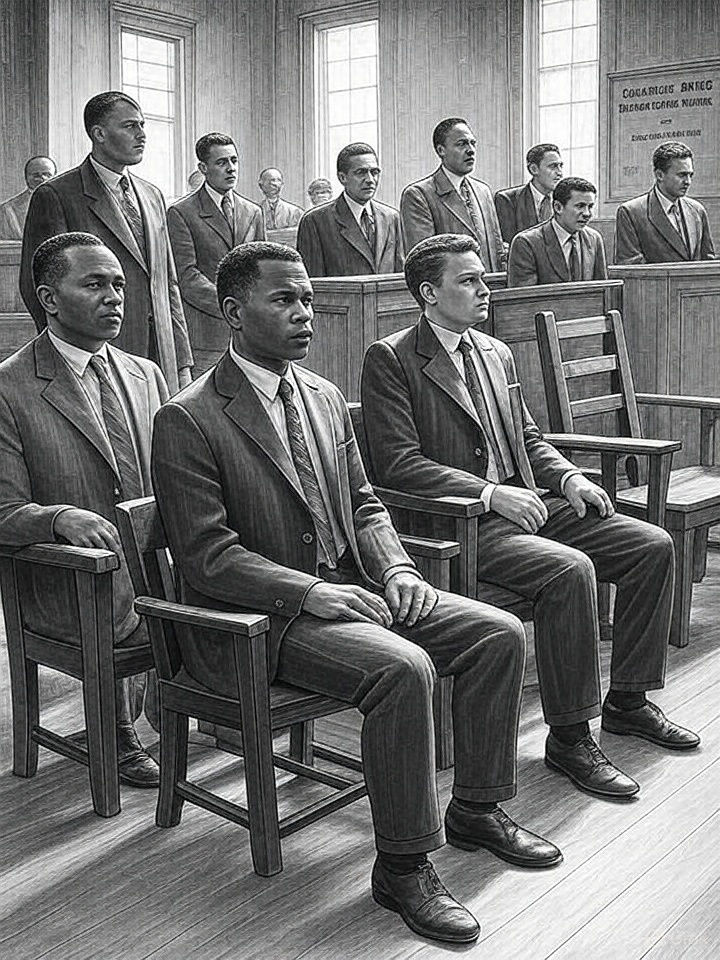
By December 12, 1945, Grayson stood trial in the District Court of Muskogee County, presided over by Judge E.A. Summers. The evidence was damning: Coley’s identification, the recovered stolen items, and Grayson’s own admissions to the thefts. He chose not to testify, and his defense offered little to counter the prosecution’s case.
The jury, operating under Oklahoma law that allowed the death penalty for aggravated rape, deliberated swiftly. They sentenced Grayson to die in the electric chair, a punishment reserved for the most heinous crimes.
A last-ditch motion questioned Grayson’s sanity, but it crumbled under scrutiny. Unverified and unsupported by affidavits, the claim relied solely on trial evidence, which the court deemed insufficient.

The sentence stood, and Grayson’s execution was set for March 13, 1946, at the Oklahoma State Penitentiary in McAlester.
Grayson’s legal team fought to save his life. An appeal delayed the execution, pushing it beyond the statutory 90-day window. In a habeas corpus petition, Grayson argued that the delay invalidated his sentence, but the Oklahoma Court of Criminal Appeals was unmoved.
In Grayson v. State (1947), they ruled that resetting the execution date was a mere administrative act, not a flaw in the sentence itself. The gavel fell, and a new date was set: May 25, 1948.

At the McAlester penitentiary, known as “Big Mac,” the electric chair awaited. Oklahoma had adopted electrocution in 1915, and by 1948, it had claimed dozens of lives. Grayson’s final moments came in the stark execution chamber, where he became one of 82 men electrocuted in the state between 1915 and 1966.
The current surged, and Lewis Grayson’s life ended, closing a case that left scars on Muskogee’s memory.
For Doris Gene Coley and her fiancé, the trauma of that October night lingered long after the courtroom fell silent. For Grayson, a man with a history of crime, the electric chair marked the end of a life defined by wrong turns


