True Crime Chronicles: The bodies of two teenagers abducted in 1981 have never been located
- Dennis McCaslin

- Aug 22, 2025
- 5 min read
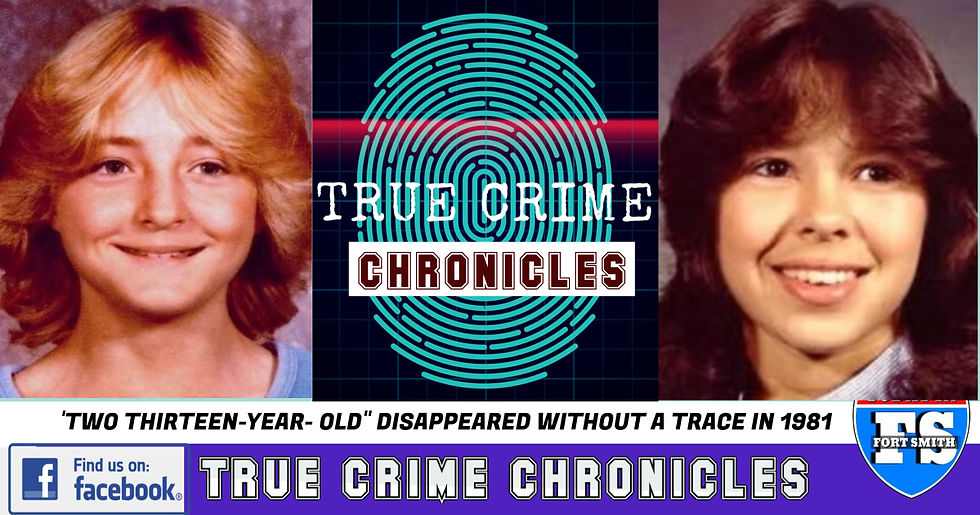


In the vibrant chaos of the 1981 Oklahoma State Fair, where the air buzzed with the scent of cotton candy and the thrill of carnival rides, two 13-year-old girls stepped into a nightmare that has lingered unsolved for over four decades.
Charlotte Kinsey and her best friend Cinda Pallett vanished without a trace on September 26, 1981, after accepting what seemed like an innocent job offer.
Their story, pieced together from witness accounts, forensic clues, and a prime suspect who taunted investigators, remains one of Oklahoma's most chilling cold cases.
The Oklahoma State Fair in Oklahoma City was in full swing that crisp autumn day, drawing families and thrill-seekers from across the state.
Charlotte Kinsey, a spirited 13-year-old with a passion for rollerskating and poetry, had tagged along with her friend Cinda Pallett, also 13.

The girls, both locals from Oklahoma City, were excited to soak in the festivities.
Around midday, Charlotte excitedly called her mother from a payphone at the fairgrounds.
"Mom, we've been offered jobs helping unload plush toys from a truck," she said, according to family recollections preserved in police reports.
Her mother, cautious but trusting of the opportunity, agreed on one condition: Charlotte must call home by 9:00 p.m. The plan was for the girls to spend the night at Cinda's house afterward.
It was the last time anyone heard from either of them.
Witnesses later described the man who approached the girls as a burly figure in his late 30s to early 50s, standing between 6'1" and 6'3" tall and weighing 200 to 250 pounds. He had dark hair, a full beard streaked with gray, a mustache, and hairy, muscular arms.

Dressed like a stereotypical fair worker in a straw cowboy hat, a brown-striped or plaid cowboy shirt, cowboy boots, and silver wire-rimmed glasses, he wore a yellow badge and a tooled leather belt emblazoned with the name "Joseph."
On his left wrist gleamed a digital watch.

He drove a tan two-door 1980 or 1981 Pontiac Grand Prix with a half-vinyl roof and South Dakota license plates--a detail that would become crucial in the investigation.The man wasn't just chatting up Charlotte and Cinda.
He approached several other children at the fair, offering them $5-an-hour gigs unloading stuffed animals from a truck. Two teenage boys, whose identities were protected in court documents, accepted the offer and joined the girls.

The group piled into the Pontiac and headed to a truck stop off Interstate 40. But when they arrived, no truck was waiting. Frustrated, the man dropped the boys in the parking lot, handed them $10, and instructed them to wait while he "went to fetch the truck."
He then drove off with Charlotte and Cinda in the backseat. The boys, sensing something amiss, never saw the girls again.
Panic set in and the families reported the girls missing, a key clue emerged: the man's discarded yellow badge. It belonged to Don Corey, a carnival drifter whose photo bore a striking resemblance to composite sketches drawn from witness descriptions.
Authorities launched a massive search, charging Corey with two counts of kidnapping. He was apprehended in Texas, but the case crumbled--Corey provided ironclad alibis proving he was in Dallas on the day of the disappearance.
Investigators quickly ruled out all legitimate Oklahoma State Fair employees, concluding the abductor had posed as one to lure his victims
.

Enter Royal Russell Long, a 42-year-old carnival worker and part-time long-haul truck driver with a dark history. Long, who bore an uncanny resemblance to the suspect sketches had arrived in Oklahoma City the day before the girls vanished to deliver a flatbed trailer. He admitted to visiting the fair but denied any involvement.
Eyewitnesses, including the two boys and other children he'd approached, positively identified him as the man offering the jobs.

Long's past painted a sinister picture. His own daughter accused him of years of molestation and claimed she'd seen him lure young girls with puppies or stuffed animals--tactics eerily similar to the plush toy ploy at the fair.
He was also linked to other unsolved cases, including the 1974 disappearances of Deborah Meyer and Carlene Brown in Wyoming. In 1984, Long pleaded guilty to kidnapping 12-year-old Sharon Baldeagle, who remains missing; he was sentenced to two life terms and died in prison in 1993 from a heart attack while serving time in Wyoming.
The evidence against Long mounted in the years following the disappearance. Authorities located the rented Pontiac Grand Prix he'd driven in September 1981. Forensic analysis revealed hairs in the trunk that matched Cinda Pallett's, along with animal hairs consistent with Cinda's pet dog and cat.

A bloody boot print and stains on the trunk mat suggested violence; an expert even interpreted the patterns as outlines of one large or two small bodies. Additionally, a lock of blonde hair found in Long's Wyoming residence was a potential match for Charlotte's, though 1980s technology couldn't confirm it.
Tragically, DNA testing wasn't advanced enough at the time to link the bloodstains definitively to the girls--or rule out animal origins.
In August 1985, Long was charged with kidnapping and murdering Charlotte and Cinda.

During proceedings, he brazenly taunted the grieving Kinsey and Pallett families, reportedly saying, "I'm the only one who knows the truth about what happened to your girls."
But the case unraveled in December 1985 when the judge excluded key evidence: Long's daughter's testimony, one boy's identification, and much of the physical forensics. All charges were dismissed, leaving Long free until his later conviction for Baldeagle's abduction
.Despite the setbacks, Long remains the prime suspect.
At the time of her disappearance, Charlotte was 5'0" to 5'1" tall, weighed 100-105 pounds, and had blonde hair and blue-gray eyes. She had a small dot-shaped scar below her left eye (from pencil lead), silver caps on her lower front teeth, pierced ears, and a triangular birthmark on her lower back.
She was last seen in a white blouse with maroon stripes, blue jeans, and sneakers.
She left behind a five-month-old baby sister, adding layers of heartbreak to her family's story.
Cinda Pallett, described in missing persons files as a bright, animal-loving girl, shared similar physical traits and was equally devoted to her friend..
Authorities believe the girls' bodies may still be somewhere in Oklahoma, possibly along Interstate 40 routes Long frequented as a trucker. The case, classified as a likely homicide, has seen renewed interest with modern DNA advancements, though no breakthroughs have surfaced.
"We may never find them, but we won't stop looking," an Oklahoma State Bureau of Investigation spokesperson told local media in a 2020 retrospective
Charlotte's love for poetry lives on through her family's memories, a poignant reminder of the life cut short
.If you have any information about Charlotte Kinsey, Cinda Pallett, or Royal Russell Long's activities in 1981, contact the Oklahoma State Bureau of Investigation at 405-231-2121 or submit tips anonymously via the NCMEC hotline at 1-800-THE-LOST.
Your call could finally bring closure to two families who have waited over 40 years.