True Crime Chronicles: A trio of killers from Idabel are all walking the streets as free men after gaining parole



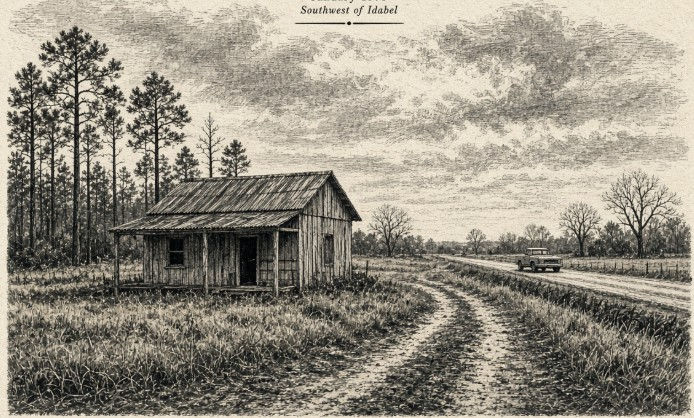
On a January afternoon in 1975, in the pine and pasture country southwest of Idabel, an old man named Daniel E. Ray, known around McCurtain County as Danny, was found dead near the house where he lived alone. Neighbors put his age at seventy-four or seventy-five.
The place was a modest rural house later described as little more than a shack without running water, a short way south and west of Dan DeBerry’s home, itself a few miles out of town. DeBerry went by on January 16, found the body, and saw that the house had been ransacked. Ray’s pockets were turned inside out. Investigators would later say the killers had taken about forty dollars.
Idabel is still a small county seat of brick storefronts and pickup traffic, the kind of town where a killing in the country becomes common knowledge in a day.

The attack had come three days earlier, on or about January 13. Three younger men from the Idabel area, Lonnie Graves, LeRoy Daniels Jr., and Frank Nelson, had been drinking. At Alma Faye Townsend’s apartment, they talked about doing a job on an old man who lived in the country.
Daniels had a gun. Graves had a knife. They left in Daniels’s pickup, drove out to Ray’s place, honked, and asked for water for the radiator. That was the story they told afterward, with variations. Water went into the radiator. Then the beating began.

What followed was brutal even by the standards of a robbery that turned into murder. Ray was knocked down, struck with the stock of a shotgun, stabbed in the right lower neck, kicked, and stomped. The knife broke. Searchers found the blade and the handle in separate places near the body. A tool mark examiner later showed they had been one knife. Bone fragments at the scene were part of Ray’s jaw, separated by blunt force.
r. Merlyn Bellamy, the assistant state medical examiner, said the stab wounds killed him. Blood from the body was type O. Type O human blood was on the knife blade. Combat boots taken from Graves had human blood on the right boot. A radiator cap lay nearby. Two billfolds were recovered. Photographs of the body were kept from the juries that would later sit on the case.
Oklahoma State Bureau of Investigation agent Sam Sparks, Sheriff L.D. Gilbreath, highway patrolman Jim Coffman, and technicians from the KEDDO mobile crime lab worked the scene and the statements that followed. On January 21, Daniels told Sparks the three had discussed robbing an old man, gone to the house, asked for water, and then Graves had struck and kicked Ray while Daniels went through his pockets.

They searched the house. Daniels said he took some money but did not know how much. The next evening, he told the sheriff they had beaten, robbed, and stabbed the old man and that Graves had done the stabbing. Graves, interviewed the same week, said they had knocked Ray down, beaten and kicked him, and taken about forty dollars. A cellmate later quoted Graves as saying he could not let the man live to identify him.
At trial the stories split, as they often do when three men try to assign the worst of a killing. Daniels testified that he was getting water when Graves pulled Daniels’s shotgun from the truck, pointed it at Ray, demanded money, and hit him with the stock. Ray fell as he tried to run. Daniels went through his pockets.
Graves stomped him. Daniels said Ray was still alive when he walked back to the pickup and that Nelson had stayed by the truck the whole time. Nelson, called in Graves’s trial, said Daniels had done the stabbing and that Graves was drunk.
That clashed with earlier sworn testimony, from Daniels’s trial, in which Nelson had said Graves stabbed Ray, broke the knife in his throat, and threw it into bushes by a well. Nelson blamed the contradictions on talk of the electric chair. Townsend and Ethel Jewel Gray placed all three at the apartment before and after the trip and recalled talk of stabbing a man.

Both men were charged in McCurtain County case 75-18 with first degree murder under the 1973 statute that made death the mandatory punishment. Judge Neal Merriott presided in the county courthouse that had replaced the old brick pile on North Central only a decade earlier.
Separate juries convicted them and sentenced them to die. Daniels’s conviction is dated September 24, 1975. Graves’s is dated November 26, 1975.
The courthouse that defined the county for two generations, the 1920 building with the jail block on the roof, was already gone by 1975, condemned after fire and a flooded basement. The photograph below is that earlier seat of judgment, the one local people still picture when they talk about Idabel justice.
The Court of Criminal Appeals affirmed Daniels’s conviction on December 27, 1976, and modified the sentence to life because Oklahoma’s mandatory death law could not stand after the United States Supreme Court’s 1976 rulings on such statutes. Graves’s conviction was affirmed on April 26, 1977, and his sentence was likewise reduced to life.

The Department of Corrections booked Daniels as offender 90864. He is listed as a Black man, six feet one inch tall, one hundred eighty one pounds, born July 18, 1953. That made him twenty-one when Ray was killed. Incarceration on the life sentence with possibility of parole began the day of his conviction, September 24, 1975.
Graves entered the system as offender 91413 on December 9, 1975. He is listed as a Black man, five feet eleven, one hundred fifty-three pounds in a 2017 identification photograph, born June 27, 1955. He was nineteen in January 1975.
Death row in those years meant the Oklahoma State Penitentiary at McAlester. Daniels later said he spent about nine months there and that after five months of waiting he was ready for it to be over.

Assistant district attorney Mike DeBerry, who had been at the scene, later remembered Daniels as an intelligent man and said he was shocked by his part in the crime. Defense doctors said Graves had an IQ near 67 and functioned at about the level of a ten-year-old. A state psychiatrist said he still knew right from wrong.
People in Idabel had called Daniels Boss Man. He had no prison record, no jail time, not even a traffic ticket. He was married, had two children, two cars, and a steady job. The official file shows parole imposed August 21, 1990. A 1993 newspaper profile said he left prison in February 1991.

Letters from dozens of Idabel residents had helped him get there. By early 1993 he was in Oklahoma City, working two janitorial jobs, singing in the choir at New Jerusalem Temple Church of God in Christ, driving the church bus, and serving as an usher. Pastor Bobby Williams called him one of his right-hand men.
Daniels told a reporter he had backslid from the Lord, that prison left him with what he called psych problems, and that the burden of the crime stayed inside him. DeBerry said that if parole had worked for him, that was fine.
The incarceration line on Daniels’s life sentence was discharged July 7, 1999. The parole term itself was discharged May 31, 2001. His file is now inactive. The state is no longer supervising him.
Graves stayed far longer. At a 1992 parole hearing he denied killing Ray. The board recommended sending him to family in Seattle. Governor David Walters said no.
The board recommended him again around 2010. In January 2015, at fifty-nine, still at James Crabtree Correctional Center in Helena, with two misconducts in nearly forty years, he appeared by video.
The hearing room filled with relatives, including his elderly mother. Lawyer Debra Hampton called the case heart-wrenching and noted that Daniels had already been free and that a third man who testified had later been convicted of perjury. Graves said he would take life outside one step at a time, with his family’s support.
The recommendation finally took. On October 25, 2017, after a little under forty-two years inside, Graves was paroled. The prison term converted to a parole term; the department records as eighty-two years, one month, and one day. He left Helena for supervision.
The current listing puts him under the Oklahoma City Administrative Supervision Unit, status active. The life sentence was not erased. He is still serving it in the community, under watch
Nelson received immunity for his testimony, according to accounts from the parole years. Beyond the conflicting stories in the two trials, little about him remains in print.
Ray himself almost disappears behind the facts of his death.
The record does not give his full family tree, his work, or the names on a funeral notice.
It gives a rural house, a small amount of cash, a ransacked room, a broken knife, a crushed jaw, and three men who used a request for radiator water as the opening move in a robbery. Fifty years on, that is still most of what can be said with certainty about the last hours of Danny Ray.
Of the two men the juries sent to die, Daniels finished his supervision in 2001 and dropped off the active rolls. Graves has been free, and watched, since the fall of 2017.


