True Crime Chronicles: A Latimer County constable died while trying to repossess a stove in 1933
- Dennis McCaslin

- 3 hours ago
- 2 min read
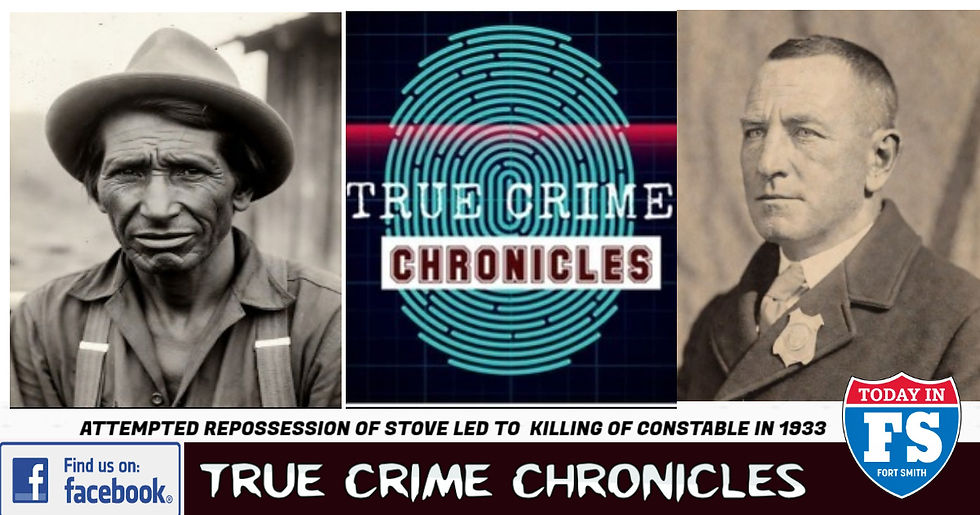


In the winter of 1933, in rural Latimer County, a property dispute turned deadly. On January 17, Constable Ellis Atoka arrived at the home of Tecumseh C. Pope in Salonia Township. Atoka carried a writ of replevin (repossession) for a stove claimed by Ras Manes. Pope was not there when the constable first showed up, but he returned home to find the lawman waiting.
A confrontation followed. Pope armed himself with a Winchester rifle. Shots were fired, and Atoka fell mortally wounded. Pope maintained he had acted in self-defense, believing the constable posed an immediate threat.
Others saw it differently--as the actions of a man who had gone looking for trouble with a gun in hand.

According to the Heavener Ledger of January 26, 1933, Tecumseh Pope, a Choctaw Indian of LeFlore, voluntarily surrendered to Latimer County authorities the previous week. He was taken to Wilburton, where he was held in the county jail for questioning in the death of Ellis Atoka, who was killed in a gun battle in the mountainous section west of LeFlore on January 18.
County authorities had been engaged in a search for the slayer since the finding of Atoka’s body. Pope appeared in Talihina late Thursday, conferred with Theodore Dukes, local attorney, and then surrendered to county officers. He was taken at once to Wilburton.
Pope, an Indian man from the area, was arrested and charged with murder. The case went to trial in the Latimer County District Court several months later. Witnesses, including Ras Manes and his wife, took the stand for the prosecution.

Doctor Booth, who had examined Atoka’s body the day after the shooting, testified about the fatal bullet wound.
The defense focused on self-defense and Pope’s right to protect his property. The jury heard evidence of Pope’s prior criminal record, which the state used to challenge his credibility. After considering the testimony, the jury convicted Tecumseh C. Pope of murder.
They fixed his punishment at life imprisonment in the state penitentiary.
Newspaper accounts in the Latimer County News Democrat from September 1933 reported the verdict under headlines announcing that T. C. Pope had been convicted and given a life sentence. Pope appealed to the Oklahoma Court of Criminal Appeals, arguing errors in the jury instructions, the denial of a request to exhume the body for further examination, and other procedural issues.
In 1934, the appeals court affirmed the conviction. The judges found that the self-defense instructions had been adequate and that the trial court had not abused its discretion in the other rulings. Tecumseh C. Pope would serve his natural life behind bars for the killing of Constable Ellis Atoka. He died in prison in 1959.
The case stood as a stark example of how quickly a civil matter over everyday property could escalate into homicide in the hardscrabble communities of eastern Oklahoma during the early years of the Great Depression.


