Travelin' Arklahoma :A unique castle on State Highway 23 in Carroll County has a quizzical construction history
- Dennis McCaslin

- Jun 9
- 3 min read


in the summer of 1943, Elise Quigley decided the time had come to replace the cramped lumber shack where she and her husband Albert, raised their five children on their eighty-acre farm south of Eureka Springs.
Albert had promised her a proper house she could design, built from timber off their own land, but wartime demands kept him occupied with lumber contracts. One morning after he left for the mill, Elise gathered the children and set to work dismantling their three-room home. By the time Albert returned that evening, the family belongings had been moved into the chicken house. Construction on the new house began at once.
Elise Fioravanti had arrived in the Ozarks from Italy at age nine, already carrying a small collection of rocks picked from creek beds on her way to school. Marriage to Albert at eighteen during the Depression brought her rock collection along to the farm, where it continued to grow with crystals, fossils, and arrowheads.

She had spent years sketching plans and building a scale model from cracker boxes and matchsticks, determined to create a place where she would not feel closed in a box but connected to the living world outside. The design called for twenty-eight large windows and French doors to flood the interior with light and views.
Glass remained scarce because of the war, so the family tacked up layers of material over the openings through the first winter. Albert and a neighbor erected the structure using lumber from the property, with only about $2000 spent on additional supplies.
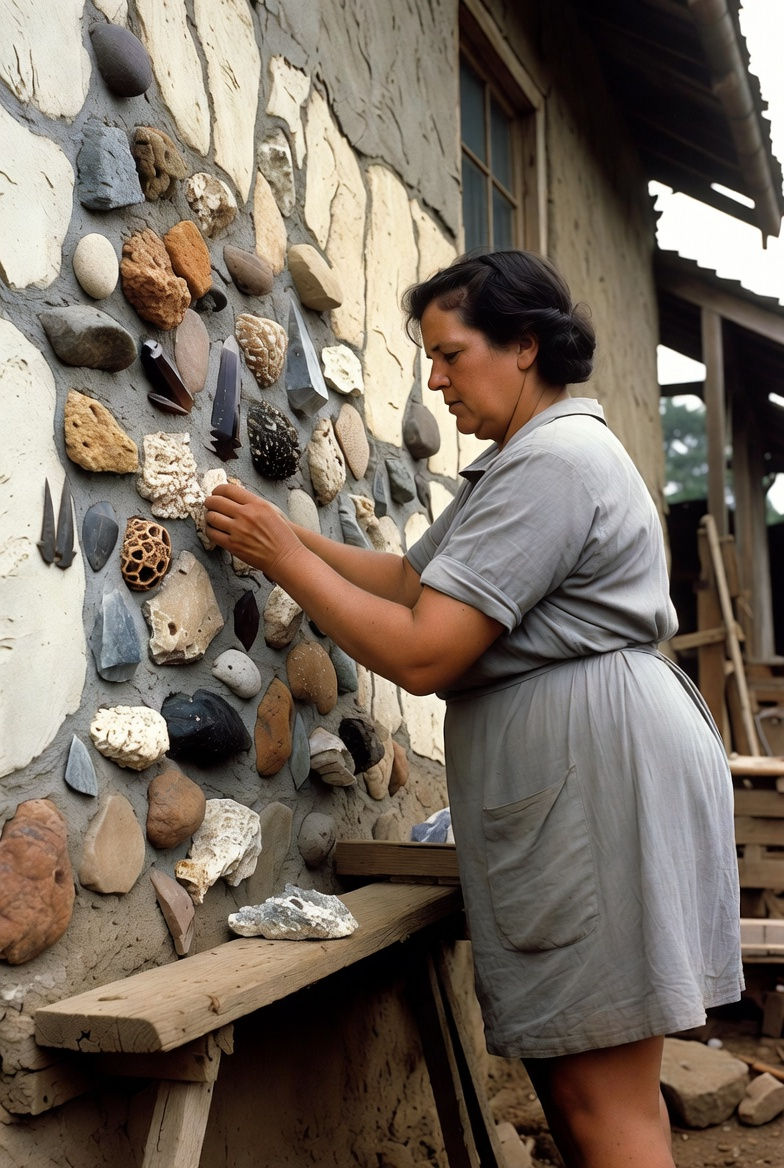
Inside, Elise incorporated a four-foot-wide, two-story open space between inner and outer walls, leaving the earth exposed to form a continuous border of soil around the living areas.
She planted tropical and flowering species there, some of which still reach the ceiling decades later, including a hibiscus that has grown since the house was built. A four-foot-square aquarium was set into one living room wall. The house became a working extension of the surrounding landscape rather than a barrier against it.
Once the frame stood, Elise taught herself to mix concrete and spent the next three years embedding her lifetime collection of stones across the exterior. Each piece was chosen and placed by hand, turning the walls into a textured mosaic of local rocks, fossils, crystals, shells, and arrowheads.
She extended the same impulse throughout the grounds, creating more than one hundred rock sculptures, a two-hundred-foot fieldstone fence, fourteen-foot pillars draped in vines, and fourteen bottle trees fashioned from her husband’s collection

. Paths wound among more than four hundred varieties of perennials, antique roses, wildflowers, a lily pond, birdbaths, and benches. A spring-fed reservoir, greenhouse, cistern, and outdoor privy completed the self-contained property.
The interior filled gradually with family antiques and her ongoing creations. Picture frames, furniture, and tabletops disappeared under arrangements of stones, marbles from the children’s collections, and other found objects. Her final major project, completed around age sixty-eight, covered an upstairs wall in a dense collage of butterflies and moths she had collected from the garden.
The house never stopped evolving during the forty years she lived in it until her death in 1984 at age seventy-four. Albert died in 1972.

What began as a private home became an unintended roadside attraction as travelers along Highway 23 stopped to look. In 1950 the family started offering tours, a practice that continues under descendants who still live on and maintain the place. The property was listed on the National Register of Historic Places in 2003 for its distinctive vernacular architecture and the singular vision behind it.
Visitors today walk the same garden paths Elise tended, pass the stonework she set in place, and step into rooms where plants she started still thrive. The house stands not as a polished monument but as the record of one woman’s persistent refusal to accept separation between her daily life and the natural world that fascinated her from childhood.
Admission prices at Quigley’s Castle are $10.00 per adult, while children 14 and under enter free when accompanied by a paying adult. Tours are offered on a walk-in basis with no reservations required, allowing visitors to experience this one-of-a-kind Ozark treasure much as travelers first encountered it decades ago along State Highway 23.
In the Ozarks, where timber and stone have long shaped how people make their homes, Quigley’s Castle remains a singular expression of that tradition pushed to its most personal extreme.
Tours run seasonally from March through October, offering a direct encounter with the place she built by hand and imagination.


