The Bottom Line: Perfect privacy will never be perfect, but solved crimes will last forever
- Dennis McCaslin

- 20 hours ago
- 4 min read


Well, looky here.
The conspiracy crowd has locked onto its newest shiny object: Flock cameras. Those automatic license-plate readers police departments put on poles to log what vehicles pass by. Overnight they’ve become the Eye of Sauron, the digital Gestapo, and proof that the deep state is tracking your trip to the feed store.
The comments under yesterday’s piece lit up faster than a dry pasture in August.
Some folks treated a utility-pole camera like it was the final piece of the New World Order puzzle.
I’ve seen this movie before. Literally.

Mel Gibson starred in Conspiracy Theory back in 1997 as a cab driver whose apartment walls were papered with clippings and whose every conversation circled back to how “they” were watching. Half the time the character was onto something. The other half he was just a mess.
The internet has turned that guy into a full-time content creator. Only now the walls refresh every thirty seconds, and the algorithm keeps feeding him more wallpaper.
We’ve watched the same cycle from both ends of the spectrum for two decades. On one side we got birtherism, years of “Obama was born in Kenya” that collapsed under birth certificates, newspaper announcements, and Hawaiian state records.

We got Pizzagate, where an online fever dream turned a pizza restaurant into a supposed trafficking hub until a man showed up with a rifle and found only pizza. We got QAnon timelines promising mass arrests and military tribunals that somehow never quite arrived on schedule.
On the other side, we got the Jussie Smollett hate-crime story that many rushed to believe and amplify before the facts unraveled in court. We got the initial Covington Catholic narrative that spread like wildfire, smug teenagers in MAGA hats “confronting” a Native elder, before fuller video showed a far more complicated scene.
We got years of “fine people on both sides” being treated as a direct endorsement of neo-Nazis even after the full transcript showed otherwise
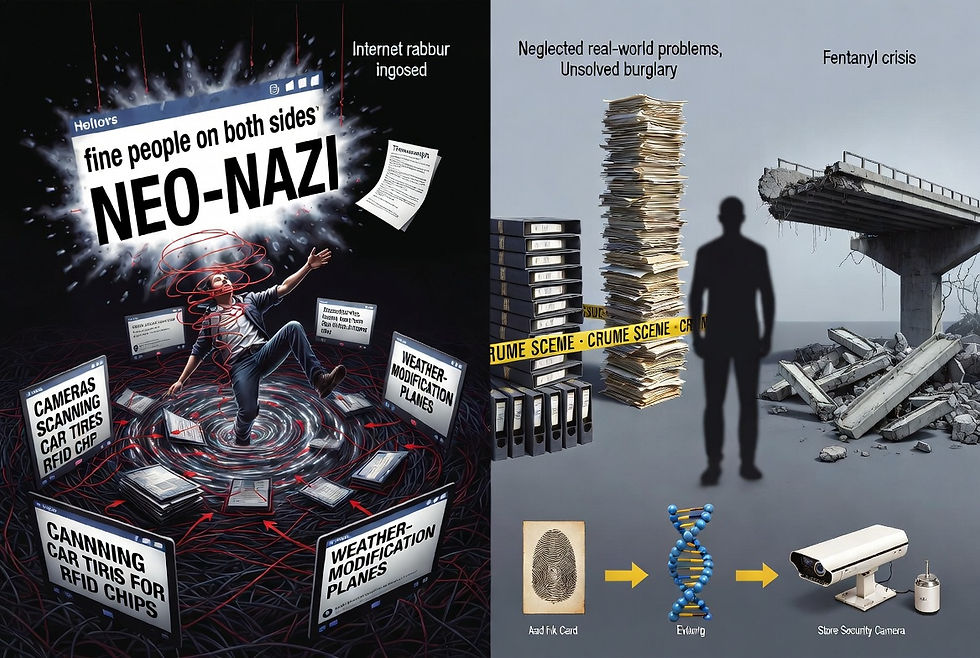
The internet doesn’t just spread these ideas. It fixates them. Algorithms reward the emotional hit. One video leads to twelve more, and before long a person who started out reasonably worried about privacy is three hours deep into a theory about how the cameras are also reading the RFID in your tires while coordinating with weather-modification planes.
While that fixation burns bandwidth, the quieter problems, property crime that never gets cleared, overloaded courts, fentanyl, aging bridges, sit there waiting for grown-ups to notice.
Technology has always changed how we fight crime and compile data. Fingerprints were once invasive newfangled nonsense. DNA was pure science fiction until it started clearing cases and freeing the innocent. Store cameras went from “Orwellian” to “why didn’t they have better ones?” the minute somebody’s truck got stolen.

License-plate readers are the latest tool in that line. They don’t invent surveillance. They just make the old “did anybody see a dark-colored sedan?” conversation faster and harder to ignore.
And the numbers, imperfect as company-reported data can be, are not nothing.
Flock’s 2025 Impact Census, drawing from roughly 700 law enforcement agencies, found its technology supported more than a million investigations, assisted in an estimated 20 percent of cleared cases in customer jurisdictions, and helped locate more than 10,000 missing persons.
An earlier analysis associated with the company estimated that Flock systems contribute to solving around 700,000 crimes a year. A study involving researchers from Texas Christian University and the University of Texas at Tyler found that adding one Flock camera per sworn officer was linked to a 9.1 percent increase in clearance rates.
Broader network effects showed that having more Flock-equipped agencies nearby also nudged clearance rates higher.
Crime still happens. Victims still bleed. The difference is whether investigators get a fighting chance to connect dots that used to take weeks of legwork.

Which brings us to the easy meme. Benjamin Franklin’s line about those who would give up essential liberty to purchase a little temporary safety deserving neither gets tossed around like confetti.
It’s a great applause line until it’s your daughter who never came home, or the neighbor carjacked in his driveway, or the elderly woman beaten while the suspect’s plate vanished into the night.
Suddenly the abstract principle meets the concrete absence of justice. Most people discover they are a lot more willing to tolerate a camera noting a license plate if it means the person who hurt someone they love might actually get identified.
And then there’s the gold-standard conspiracy that still pays the bills for documentaries and podcasts nearly seventy years later: JFK.

Millions of research hours. Untold dollars. Books stacked to the ceiling. Yet after all that, the stubborn physical facts remain stubborn. Lee Harvey Oswald carried a long wrapped package into the Texas School Book Depository that day. A rifle was later found on the sixth floor near the place where he worked, close to a sniper’s nest that ballistics and trajectory analysis showed would have given a shooter a clear opportunity to fire from behind the presidential limousine.
Everything else, grassy knolls, second shooters, shadowy cabals, has been argued into exhaustion without producing the kind of hard evidence that would overturn those core points. The mystery endures not because the evidence is overwhelming, but because the human mind hates an incomplete story and the internet rewards the people who keep the incomplete story open for business.
So by all means, keep an eye on how new technology is used. Demand warrants, audits, retention limits, and real oversight. That’s healthy skepticism.
But when the latest tool becomes an entire personality and a comment-section battlefield, we’re not defending liberty. We’re just distracting ourselves again.
The real work of living in a free society is harder and less exciting than the next viral panic. It involves actual trade-offs, actual victims, and the boring adult recognition that perfect privacy and perfect safety never quite share the same room.
Flock cameras aren’t the Illuminati. They’re just the newest mirror.
Some folks still can’t stop staring at their own reflection in it.


