Stone Gardens: The journey of a Missouri CSA Calvaryman brought him to a final resting place in rural Sequoyah County
- Dennis McCaslin

- Dec 31, 2025
- 2 min read


Against a rural backdrop in Sequoyah County, a small family cemetery bears the name Lessley. Tucked on rural land that was once an allotment in Indian Territory, it holds the graves of several generations, starting with its founder: Adam Jefferson Lessley, a Missouri-born farmer who wore Confederate gray in his youth and spent his later years tilling frontier soil.
Born June 1, 1846, in Cape Girardeau County, Missouri, Adam grew up in a border state torn by conflicting loyalties. His parents were Thomas H. Lessley and Elizabeth Neale; he was one of eleven children.
Missouri farms in the 1850s were modest operations, and the 1850 census shows the family listed under the variant spelling "Lessly."

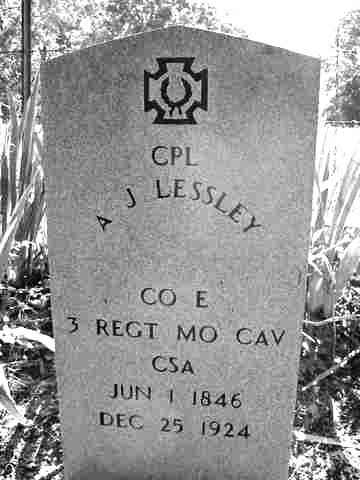
When war came in 1861, the teenage Adam sided with the South. He enlisted in Confederate service and rose to the rank of corporal in Company E, 3rd Regiment Missouri Cavalry, CSA.
Missouri Confederate cavalry units spent much of the war in hard fighting across the Trans-Mississippi theater conducting raids, skirmishes, and rear-guard actions against Union forces amid guerrilla warfare and occupation.
He survived the conflict and, decades later, qualified for the 1905 Civil War Campaign Medal issued to veterans of both sides.
After Appomattox, Adam moved westward. In 1871, in Wilson County, Kansas, he married Semantha E. Penn, daughter of Stacy Penn, a Union private who had served five years in a Kansas regiment. The marriage briefly joined families from opposing armies. They had one known son, James Oscar Lesley, born in 1877
. Semantha died the following year at age 24 and was buried in Kansas. In February 1879, in Franklin County, Arkansas, Adam married Fannie L. Lyman. The couple soon pushed farther west into Indian Territory, settling in the area that became Sequoyah County after Oklahoma statehood
in 1907. The land included an allotment linked to Fannie. There, Adam farmed and raised a large second family as the region shifted from Cherokee Nation frontier to organized farmland

.Over the next two decades Fannie gave birth to Thomas Franklin in 1881, Robert Lafayette in 1884, Bertha Lee in 1888, twin daughters Elby Frances and Esther Catherine in 1891, Julian Wesley in 1896, David Edman in 1897, Bonnie Mae in 1900, and the youngest, another Fannie, in 1903.
Many of the children stayed close to home in Oklahoma; several later joined their parents in the family cemetery
.Adam Jefferson Lessley died on Christmas Day 1924 in Sallisaw at age 78, after several weeks of illness. His funeral, held the next day, drew crowds from across the county; J. A. Peters, a Baptist minister and longtime friend, officiated at the graveside in the family plot near his old home.
His obituary listed him as a member of the local masonic Lodge.
His stone in Lessley Cemetery marks him plainly: “CPL A J LESSLEY CO E 3 REG’T MO CAV CSA.”
Fannie followed in 1933 and was buried in Missouri.His path...from Missouri battlegrounds through Kansas and Arkansas to final roots in Oklahoma...tracked the postwar drift of countless Southern families seeking new starts on opening land.
The private cemetery he helped establish stands as the enduring marker of that journey, its stones scattered across the Oklahoma countryside.


