Stone Gardens: Siberia to the Southern Plains:-One couple’s quiet and epic journey to the Heratland of America
- Dennis McCaslin

- 3 hours ago
- 3 min read


William H. “Willie” Berg and Mary Reimer Berg shared a life rooted in the Mennonite Brethren communities of Oklahoma, a story that traces the paths of Russian Mennonite families across continents and generations.
Willie was born on November 5, 1912, in Goteborg, Kiowa County, Oklahoma. Mary was born on August 25, 1917, in the village of Schoenthal in the Slavgorod Mennonite Settlement of western Siberia.
Their marriage in 1936 joined two branches of the same German-speaking Anabaptist people who had long lived under Russian rule before seeking new homes in America.
Mary’s father, Aaron Aron Reimer, was born March 9, 1870, in Fuerstenwerder in the Molotschna Colony of South Russia. He worked as a farmer and served as a Mennonite Brethren preacher and elder. Her mother, Sarah Janzen, was born around 1870 in the same region and died in December 1923 in Schoenthal.

The family had moved eastward with other Mennonites who established the Slavgorod settlement around 1907 to 1910 under the Stolypin reforms. Aaron helped lead the Schöntal congregation there. After Sarah’s death and as Soviet pressures mounted through war, revolution, and the approach of collectivization, the Reimers prepared to leave.
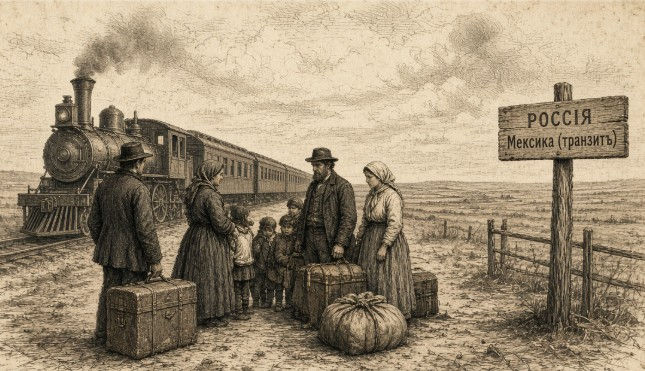
They emigrated in the mid-1920s. One record places the family’s departure in 1924 with settlement near Corn and Bessie in western Oklahoma. Another notes Mary’s arrival on October 9, 1928, at El Paso, Texas, from Slavgorod with her father and siblings.
Many Russian Mennonites of that decade used Mexico as a transit point because of United States immigration quotas. Aaron later remarried and died on September 3, 1931, in Bessie. Mary’s siblings included Katharina, who married a Plett, John A., Agatha Bartel, the young preacher Jacob J., and Helena Becker. Some remained behind in Russia or later moved to Canada.
Willie’s parents carried similar Molotschna roots. His father, Heinrich Herman “Henry” Berg, was born September 14, 1874, in Tiegerweide, South Russia, and died November 3, 1930. His mother, Elizabeth Beier, was born October 25, 1884, in Parker, South Dakota, to parents who had also come from the Molotschna area.
The Beiers moved to Corn, Oklahoma, in 1901. Elizabeth was baptized in the Corn Mennonite Brethren Church in 1903 and later joined the congregation in Gotebo. She married Henry on January 2, 1910, becoming stepmother to his three children from an earlier marriage and mother to seven more, one of whom died young. The family relocated to the Inola area in 1920.

Gotebo itself had organized a Mennonite Brethren church in 1902. Willie grew up in these farming communities of western and then eastern Oklahoma.
He and Mary married on May 29, 1936. They farmed near Inola, belonged to the local Mennonite Brethren church, and raised their children there: Billy Joe, born in 1937, Bobby Gene in 1940, Ronald Henry “Butch” in 1942, and Lawanna Marie in 1951.
Another son, Richard Wayne, also appears in family records. The children later recalled a household marked by hard work on the farm, steady faith, and close ties to the church. One son noted that the family’s character may have drawn from his mother’s father, the pastor who fled persecution in Russia and joined the larger movement of Mennonite immigrants to America.

Willie died on June 3, 1996, in Tulsa at the age of eighty-three. Mary died on October 29, 1999, at eighty-two. Both are buried in Parkside Mennonite Brethren Cemetery in Mayes County.
Their shared grave inscription reads “ICH LIEBE DICH,” the German words for “I love you.”
Both families spoke German and Plautdietsch, shared the same Anabaptist faith, and descended from the Prussian Mennonites who settled the Molotschna Colony in the late eighteenth and early nineteenth centuries.
Marrying within a specific group was the long-standing pattern among these people. The outward labels of “German” and “Russian” simply reflected the places their ancestors had lived. Willie’s parents had already been part of the Oklahoma settlements that grew after the land openings of the 1890s. Mary’s more recent arrival from Siberia connected two streams of the same people group that had rebuilt their lives on the southern plains.
The Bergs’ story mirrors the wider journey of Russian Mennonites in the twentieth century: from the colonies of South Russia to the Siberian steppe, through the hardships of the 1920s, and into the established farming churches of Oklahoma.
In the fields near Inola and in the quiet rows of Parkside Cemetery, that history found a lasting home.


