Stone Gardens: Samuel Shunk Smith- A Civil War veteran’s journey through war, relocation, and loss

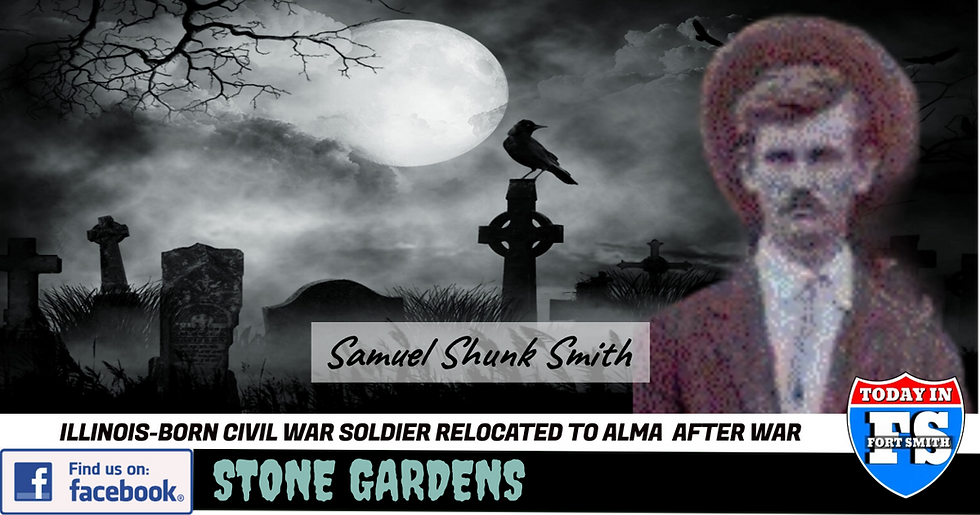


In the serene Newberry Chapel Cemetery near Alma a modest headstone bears the inscription “Company F, 51 Ill Inf,” marking the final resting place of Samuel Shunk Smith.
Born on July 2, 1838, in Beardstown, Illinois, and passing on January 13, 1911, in Rudy, Samuel’s life was a tapestry of courage, loss, and renewal. A Union veteran of the Civil War, he faced the crucible of battle, endured the heartbreak of losing his first wife, and forged a new chapter with a second marriage.
His story, pieced together from family records, military histories, and community memorials, illuminates the fortitude of an ordinary man who lived through extraordinary times.
Samuel Shunk Smith grew up in Beardstown, a vibrant river town in Cass County, Illinois, where the Illinois River buzzed with trade and whispers of a nation dividing. In 1861, as the Civil War ignited, Samuel, at 23, answered President Lincoln’s call for volunteers.

Enlisting in Company F of the 51st Illinois Infantry Regiment, mustered into service on December 24, 1861, in Chicago, he joined a unit destined for the Western Theater’s fiercest battles.
As a private, Samuel marched south with the Army of the Tennessee, his musket in hand and his heart steeled for the trials ahead.
The 51st Illinois faced its first test at the Battle of Shiloh (April 6–7, 1862), where Samuel likely stood amid the chaos of the “Hornet’s Nest,” enduring Confederate assaults under General Ulysses S. Grant’s command.
The regiment’s grit held firm, but the cost was high. By winter, Samuel marched to the Battle of Stones River (December 31, 1862–January 2, 1863), where the 51st lost 57 men to fierce fighting. Under General Philip H. Sheridan, Samuel braved artillery barrages and bitter cold, his survival a testament to his resolve.
In September 1863, the Battle of Chickamauga saw the 51st Illinois suffer devastating losses--90 of 209 men on the first day alone. Samuel would have been among the men who scrambled to build barricades on the Union’s right flank, retreating under pressure to Missionary Ridge.

Two months later, at Missionary Ridge (November 25, 1863), he joined the triumphant charge that broke the Confederate line, a defining moment for the regiment despite losing 39 men, including Captain George L. Billows. Samuel served through 1864, and fought in the Atlanta Campaign, facing bloody assaults at Kennesaw Mountain and Jonesboro, helping secure a Union victory that reshaped the war.
Whether his enlistment ended at the regiment’s muster-out in 1865, Samuel’s service marked him as a veteran of the Union’s hardest-fought campaigns.

Returning to Cass County, Samuel sought solace in family life. On November 19, 1863, before his time in the War, he married Susan Stuckey, a local woman whose steadfast presence anchored him amidst the war’s shadow.
Their union, possibly forged during a furlough or post-discharge, produced a daughter, Mary Evaline Smith Hancock, born in 1867. Yet, the joy of family was tempered by tragedy. Susan’s death occurred before 1892, when Samuel remarried.
Historical records are silent on the exact date or cause—perhaps illness, childbirth complications, or the hardships of post-war life claimed her, as was common in the era
Her passing left Samuel a widower, raising young Mary alone in a world reshaped by war.

In 1889, at age 51, Samuel found love again with Amanda Abigail Sumpter, a 20-year-old from Boxley in Newton County. Their marriage, formalized on September 8, 1892, in Newton County, marked a new chapter.
Amanda, born in 1871 to John Sumpter and Mary Ann Liperd, brought youthful energy to Samuel’s life. The couple’s age difference--over 30 years--raised eyebrows but reflected a practical choice for a widower seeking companionship and a partner to share life’s burdens.
T

ogether, they welcomed a daughter, Fannie Alice Smith Boatright, born in 1888, before their official marriage, suggesting a relationship that began earlier.
The family settled in Rudy, Crawford County, where Samuel likely turned to farming, a common livelihood for Union veterans seeking stability in Arkansas’s fertile lands.
Samuel’s relocation to Arkansas mirrored a broader migration of Civil War veterans chasing opportunity in the post-war South. Newton and Crawford Counties, with their rolling hills and tight-knit communities, offered a fresh start. Samuel’s life in Rudy was modest but meaningful, centered on family and community. s.

Samuel’s second marriage to Amanda endured until his death, and she outlived him, passing in 1948. Their home, a hub of rural life, supported children from both marriages—Mary Evaline, who lived until 1949, and Fannie Alice, who survived until 1968.
Amanda’s youth and longevity ensured Samuel’s legacy endured through his daughters and their descendants, who honored his memory with a headstone in Newberry Chapel Cemetery.
On January 13, 1911, Samuel Shunk Smith passed away at 72, his life bridging the antebellum era to the early 20th century. Buried in Newberry Chapel Cemetery, his headstone, inscribed with “Company F, 51 Ill Inf,” stands as a quiet tribute to his service.
. His life, from the battlefields of Shiloh to the fields of Arkansas, embodies the quiet valor of those who fought for the Union and rebuilt in its aftermath.


