Stone Gardens: Pioneering Whittington family planted deep roots in the area of Mt. Ida in Montgomery County


In the hills of Montgomery County the Whittington family’s story is a testament to the impact of early settlers who shaped the region’s pioneer era.
From Granville Whittington’s arrival in 1837 to the lasting contributions of his descendants, their legacy----preserved in letters, ledgers, graves, and civic milestones--offers a vivid window into the grit and determination that built Mount Ida.
In 1837, Granville Whittington left Boston to join his brother Hiram Abiff Whittington in the Arkansas Territory, settling near what would become Mount Ida.
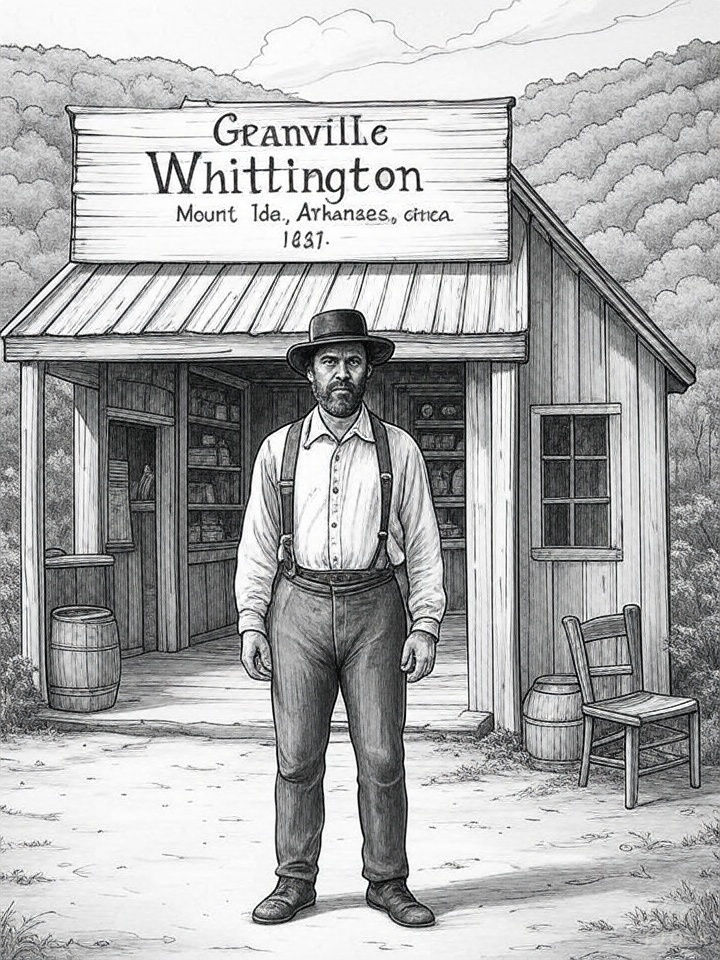
A man of vision, Granville opened a general store about one and a half miles north of the present town square, serving as the area’s first postmaster from 1836 to 1848.
His store’s surviving ledgers reveal the economic heartbeat of a cash-scarce frontier, detailing trades and debts that sustained the community.
Beyond commerce, Granville’s civic influence was profound. In 1835, he served as secretary for a meeting petitioning Congress for Arkansas statehood, a pivotal step toward statehood in 1836.
Elected to the Arkansas House of Representatives in 1846, he represented Montgomery County during a formative period.
The renaming of Salem to Mount Ida in 1850 by the county court reflects the growing community Granville helped foster.

Granville’s personal life was equally foundational. Married to Cordelia Wilder in Boston on August 31, 1831, he and his wife raised eight of their ten children to adulthood in Montgomery County.
The well-preserved headstone of their daughter Sara (1842–1846) in a local cemetery stands as a poignant reminder of the era’s hardships. Granville died on April 27, 1887, at 79, followed by Cordelia on January 10, 1892, their legacy cemented in the region’s historical

Granville’s brother, Hiram Abiff Whittington, left an equally compelling mark through his letters, written between 1827 and 1834. Discovered in 1913 in the attic of Granville’s pioneer home, these letters were published in 1997 as Observations of Arkansas: The 1824-1863 Letters of Hiram Abiff Whittington, compiled by Bobbie Jones McLane, Wendy Bradley Richter, and Charles W. Cunning.
Written from Little Rock and Hot Springs, Hiram’s correspondence captures the raw realities of frontier life---economic prospects, Native American interactions, elections, and the 1833 cholera outbreak west of the Mississippi. Urging Granville to join him, Hiram promised opportunities like book-binding, hinting at the territory’s emerging industries.
Donated to the University of Arkansas in 2008 by Ann Jones, a descendant of Granville’s daughter Patsy Whittington Moreland, these letters remain a vital resource for historians.
Granville’s son, Hiram A. Whittington, born February 17, 1832, in New Hampshire, carried the family’s legacy forward. A successful agriculturist, Hiram A. married Martha Ann Garrett in November 1860, raising children including Jefferson D., Ada E., Hiram A., Cordelia, and Clara J. on their farm on Ball Park Road.

The Civil War tested their mettle--Hiram A. served as a first lieutenant in the Confederate Twenty-fourth Arkansas Infantry, later joining Col. Newton’s regiment. The war ravaged his farm, burning his house and destroying property, yet Hiram rebuilt, focusing on stock farming.
Martha died in March 1886, and she, along with three children and three grandchildren, are buried on the family farm, a testament to their enduring roots.
The Whittington legacy continued through Granville A. Whittington (1869–1942), son of Junius G. Whittington (1839–1886) and Lucinda Celia Stall Whittington (1846–1941). Born in Arkansas, Granville A. married Annie H. Fail (1871–1965) on October 24, 1894, raising five children: William Junius "June" (1897–1967), Walter L. (1899–1980), Granville A. (1901–1989), James Stall "Jimmy" (1909–1968), and Patsy Ann Whittington Moreland (1912–1986).

Granville A. died on May 3, 1942, in Monroe County and is buried in the Whittington Cemetery in Mount Ida, alongside family members who helped shape the region.
From Granville’s foundational contributions to Hiram A.’s resilience and Granville A.’s continuation of the family name, the Whittingtons embody the pioneer spirit that defined Montgomery County.
Their general store, letters, and civic efforts helped transform a frontier outpost into a thriving community. The Whittington Cemetery, with its well-preserved headstones, and the letters preserved at the University of Arkansas stand as testament to their impact.


