Stone Gardens: North Carolina transplant was instrumental in the legal and political circles of early Van Buren
- Dennis McCaslin

- Feb 11
- 4 min read


Judge Jesse Turner left a lasting mark on Arkansas through his long career in law, politics, and economic development. Born into a family with Scotch-Irish heritage, he rose from humble beginnings in North Carolina to become a key figure in the state's formative years.
His story reflects the challenges of frontier life, partisan battles, and the turbulence of the Civil War era. Turner's commitment to public service and regional growth helped shape northwestern Arkansas, where he spent most of his life.
Turner entered the world on October 3, 1805, in Orange County, North Carolina. His parents, James Turner and Rebecca Clendenin Turner, traced their roots back to Scotland, then Ireland, Pennsylvania, and finally North Carolina. He received a basic education in local schools and started teaching at age 18 to support himself.

At 19, he began studying law under attorney William McCauley. By 1825, at just 20 years old, Turner passed the bar exam and started practicing in North Carolina.
Seeking better prospects, he moved west in 1830, settling briefly in Bellefonte, a small town in northern Alabama that later became a ghost town. The following spring, in 1831, he arrived in Van Buren, then part of the Arkansas Territory.
Arkansas achieved statehood in 1836, and Van Buren, the seat of Crawford County, became Turner's permanent home.
n Van Buren, Turner built a thriving legal practice. He gained a reputation for his sharp mind and extensive personal library, which grew to about 1,500 volumes, a notable collection for the time. His work as a lawyer spanned 63 years, making him one of the longest-practicing attorneys in Arkansas history.

Turner also mentored others, including his son, who later joined him in the firm Turner & Turner
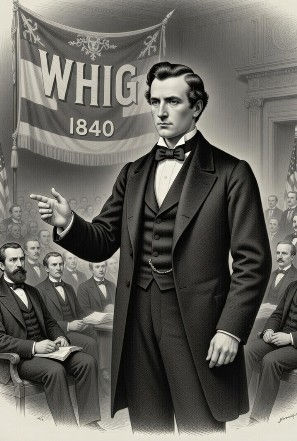
.Politically, Turner aligned with the Whig Party, which formed in the 1830s as opposition to President Andrew Jackson's Democratic policies. In Arkansas, the Whigs challenged the dominant Democratic group known as "The Family," a network of interconnected politicians who controlled much of the state's early government.
The Whigs supported federal involvement in economic development, including internal improvements like roads and canals, protective tariffs, and a national bank.
This contrasted with the Democrats' emphasis on states' rights and limited federal power. Arkansas Whigs, including Turner, drew support mainly from southern and eastern parts of the state where plantation agriculture and slavery were more established.
However, the party struggled statewide, winning few major elections. They often failed to field candidates and relied on high voter turnout in their strongholds.
Turner emerged as a Whig leader in northwestern Arkansas. He opposed Jackson's policies and became active in state politics. In 1838, he won election to the Arkansas House of Representatives from Crawford County. By 1840, he chaired the state's Whig convention and backed William Henry Harrison for president, though Arkansas voters favored Democrat Martin Van Buren.
Harrison's victory led to Turner's appointment to the board of visitors at West Point Military Academy in 1841. He later served in the Arkansas Senate and was appointed U.S. attorney for the Western District of Arkansas after the district court's creation.

As tensions over slavery and sectionalism grew, Turner opposed secession. In 1861, he served as a delegate to the Arkansas Secession Convention in Little Rock, acting as temporary chairman and arguing against leaving the Union.
After the fall of Fort Sumter, he reluctantly supported secession, seeing it as a revolutionary act rather than a legal right. During the Civil War, Turner withdrew from active politics and quietly shifted to the Democratic Party. When Union forces took control of Arkansas, he accepted the Confederacy's defeat and acknowledged that slavery had to end.
In the postwar Reconstruction period, Turner helped draft Arkansas's new constitution, which abolished slavery and outlined terms for rejoining the Union. He returned to politics as a Democrat, winning election to the Arkansas General Assembly in the 1870s.
In 1878, Governor William R. Miller appointed him associate justice of the Arkansas Supreme Court to fill a vacancy left by Justice David Walker, who resigned due to health issues. Turner's tenure was short, lasting only the remainder of the term, and he authored no major opinions during that time.
Beyond politics and law, Turner focused on economic progress. He played a central role in organizing the Little Rock and Fort Smith Railroad, serving as its first president for 11 years. This effort connected western Arkansas to larger markets, boosting trade and development in the region.
On a personal level, Turner married Rebecca J. Allen. They had children, including son Jesse Turner Jr., who became a lawyer and partner in the family firm.

Turner valued education and community, traits that influenced his family and professional life.
Turner died suddenly on November 22, 1894, at age 89 in Van Buren. He had been in good health until that day, when he passed away quietly at home. His death marked the end of an era for Arkansas's early leaders.
He was buried in Fairview Cemetery in Van Buren, a historic site that holds the graves of many prominent figures from the area's past.
Turner's legacy extended well beyond his lifetime. During World War II, the U.S. Army established a training camp on Pickett Hill east of Van Buren and named it Camp Jesse Turner in his honor. The camp prepared soldiers in four Railroad Operating Battalions to manage captured enemy rail lines in North Africa, Sicily, Italy, and southern France, reflecting Turner's railroad contributions.

Additionally, public housing in Van Buren was once called Jesse Turner Terrace, likely named after him, though it was renamed the Van Buren Housing Authority more than three decades ago.
Turner remains remembered as a principled leader who guided Arkansas through division and growth, with a steadfast focus on law, economy, and his community.


