Stone Gardens: Neighbors in Newton County on opposite sides of the War Between the States clashed in 1963


In mid-June 18,63 two neighbors from the same Tennessee migration stream killed each other in the Buffalo River valley over gunpowder. One was Braxton Edgmon, a fifty-year-old farmer working the Confederate saltpeter caves above Boxley.
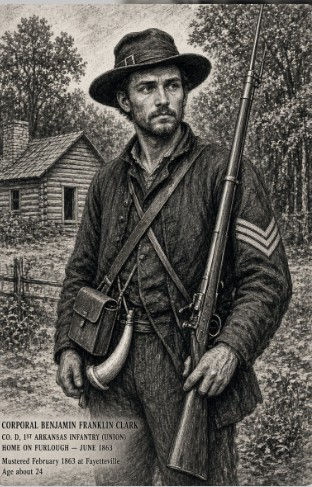
The other was Cpl. Benjamin Franklin Clark of the 1st Arkansas Infantry (Union), home on furlough. Clark fired first. Edgmon’s companions shot Clark while he reloaded. Both men were buried without the marker a quieter death would have earned.
Braxton was born March 20, 1813, in Tennessee, almost certainly in the Roane County neighborhood where his parents lived. He was the son of Samuel Deatherage Edgemon (August 8, 1792, Roane County –August 23, 1876, Ten Mile, Meigs County) and Sarah Jane “Sallie” Piercy or Pierce Edgemon (1798–1841).

Samuel was the son of William Edgemon, born about 1765 in Surry County, North Carolina, and died in 1838 in Roane County, and of Nancy Deathrage or Deatherage (1766–1830). William and Nancy lie at Baldwin Cemetery in what became Meigs County.
Their children included Samuel, Thomas Kimble Edgemon Sr., Johnston Edgmon, and Nancy Edgemon Walker. The name wanders in the records--Edgmon, Edgemon, Edgeman—as the family moved from the Carolina Piedmont into East Tennessee after the Revolution.
Samuel married Sallie about 1812. After her death, he married Jane Allen, stayed in Tennessee, and was buried in the Edgemon Cemetery at Ten Mile. Braxton was the son who went west. Sisters on Samuel’s line included Sabra Ann and Drusana, both of whom married Clarks. That surname would come back in Arkansas.
On April4, 1832, in Rhea County, Tennessee, Braxton married Mary “Polly” Casey, born February 26, 1813, daughter of Abner and Elizabeth Bowen Casey. The Caseys belonged to the same Appalachian stream that filled Newton County. Jesse Casey--early settler, Primitive Baptist minister, physician, and first postmaster of the Whiteleys office in 1851--was of that kin. The valley later called Boxley was still Whiteleys in the 1840s and 1850s, named for the Whitleys.

Walnut Grove Baptist Church was organized about 1840. A water-powered grist mill stood on the river. Known children of Braxton and Polly include Rachel Rebecca Edgemon Casey (1834–1863), William Thomas Edgemon (July 20, 1844 at Boxley to January 19, 1920 in Dallas), Nancy Angeline Edgmon Sparks (1849–1928), Frances Marion Edgmon (1855–1898), and Andrew Jackson “Jack” Edgmon, whose public file is thinner.
Rachel died the same year as her father. William Thomas married Olive Amanda Allen in Iowa in 1865, a sign of wartime scatter, and later lived in Texas. Frances Marion stayed on the river; his stone is in the main Walnut Grove yard, and later Edgmons--Fayette “Fate,” Josephine Clark Edgmon, and others--filled the same ground. A Clark marriage in the next generation shows the families did not stay enemies forever.
By 1860, Braxton farmed in Newton County. The census index puts Edgmons in several Van Buren Township households. Neighbor Benjamin F. Clark, about twenty-one, lived in the same township near the Whiteley post office with his widowed mother and sisters.

They were not strangers. They were the next farm over, from the same Tennessee counties. Newton County that year counted 3,369 white residents and twenty-five enslaved people: poor, isolated, and full of caves.
Boxley sits in the Buffalo valley inside the Boston Mountains--river, bluff, pasture, and corn. The settlement raised grain and livestock and later turkeys, honey, and maple sugar. Lead was tried and dropped. The industrial prize was underground. Potassium nitrate, saltpeter or niter, forms in limestone caves from bat guano.
Mixed with charcoal and sulfur it is gunpowder. After the Union blockade cut Confederate imports, the Nitre and Mining Bureau and private contractors turned Ozark caves into factories. Newton County’s deposits, close to wood, water, and potash, were called nearly inexhaustible. A major works stood on Cave Mountain south of the settlement.
Other operations ran downstream and on Cave Creek. Workers leached cave dirt in hoppers, boiled the liquor in kettles, and crystallized the niter. Many of those workers were exempt from regular conscription because the powder mattered more than another rifle in the line.

Braxton’s service, as the memorial and local tradition put it, was this work. He does not appear in compiled Confederate infantry records as a regularly mustered soldier, which fits nitre labor. Younger Edgmons did enlist. Samuel Edgmon, born 1839, and Abner Edgmon, born 1842, of Hill’s Cavalry both died in Newton County in the first half of 1863--February and Ma--before Braxton’s own death.
Union strategy treated the caves as military targets. On 10 January 10, 1863, Federal troops attacked and destroyed a large saltpeter works on the Buffalo, an action recorded on the county marker in Jasper and in the Encyclopedia of Arkansas. Mining did not stop. The method was to scatter, hide the kettles, and resume when the column left.
By June, men were still moving powder and leaching dirt. Braxton was among them. So, in the Clark family account, was Berry Casey, almost certainly Polly’s kin. Newton County’s war was not Pea Ridge. It was neighbors, furloughs, caves, and bushwhacking.
Former sheriff John Cecil led a Confederate guerrilla band. James R. Vanderpool led Unionist “Mountain Feds.” Jasper burned in 1863. Families lived in caves. The county’s population actually rose as refugees hid in the hollows.
Loyalty maps do not capture a valley where Edgmons and Clarks had intermarried in Tennessee and then chose opposite armies.
The two surviving narratives agree on the shape of the killing and disagree by a day. Find a Grave, drawing on a 2015 note by Travis Holt and later merged memorials, says Braxton was ambushed by neighbor Benjamin F. Clark while Clark was home on leave from the Union army, and that Clark was then killed by Braxton’s companions while he reloaded.
The death date given is June14, 1863. The Arkansas Civil War marker at Jasper lists skirmishes on June 15 and November 15, 1863. That June date is not accidental; local memory folded this neighbor killing into the county’s official list of actions. WikiTree’s sketch of Clark--born about 1839 in Roane County, the same county as Braxton’s people--is more specific from the other side.

Clark enlisted February 20 1863 at Fayetteville as a corporal in Company D, 1st Arkansas Infantry (Union). Home on furlough, he tried to stop two neighbors, Braxton Edgmon and Berry Case, who were making gunpowder for the Confederates, and was shot and killed on June 16, 1863. Clark, in blue, intercepts two Confederate powder-makers. He shoots. Someone with Edgmon--Casey or another companion--kills Clark at the reload. Both men die within a day of each other. No court-martial, no newspaper dispatch that has surfaced, no surviving inquest.
A conflicting compiled date of September 6, 1864 still floats on some trees and on an older, now-merged memorial. Find a Grave discarded it when the two Walnut Grove listings were consolidated and the complete date of June 14, 1863 was accepted. Mid-June 1863 matches Clark’s compiled service, the county marker, and the Holt tradition. “Bushwhacked” is the memorial’s word.
In 1863 Newton County that often meant a man you knew, in uniform or out of it, who decided the war would be settled on the farm lane.

Polly Casey Edgmon lived another twenty-three years. She is buried in the main Walnut Grove Cemetery under a stone that calls her Grandmother and names her wife of Braxton and daughter of Abner and Elizabeth Bowen Casey. She died July 27, 1886.
The children scattered and also stayed. William Thomas’s Iowa marriage and Texas death show how the war broke the household’s map. Frances Marion’s line remained on the river. In 1883, when the Whiteleys post office was reborn as Boxley, the first postmaster was Samuel Edgmon--another bearer of the name, not Braxton’s Tennessee father.
Rachel Rebecca’s death in 1863 means Polly lost a husband and a daughter in the same year. The record does not say whether Rachel died of the same violence, of disease, or in childbirth. Clark’s mother and sisters fade from the easy public sketches after June.
His Union service was short: enlisted February, dead June. Company D of the 1st Arkansas Infantry (U.S.) was one of the units Newton County Unionists actually joined. The county sent men both ways. That is the fact the Jasper marker insists on, and the Edgmon–Clark deaths are its smallest proof.
There are two cemeteries in Boxley with the Walnut Grove name. Walnut Grove Cemetery, also called Boxley Cemetery, sits beside Boxley Baptist Church on a short drive off Arkansas Highway 21. From Madison County, stay on 21 through the sharp corner--left would go to Lost Valley and Compton--continue about a mile, and turn at the church sign and mailboxes. From the south, turn at the same church drive after Mossville.

The old church, the new church, and the pastor’s house stand by the graves. Transcribers count a few hundred marked burials and twenty-five or more unmarked or fieldstone graves.
This is where Polly, Frances Marion, and the later Edgmons lie. Walnut Grove Cemetery II is described as a small unmarked graveyard that is part of a fence row outside the main cemetery. At its creation all of its graves were unmarked. It has no published GPS. Braxton’s memorial is here: unmarked grave, no marker ever known to exist, intentionally buried without a stone because of the times and circumstances.
An older memorial at the other Walnut Grove, carrying a different death date, was merged into this one. Intentional anonymity is itself a statement. In 18,63 a marked Confederate powder-maker’s grave was an invitation. Union columns, guerrillas, and grieving kin all passed that fence row. Families buried their dead low and said little.
A century and a half later the internet memorial is the marker they would not risk. Cave Mountain Cemetery and Whiteley Cemetery lie in the same small radius. The complex now sits inside or on the edge of Buffalo National River country.
Boxley Valley is a cultural landscape of historic farms, the later mill on the National Register, and Highway 21 as the Ozark Highlands Scenic Byway. The caves that made the valley a war target are archaeological sites as well as war sites.
The story is not a romance of noble cause. It is a record of how a border-mountain war turned a saltpeter kettle into a motive, a furlough into an ambush, and a family cemetery into two lists--one with names you can photograph, and one with a man put in the ground so quietly that the silence is the only inscription left.