Stone Gardens: Milum Cemetery holds the only veteran of the Revolutionary War buried in Boone County


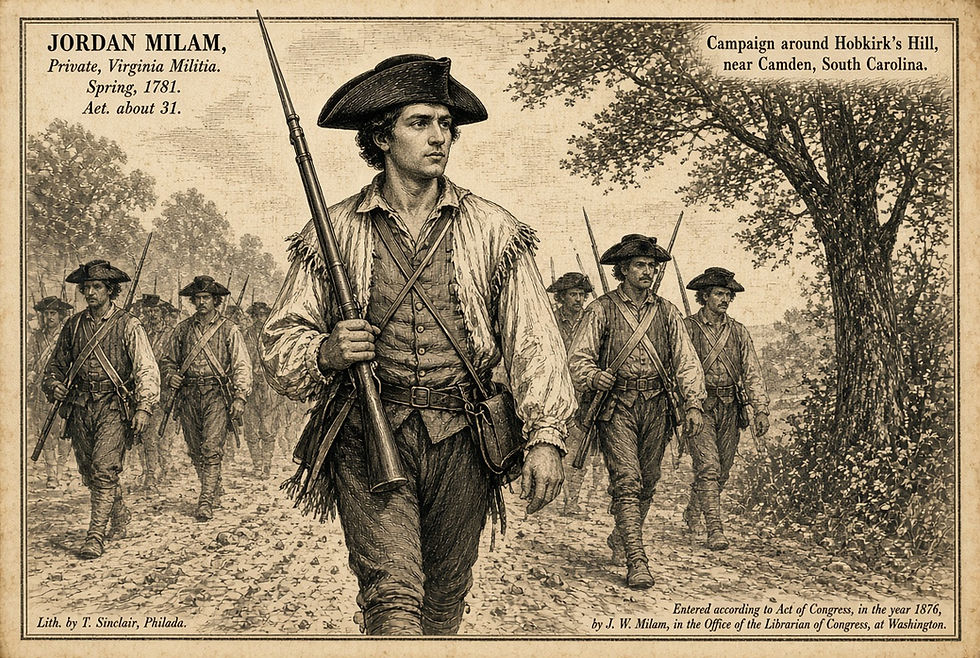
In the spring of 1781, when Nathanael Greene’s army maneuvered against the British in the Carolinas and Virginia militia answered calls to reinforce the Southern Department, a private from Henry County stepped into the ranks as a substitute.
Jordan Milam marched with Captain David Lanier’s company of Colonel Abraham Penn’s regiment toward the Troublesome Old Iron Works, joined the main force, and pushed south through North Carolina to the vicinity of Camden.

There, around the time of the fighting at Hobkirk’s Hill, he took part in the skirmishing that kept pressure on the enemy lines.
His term stretched a few days past its end while the men waited for reinforcements, after which he returned home only to be drafted again and ordered out under Captain Swanson and Colonel St. George Tucker.
That second tour carried the conscripted soldier to Bottoms Bridge on the Chickahominy and on to Jamestown, where the militia met the main army under George Washington before he was finally discharged.
Altogether, his documented service totaled roughly six months and ten days in the Virginia line.
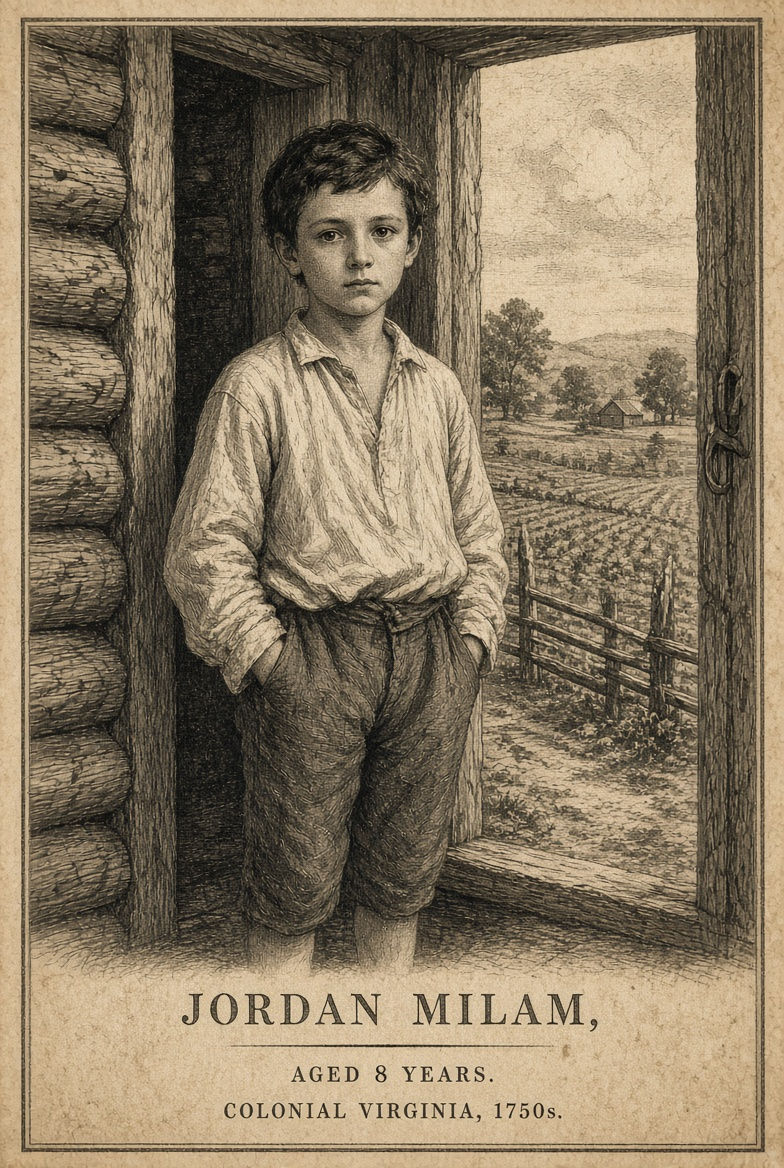
Born around the last week of February in 1750 in the Virginia Piedmont, most likely in or near Goochland County, Jordan was the son of Samuel Milam and Sarah Kemp. Parish records from St. James Northam note a child of that name baptized in the summer of 1764, a discrepancy that has long complicated the family timeline; the age he gave under oath for his pension in 1832 points firmly to the earlier birth year.
Little is known of formal schooling. Like most sons of small farmers and tradesmen on the Virginia frontier, he grew up with the practical education of the land, learning to read enough for business and religion, to handle livestock, and to navigate the shifting county boundaries of the day. By the time the war reached him he was living in Henry County, old enough to serve and willing to stand in for another man.
After the fighting ended, he moved south into the backcountry of South Carolina. On the second of August, either in 1791 or 1792, he married Mary Peacock in the Abbeville District. The couple raised a large family of about a dozen children, among them Samuel James, born in 1793, John Belfield, Dudley, William Bluford, Jordan Washington, Bartlett, Thomas, Henry, Edward, Susannah, and Nancy. Census records place them in Abbeville around 1800.

Sometime in the following decade or early teens they pushed west into Middle Tennessee, settling in Hickman County near Centerville. There Jordan farmed and raised his family while the frontier continued its slow advance. In September 1832, then in his early eighties, he appeared before the circuit court and gave his declaration under the pension act of that
year.
He described the two tours, named his officers, and received a modest annual payment of a little more than twenty-one dollars, retroactive to March 1831. His post-office address remained Centerville through at least 1837.

In the autumn of 1851, past his hundredth year, Jordan left Tennessee to join his son Samuel, who had already moved to the Crooked Creek valley in what was then Carroll County, Arkansas. He settled at Samuel’s house on the twenty-first of November. Barely six weeks later, on the last day of December, he died there.
Family tradition and the pension file both record that he was laid to rest on land Samuel owned, one of the first interments that turned the family plot into a lasting burying ground.
The place is known today as Milum Cemetery, also called Old Milum, Liberty, or Silver Valley Cemetery, a short distance from modern Harrison in Boone County. Samuel later formally deeded a portion of the tract for public burial use in 1872. Jordan’s widow Mary, who had followed him or remained nearby, applied for a widow’s pension in 1855 from both Carroll and Marion counties, supported by their sons Henry and Edward. She lived several years longer and is believed to rest nearby as well.

Th grave of the old soldier has drawn quiet attention ever since. He is the only Revolutionary War patriot known to be buried in Boone County. A local chapter of the Sons of the American Revolution bears his name, and a marker in his honor stands on the lawn of the Boone County Courthouse.
The cemetery itself, shaded by trees along the creek bottoms, holds generations of the family he brought west and the neighbors who followed them into the Ozarks.
Jordan Milam’s long journey from the Virginia militia camps of 1781 to a quiet hillside in Arkansas closed more than a century of life that bridged the founding of the nation and the opening of the western frontier.


