Stone Gardens: Madison County Sheriff Benjamin Vaughn and wife "Churby" epitomized "true grit" in 1800's Arkansas


In the spring of 1815, as Tennessee teetered on the edge of westward expansion and the United States emerged from the War of 1812, Benjamin Franklin Vaughan was born into a young nation in transition,
His birth coincided with a world in upheaval--Napoleon’s defeat at Waterloo, Ferdinand VII’s restoration in Spain, and James Madison’s presidency shaping a republic finding its footing.
Benjamin’s roots ran deep in early American soil, entwined with Welsh and Cherokee ancestry through his mother, Martha Vaughan, daughter of William Vaughan and Fereby Benton, and his father, James Vaughan, descended from John Vaughan and Nancy Callicott.
Though his parents parted ways early, Benjamin’s formative years were shaped by his grandparents, William and Fereby, whose tales of frontier life and Cherokee kin left an indelible mark on the young boy.
Between 1833 and 1837, Benjamin married Cherubia Ann Harp--“Churby”--a Tennessee native born in 1817, reportedly kin to John Harp, a pioneer who migrated to Arkansas from Sweden’s Cove.
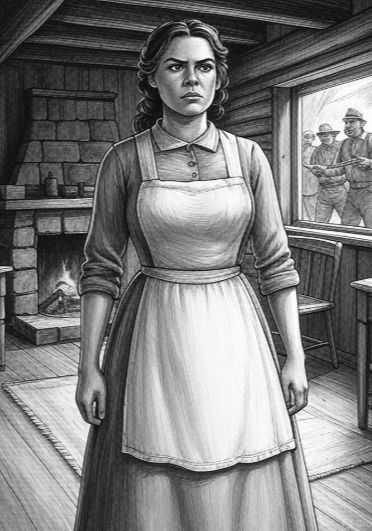
Churby proved a formidable frontier woman, her resilience shining through in a post-Civil War incident when salt, a scarce commodity, drew the attention of armed men. When they demanded the hidden seasoning, Churby, calm and resolute, invited them to search the house, knowing the salt lay concealed beneath the floorboards.
They left empty-handed, outwitted by her quiet defiance.
In 1843, Benjamin purchased 160 acres near Hindsville from Daniel Vaughan, later moving to Huntsville and eventually settling in Clifty, a rugged community north of town.
His public service began in 1848 when he was elected Sheriff of Madison County, a role he held for a decade. His civic contributions spanned decades: Representative to the Arkansas General Assembly in 1858, Sheriff and Assessor from 1867 to 1868, and again from 1876 to 1878, with additional terms as Assessor in between.
His reputation as a fearless lawman was forged through grit, wit, and an unyielding sense of justice.

One legendary tale from his sheriff days illustrates this vividly. In the southeast corner of Madison County, a father and his two sons, notorious hog thieves--a crime considered among the basest in frontier Arkansas--had evaded arrest. Warrants were issued, but when a deputy ventured into their territory, the armed trio fled to the hills, vowing to shoot any lawman who pursued them.
Known as dead shots with their squirrel rifles, they intimidated the deputy, who returned to Huntsville and warned Benjamin that the men were too dangerous to apprehend without risking lives.
Undeterred, Benjamin set out alone the next morning, warrants tucked in his saddlebags, unarmed. It was July 4th, and he knew the community would be gathered for a celebration at a big spring near King Fork of Kings River. Suspecting the fugitives would blend into the crowd while keeping watch for strangers, Benjamin rode boldly into the gathering, dismounted, and tied his horse to a tree.

Recognized at once, he exchanged handshakes and rough jokes with the locals as a few wary figures slipped into the timber. Then, a tough, bewhiskered man--the father of the thieves--pushed through the crowd.
“Howdy, Sheriff,” he said, extending a hand and meeting Benjamin’s gaze. “Got a warrant for me an’ the boys?”
“Sure have,” Benjamin replied.“Where’s your bodyguard and the deputies to take us to the county seat?” the man asked.Benjamin grinned, rolled up his sleeve, and flexed his arm.
“Here’s my bodyguard,” he quipped, grasping his muscle. “And I don’t need no deputies to herd you damned ridge runners into court. I’ll do it myself.”
The old man grinned back. “Ain’t you even got no gun?”
“Hell no, I don’t need a gun,” Benjamin shot back.
Stunned by his audacity, the trio surrendered on the spot. Benjamin tucked the warrants and bonds into his saddlebags, shook their hands, and warned, “When the September term of court comes around, every one of you damned polecats better be there, or I’ll come back and horsewhip you all the way to Huntsville.”

“We’ll be there,” the old man promised.When September arrived, the father and his sons appeared in court, pleading guilty to the charges.
Given the arduous journey to the penitentiary in Little Rock, the prosecuting attorney recommended a jail sentence. Benjamin, responsible for feeding the prisoners, called the father over.
“If you think I’m gonna carry grub from my house to you and your worthless sons in jail, you’re crazy,” he said. “I’m makin’ you the jailer. Feed ‘em yourself or let ‘em starve. Here’s the key--lock ‘em up and don’t let ‘em escape.”
The father took the key, and the three served their sentences without incident.
“This proves,” Benjamin later reflected, “that in the old pioneer stock, a man’s word of honor was as good as his bond, and there was even a code of honor among hog thieves.”
Benjamin and Churby raised seven children in Madison County, their legacy woven into the region’s history. One son, Benjamin Franklin “Ben” Vaughn, lived to 92, passing in 1953 in Clifty.
Benjamin died on April 7, 1903, and was buried in the Clifty Cemetery beside Churby, who had preceded him by a decade.


