Stone Gardens: From the Mississippi pines to Logan County, the Blair family is a story of untold perseverance
- Dennis McCaslin

- Jul 6, 2025
- 3 min read
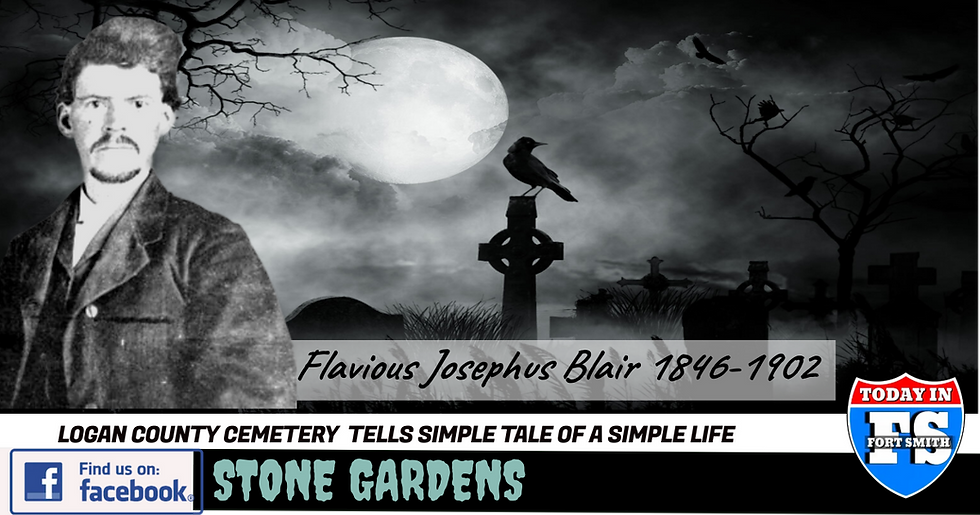


In the Pine Log Cemetery in Barber, Logan County, rests a man whose life spanned the most turbulent and transformative decades in American history in relative obscurity. Though his name may not appear in textbooks, his story, and that of his family, echoes the quiet perseverance that built the American South.
Flavious Josephus Blair--known to kin and community as “F.V.--was born on New Year’s Day, 1846, in Neshoba County, Mississippi. Flavious was the fifth of at least seven children born to Samuel Blair and Hannah Crawford McCrory Blair, a couple of North Carolina stock who migrated westward in the early 19th century.
The Blairs were part of a wave of settlers who carved homesteads from the piney woods of Mississippi, bringing with them the values of hard work, faith, and family.
The Blair household was a lively one. His eldest sister, Jane Gertrude Blair, born in 1830, would live to see the end of World War I. She married into the Moore family and became a matriarch in her own right.

Mary Ann Blair, born in 1835, married into the Kea family and passed away just before the turn of the century.
Charles Hargis Blair, born in 1849, and Allen Walker Blair, born in 1853, would both outlive Flavious by decades, carrying the family name into the 20th century.
Together, these siblings formed a constellation of kinship that stretched across Mississippi and into Arkansas, each one a thread in the broader fabric of Southern resilience.
The 1850 census captures a snapshot of the Blair family in Neshoba County: Samuel, a 53-year-old farmer; Hannah, his industrious wife; and their children, ranging from young adults to toddlers.
By 1860, Samuel had passed away, and Hannah was listed as head of household--a quiet testament to the strength of frontier women. Flavious, then just 14, came of age in a nation on the brink of civil war.

Though no military record has yet surfaced, it’s likely that the war years left an indelible mark on young Flavious. In the decades that followed, he married Tennesse "Tennie" Moore, a woman born in 1852 whose name hints at the family’s Southern roots.
Together, they raised five sons: Franklin Lafayette, Allen Parker, Henry Alfred, James Flavius, and Will Newton. These boys would grow up in the post-Reconstruction South, their lives shaped by the legacy of their father’s generation.
By the 1890s, the Blairs had resettled in Logan County as part of a broader migration of Southern families seeking new beginnings in the Ozark foothills. Tennie passed away in 1893, and Flavious followed her in 1902 at the age of 56. He was laid to rest in Pine Log Cemetery, a quiet resting place for many of the region’s early settlers.
But the story doesn’t end there. The Blair siblings—Jane, Mary Ann, Charles, Allen, and Flavious—represent a family that weathered war, westward migration, and the slow grind of rural life with dignity and determination.

Their lifespans alone tell a story of endurance:
🕊️ Jane Gertrude Blair Moore (1830–1918) lived 88 years, witnessing the rise and fall of the Confederacy, the Reconstruction era, and the final days of World War I.
🕊️ Mary Ann Blair Kea (1835–1892) lived 57 years, spanning the antebellum South and the Gilded Age.
Flavious Josephus Blair (1846–1902) lived 56 years, raising a family in Arkansas during the postwar rebuilding of the South.
Charles Hargis Blair (1849–1929) lived 80 years, into the Roaring Twenties and the age of the automobile.
Allen Walker Blair (1853–1920) lived 67 years, bridging the agrarian 19th century and the industrializing 20th.

Together, their lives stretched from the early 1830s to the end of the 1920s—nearly a full century of American transformation.
Their descendants, scattered across Arkansas and beyond, are living proof that legacy is not always measured in monuments, but in memory.
When we walk the rows of Pine Log Cemetery and trace the names etched in stone, we are reminded that every family has its storytellers, its survivors, and its silent heroes.
In the case of Flavious Josephus Blair and his siblings, theirs is a story worth telling.


