Stone Gardens: Drunken Saturday night fall from horse near Eureka Springs train depot led to death of local resident
- Dennis McCaslin

- Jun 5, 2025
- 3 min read
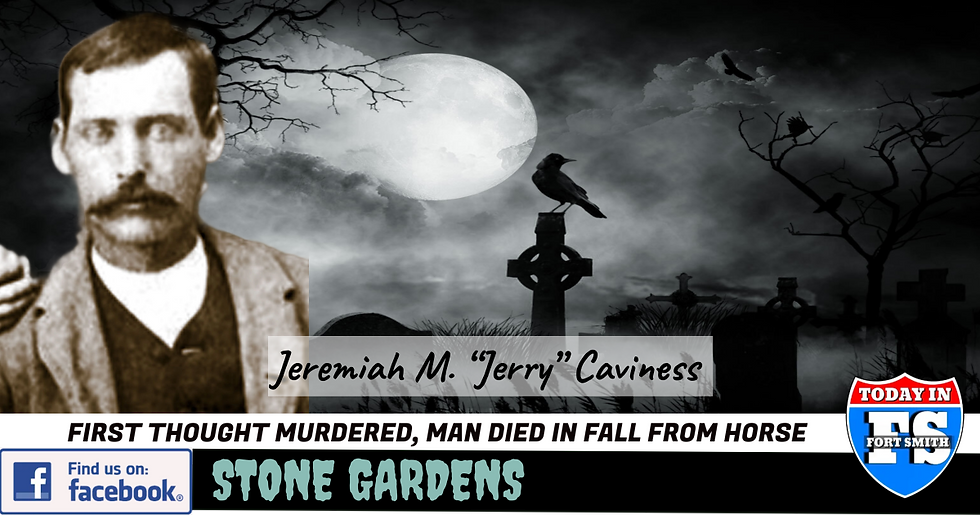


In Eureka Springs the IOOF Cemetery stands as a testament to the town’s rich history, its headstones whispering stories of lives long past.
Among them lies Jeremiah M. “Jerry” Caviness, a man whose life and untimely death in 1895 left an indelible mark on this vibrant community.
Born on April 13, 1857, in Keokuk County, Iowa, Jerry’s journey from the Midwest to the Ozarks ended in tragedy, a story preserved in newspaper accounts and a new gravestone erected by his great-grandchildren in 2018.
Jerry Caviness was the son of John Caviness (1814–1892) and Susannah Poe Caviness (1813–1878), part of a large family with deep roots in Iowa.
One of eight known siblings, including Rev. Joab Caviness and Alfred B. Caviness, Jerry grew up in a time of westward expansion and opportunity.
In 1878, at age 21, he married Martha A. Kirk in Henry County, Iowa, and together they raised four children: Joseph Alfred, John William “Jack,” Minnie Louisa, and Maude Ann.

After Martha’s death in 1891, Jerry married Lulu Belle Dover Agnew in 1892, welcoming two more children, Benjamin Weaver “Weed” and Gay Alberta. His life was one of family connections but it was in Eureka Springs that his story took a fateful turn.
By the 1890s, Eureka Springs was a bustling resort town, famed for its healing mineral springs and attracting settlers, tourists, and dreamers alike. Jerry, like many, may have been drawn to the town’s promise of prosperity or health, though the exact reasons for his relocation from Iowa remain unclear.
What is certain is that on September 21, 1895, at the age of 38, Jerry met a tragic end that shook the community. A report from the Times-Echo, preserved by descendant Patricia Caviness Perkins, recounts the harrowing details.

That Saturday evening, as dusk settled over Eureka Springs, word spread that a man had been murdered and placed on the railroad tracks near the depot to conceal the crime. A crowd gathered as officers investigated, only to find Jerry’s body with a broken neck, a deep gash across his forehead, and another from his mouth to his chin.
His horse, found nearby, was bruised and bleeding, hinting at a violent accident. The initial suspicion of foul play gave way to a grim realization: Jerry, who had been drinking heavily that day, had likely been thrown from his horse onto a railroad trestle just below the depot.
The inquest verdict confirmed this, noting $11.08 in silver found in his pockets, dispelling robbery rumors. Earlier that day, Jerry had withdrawn $225 from the Citizens Bank, entrusting $100 to an attorney, A.N. Matthews, before his fateful ride.
The Times-Echo painted a vivid picture of Jerry’s final moments: after causing a disturbance and evading arrest by policeman Willis, he galloped down Main Street on his horse, possibly too intoxicated to navigate the treacherous path near the railroad. The article noted this was the third alcohol-related death on that road in less than a year, a sobering reminder of the era’s challenges with liquor and safety.
Jerry’s death left behind a grieving family, including his young children and second wife, Lulu Belle, who outlived him by decades, passing in 1976 at age 104.

His legacy endured through his six children, whose descendants honored him with a new gravestone in the IOOF Cemetery on October 16, 2018.
Today, the IOOF Cemetery remains a focal point of Eureka Springs’ heritage, hosting events like the “Voices from Eureka’s Silent City” tours, where visitors hear the stories of figures like Jerry Caviness. His life, though brief, reflects the hopes and hardships of a town in its heyday, a place where dreams of a better future often met the harsh realities of the frontier.


