Stone Gardens: Depite the turmoil and strife of the Civil War, a Union soldier found his final resting place near foes
- Dennis McCaslin
- 4 minutes ago
- 4 min read


We all know that Stone Gardens hold histories and memories--men who died on both sides of the conflict between the North and the South are buried throughout the various cemeteries in Carroll County, and the historic Denver Cemetery is no exception.
In Denver Cemetery itself, Confederate graves (such as those of John Avery, S. A. Beck, George W. Capps, and others) stand near Union markers. The grounds serve as a quiet testament to post-war reconciliation, where former enemies and their families farmed side-by-side, raised children together, and eventually shared the same hallowed ground.

Leroy Green Ayers’ own marked grave as a Union veteran stands as a powerful counterpoint--reminding visitors that even in a predominantly Confederate-leaning county, individual convictions and border-state complexities created a mixed military heritage.
The county is home to a significant number of Confederate veterans, with documents detailing dozens of Southern soldiers laid to rest across Carroll County’s many rural cemeteries. In total, more than 160 Confederate veterans are known to be buried in the county, reflecting the strong Southern sympathy that prevailed in much of the region despite the presence of Unionist pockets like Leroy Green Ayers and his comrade
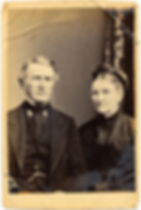
Leroy Green Ayers was born on June 16, 1827, in Lincoln County, Tennessee, to Baker William Ayers and Elizabeth B. Clark.
Baker William Ayers was born on November 23, 1804, in Franklin County, Georgia, the son of Amon O. Ayres (born about 1775 in North Carolina) and Nancy Payne. Amon was in turn the son of Rogimalick Baker Ayers (born about 1750 in Pittsylvania County, Virginia), whose family had deep roots in colonial Virginia.
This Ayers line reflects the broader southward and westward migrations common among early American families seeking land and opportunity, moving from Virginia through Georgia into Tennessee.
Elizabeth B. Clark, born in 1808 (likely in North Carolina), married Baker around 1823 or 1824 in Lincoln County, Tennessee. She died in 1858.

Leroy grew up in a farming family amid the rolling hills of middle Tennessee. As a young man he married Mary Elizabeth Lewis, and together they began raising a family that included Orlena Miriland (Lena), Rufus Childress, George W., and William Alvin Ayers
. Life in Lincoln County revolved around agriculture, but the gathering clouds of sectional conflict would soon upend the family's world.

When the Civil War erupted, Leroy enlisted as a private in Company K of the 1st Arkansas Cavalry (Union). Like many Southern Unionists from border regions, he joined a unit composed largely of Arkansans and Tennesseans who opposed secession.
The regiment saw extensive action across northwest Arkansas and southwest Missouri, participating in the Battle of Prairie Grove, operations against Confederate raiders, and numerous skirmishes to secure the region. Leroy served through the hardships of guerrilla warfare and frontier campaigning until the wars end.
After the conflict, like many veterans seeking new opportunities and fresh land in the recovering South, Leroy and his family joined the broader post-war migration.
Mary Elizabeth died in 1863, likely during or shortly after the war's hardships. By the late 1860s they had relocated to Carroll County, Arkansas, settling near the community of Denver in the Ozark foothills. In 1866 Leroy married his second wife, Rachel Drucilla Wheat Sullivan. They raised additional children together, including Cordelia, Geneva (Genevia), Leroy Larue, Leander Green, and Etta Mae.
The area that became known as Denver lies along Long Creek near its confluence with Dry Creek in northwestern Carroll County. White settlement in this part of the Ozarks began in the 1830s, shortly after Carroll County was established on November 1, 1833, and named for Charles Carroll of Carrollton, a signer of the Declaration of Independence
.Early development included mills on Long Creek; Malachi Reeves constructed one near the future Denver site by 1836. The community was originally called Old Salem before taking the name Denver. A post office opened on August 11, 1884, with Willis F. Miles (a Confederate veteran) as postmaster; it operated intermittently until the 1960s. Early settlers included families like the Gaddys, and by the late 19th century Denver featured a general store, hotel, I.O.O.F. Lodge #542 (chartered 1908), and a tight-knit rural farming community.
It remained a classic Ozark crossroads settlement, supporting families through agriculture, milling, and neighborly cooperation in the post-Civil War era.
In Arkansas the Ayers family established roots as farmers. Leroy acquired land through homestead and cash entries in the area (Township 20 North, Range 22 West), contributing to the post-war settlement of Carroll County. The Ayers household became part of the tight-knit rural community centered around Denver.
Leroy lived out his remaining years tending his farm and family in this new home. He died on February 19, 1882, at age 54 in Denver, Carroll County, Arkansas. He was laid to rest in Denver Cemetery, where a marker honors his service as a Union veteran. Rachel survived him until 1910 and rests nearby.
Through two marriages and the trials of war and relocation, Leroy Green Ayers embodied the resilience of 19th-century Southern families. His journey from the farmlands of Tennessee to the hills of northwest Arkansas, building on the migratory legacy of his Virginia-Georgia-Tennessee ancestors, left a lasting imprint on the region, with descendants continuing to honor the family's pioneer and military heritage in Carroll County and beyond.
