Stone Gardens: Craig County politician with unique name served as mayor of Vinita and in the state senate in the 1940's
- Dennis McCaslin

- Apr 22
- 5 min read
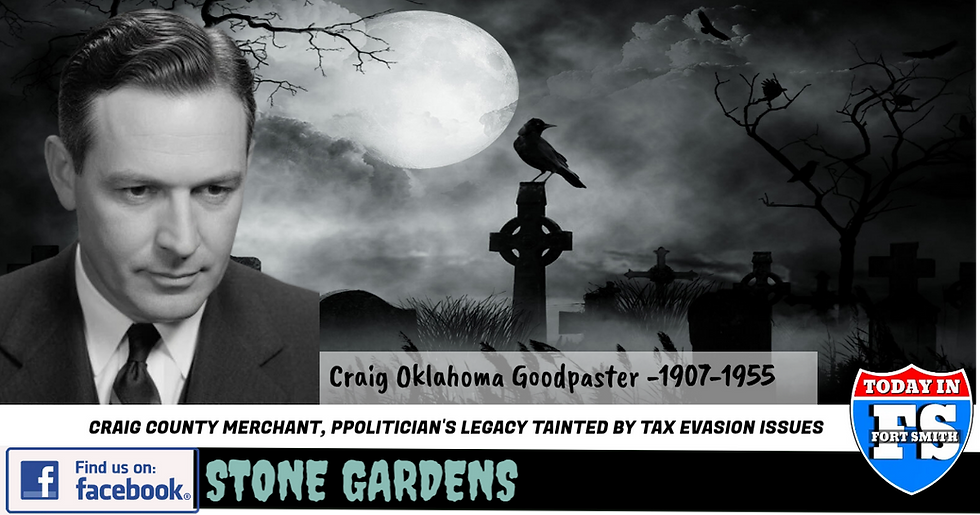


Born on November 20, 1907, in Vinita, (Craig County), Craig Oklahoma Goodpaster entered the world at a pivotal moment in state history. He was reportedly the first white child born in Craig County after Oklahoma achieved statehood on November 16, 1907.
His distinctive middle name--“Oklahoma”--reflected this unique distinction and tied him symbolically to the young state's identity.
His parents were Charles Herbert Goodpaster (1879–1940), who had roots tracing back to Missouri before settling in the region, and Belle Goodpaster (1886–1980), a longtime Vinita resident who outlived her son by many years.
Craig grew up alongside siblings, including brothers Francis C. Goodpaster (1909–2002), a decorated World War II veteran, Craig County commissioner, postmaster, and community leader for whom the Vinita post office was later named, and Herbert K. Goodpaster (1905–1976).
The family established deep roots in Vinita and the surrounding Craig County area, where agriculture, ranching, and small-town commerce defined daily life. Details of Goodpaster’s formal education remain sparse in surviving records, but like many young men of his era in rural Oklahoma, he attended local public schools in Vinita before entering the workforce.
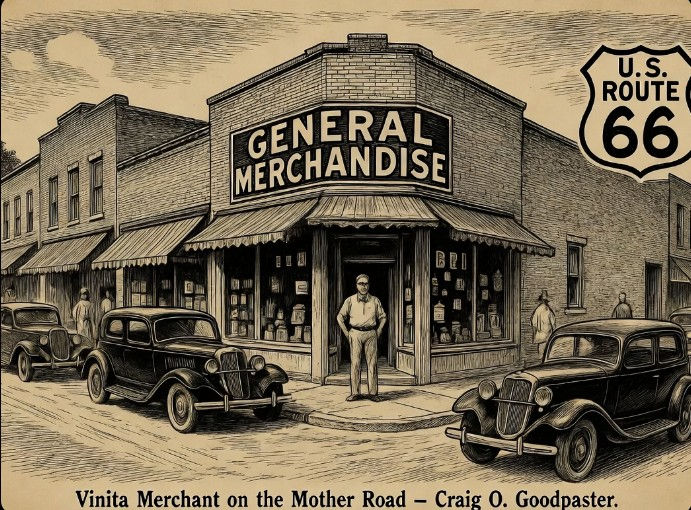
By adulthood, he had become a successful merchant in Vinita, operating businesses that served the agricultural and retail needs of Craig and neighboring Mayes counties. His entrepreneurial spirit aligned with the booming post-statehood economy along historic Route 66, which passed through Vinita and connected the community to broader opportunities.
In his personal life, Goodpaster married Olive Lavange Allen (1908–1998), a union that anchored a large and active family. Together, they raised six children on a ranch west of Centralia in Craig County, blending merchant life with rural traditions.
Their children included:
Charles Allen Goodpaster (1929–2005)
Marguerite Goodpaster Shelton
Sarah “Sally” E. Goodpaster Brandeberry (1932–2020)
Jane Ola Belle Goodpaster Snedden (1934–2019), who graduated from Vinita High School in 1952, attended Principia College and Oklahoma State University, taught elementary education, served as Will Rogers Memorial Rodeo Queen in 1951, and remained deeply involved in local ranching and Christian Science activities
James Delano “Jimmy” Goodpaster (1940–2011), who became a judge serving Northeast Oklahoma and a proud Oklahoma State University alumnus and University of Tulsa College of Law graduate
Another son, often referred to in contemporary accounts as “Peachy” (likely a nickname for one of the younger boys at the time of his father’s death)
The Goodpaster household was known for hospitality, with Jane later recalling her mother feeding cowboys and visitors at the family ranch. The children’s later accomplishments--in education, law, teaching, and community involvement--reflected the values of hard work and public service instilled in the home.
Olive survived her husband by more than four decades, passing away in 1998.

Goodpaster’s political career began locally and rose to the state level. He served as mayor of Vinita around 1937, a role in which he addressed municipal needs in a growing railroad and highway town. His leadership earned him broader recognition, leading to his election as a Democratic state senator representing District 29, which encompassed Craig and Mayes counties.
He served in the Oklahoma Senate during the 1940s and into the early 1950s (notably listed in rosters for sessions including the 19th through approximately the 23rd–24th legislatures).
As a senator, he collaborated on legislation affecting rural Oklahoma, including issues relevant to agriculture, commerce, and local governance. Colleagues remembered him as a practical voice for his constituents along the prairie and Route 66 corridor.
While Goodpaster built a reputation as a successful Vinita merchant, mayor, and Democratic state senator representing Craig and Mayes counties, his public life was not without controversy.
According to a contemporary newspaper account from the period between 1937 and 1955, Goodpaster was charged with federal income tax evasion related to his business operations in Vinita. The case centered on allegations that he had failed to report or properly account for taxable income generated through his merchant activities, which included retail and commercial enterprises serving the agricultural community and Route 66 travelers.
Such charges were not uncommon in the post-Depression and wartime eras, when federal tax enforcement intensified and small-business owners faced heightened scrutiny over record-keeping and filings.
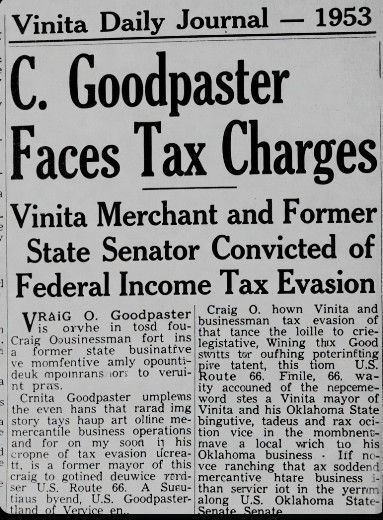
Goodpaster was ultimately convicted on the tax evasion charges. The conviction, while drawing local attention in Craig County and northeast Oklahoma newspapers, appears to have been handled as a relatively contained legal matter rather than a high-profile national scandal.
Details in the reporting emphasized his status as a former public official, which may have amplified interest in the case among constituents who viewed him as a representative of small-town commerce and governance.
At the time, Goodpaster had already stepped away from active Senate service and was focusing on his merchant businesses and family ranch west of Centralia. The legal proceedings occurred in the years leading up to his untimely death in 1955, adding a layer of personal and professional strain during what should have been a period of continued community leadership.
Tragedy struck suddenly on November 22, 1955--just two days after his 48th birthday. While driving west of Vinita on U.S. Route 66, Goodpaster was killed instantly in a collision with a truck approximately seven miles west of town.
Contemporary newspaper accounts described the accident as a head-on or side-impact crash that claimed his life at the scene. Oklahoma Highway Patrol investigations at the time noted the hazards of the busy highway, which carried heavy commercial and tourist traffic through Craig County.
The loss reverberated through Vinita and the surrounding communities, where Goodpaster was known as a respected businessman and former public servant.
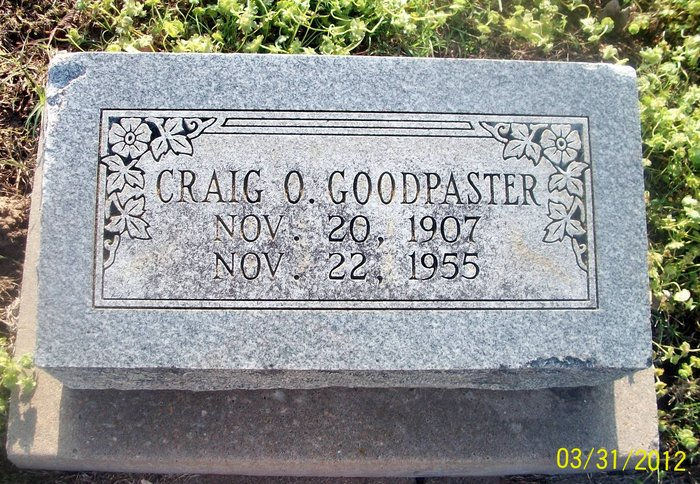
Funeral services for Craig O. Goodpaster were held in Vinita, directed by the local Burckhalter funeral home. He was laid to rest in Fairview Cemetery in Vinita. His gravesite remains in the community he served, near family members including his parents and siblings.
Goodpaster’s legacy endures through his family’s continued contributions to Northeast Oklahoma. His children and grandchildren pursued careers in education, law, ranching, and public service, carrying forward a tradition of community involvement
. Brother Francis’s own extensive civic record--veteran, postmaster, commissioner, and philanthropist--further amplified the Goodpaster name in Vinita.
Craig’s brief but impactful political tenure exemplified the mid-20th-century Oklahoma ideal of local merchants stepping into governance to advocate for rural districts. Though his life was cut short, he represented a generation that helped shape Craig County in the decades following statehood: bridging agriculture and commerce, local politics and family values, and the optimism of a young state with the realities of highway travel and small-town life.In an era when Route 66 symbolized mobility and progress, Goodpaster’s story also serves as a poignant reminder of its dangers.
His name, bestowed at birth to mark Oklahoma’s statehood, now rests in the soil of the county that bore the same pioneering spirit.
Decades later, the Goodpaster family’s deep ties to Vinita, Centralia, and Craig County continue to reflect the quiet, steadfast contributions of families who built and sustained Oklahoma’s heartland communities.\


