Stone Gardens: An itinerant poet with Arkansas roots saw his words published across a cross-section of states
- Dennis McCaslin

- 12 minutes ago
- 2 min read
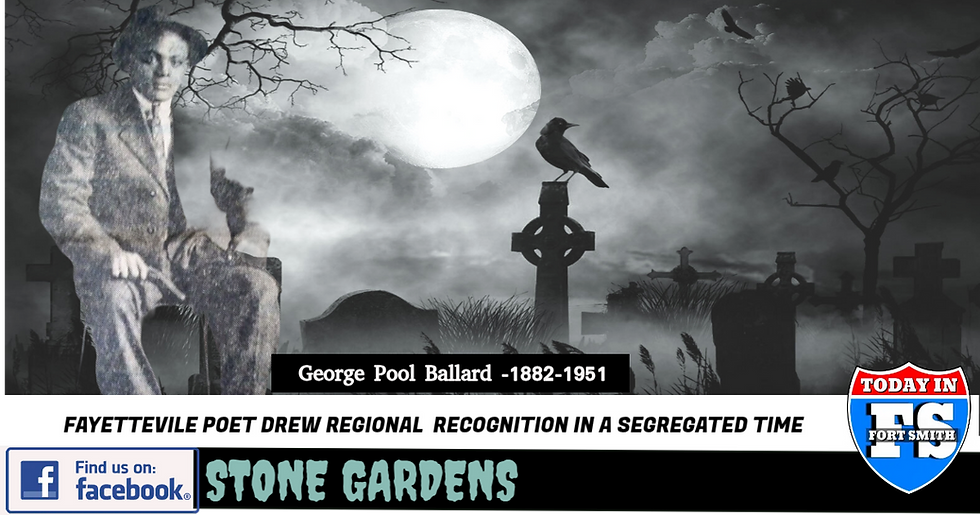


One unmarked gravesite in a cemetery once segregated by time, history, and a culture defined by the aftermath of the American Civil War holds the remains of George Pool Ballard. Oaks Cemetery in Fayetteville, Arkansas, became the resting place for many of the city’s African American citizens in the decades after emancipation, and here Ballard lies without a marker.

He was born on January 4, 1882, on his parents’ small farm near the rural community of Cincinnati in western Washington County. Public schools for African Americans did not exist in that part of Arkansas then, so he probably received no formal public education. Little else is known of those early years.
By 1902 he had moved to Fayetteville. On March 6 of that year he married Rosetta Dart. The couple lived on East Mountain Street in the traditionally Black neighborhood known as Tin Cup. Ballard supported them through a series of practical jobs.
He worked as a janitor at the county jail, operated a shoeshine parlor, and later served as an auto mechanic.
In the early 1920s his poetry began appearing in the Fayetteville Daily Democrat, edited at the time by Lessie Stringfellow Read.

The paper gave him a public platform rare for an African American writer under segregation. His most widely noticed piece, “Woodrow Wilson--A Tribute,” was published on February 6, 1924, three days after the former president’s death.
It was reprinted in newspapers in other parts of the country, and complimentary letters arrived from readers across the nation. The editors continued to label him with phrases such as “Negro Singer,” “Negro Poet,” or “Colored Versifier.”
In 1928 Read oversaw the publication of his collection Ozarks “Ballards,” issued by the Democrat Publishing Company to help pay the mortgage on his home. In her foreword she offered support while also stating that “there is claimed for his work no serious literary worth” and that Ballard “knows nothing of the techniques of writing.”

The poems themselves show skilled use of rhyme, meter, and verse forms. Most are accessible pieces written for a general audience, commenting on local events such as the centennial of Fayetteville, the marriage of the mayor, Prohibition, the seasons, and holidays. A few, among them “The Toiler Speaks” and “A Broken Promise,” offer more pointed reflections on race and labor.
Ballard continued to publish occasional poems in the Daily Democrat and later the Northwest Arkansas Times. He attended sessions of the University-City Poetry Club hosted by Rosa Zagnoni Marinoni. On May 21, 1936, the library of Fayetteville’s new Lincoln School for African American students was dedicated as the George Ballard Library.

In later years he shined shoes at Camp Chaffee during the Second World War and made trips to Los Angeles to visit family. He died on December 3, 1951. His body was placed in an unmarked grave in Oaks Cemetery, the burial ground established soon after the Civil War on land set aside for the African American residents of Washington County.
The poems remain as the clearest record of a life of steady observation and careful craft lived within the limits of his time and place.