Stone Gardens: An editorial crime-fighter spent four years serving Oklahoma’s Second Congressional District
- Dennis McCaslin

- 3 minutes ago
- 2 min read
T


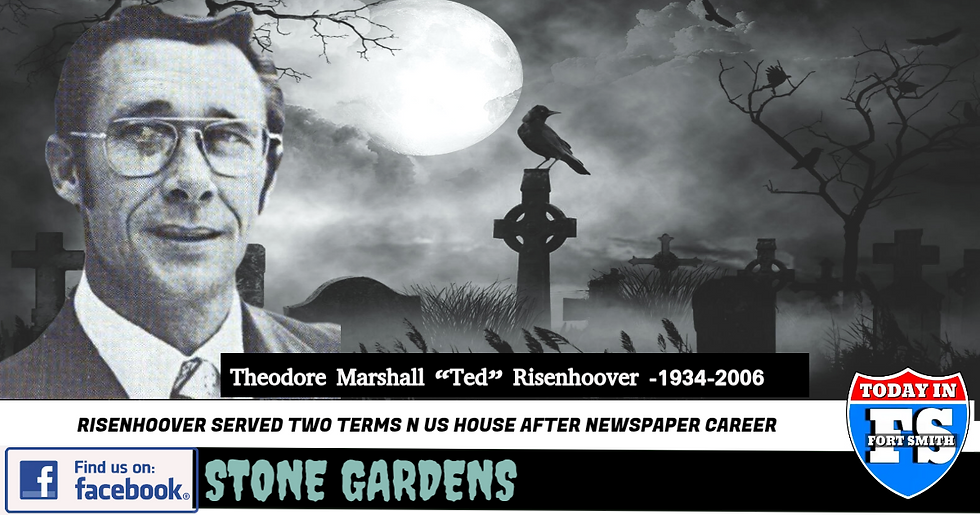
Theodore Marshall “Ted” Risenhoover was born on November 3, 1934, in the small Haskell County community of East Liberty near Stigler,.
The son of Jacob and Allene Westbrook Risenhoover, he graduated from Stigler High School in 1952.
He worked briefly for Western Electric before enlisting in the U.S. Air Force, serving from 1955 to 1963. While in the military, he studied government and economics at the University of Alabama. A
AThe fter his discharge, he returned to Oklahoma and earned a bachelor’s degree in business administration from Northeastern State College in Tahlequah in 1965.

Before finishing college, Risenhoover entered the newspaper business in Tahlequah.
He became part-owner and president of the Pictorial Press and later acquired the Tahlequah Star-Citizen. Known for aggressive reporting on organized crime in northeastern Oklahoma, his efforts drew real danger-- the Pictorial Press office was bombed.
His work on the issue led to an appointment on the Oklahoma Crime Commission, where he served from 1970 to 1974.

Risenhoover was elected as a Democrat to the U.S. House of Representatives from Oklahoma’s Second Congressional District
in 1974. He served two terms (1975–1979), focusing on issues affecting southeastern Oklahoma such as agriculture, ranching, flood control, economic development, and improvements tied to the McClellan-Kerr Navigation System and area reservoirs.
He sponsored or supported measures including legislation related to the Osage Tribe, statute of limitations on certain federal claims, and a joint resolution designating Native American Awareness Week.

No major personal or political scandals marked his congressional record, though a 1978 Washington Post lifestyle article describing his Washington townhouse -- including a heart-shaped waterbed -- was weaponized by challenger Mike Synar’s campaign. Copies of the story were widely distributed, contributing to questions about his image and helping Synar win the Democratic primary.

Risenhoover was married and divorced three times and had a son and a daughter.
After leaving Congress, he worked at the Pentagon and later for the House doorkeeper before returning to Oklahoma, where he continued in various roles and eventually sold his newspaper interests.
He died on September 10, 2006, in Claremore, Oklahoma, and was buried at Fort Gibson National Cemetery.
From Choctaw Nation roots through coal mining, railroads, and the modern reservoir era , Risenhoover was one of the local figures who served both in uniform and in public office while staying connected to the land along the South Canadian River and Kerr Reservoir.


