Stone Gardens: A twenty-six year-old left the comfort of his Massachusetts home to minister to the Osage and Creek
- Dennis McCaslin

- 6 minutes ago
- 2 min read


Rev. Epaphras Chapman was born on April 25, 1792, in East Haddam, Middlesex County, Connecticut. He married Hannah Eliza Mansfield Fowler on September 20, 1820. Hannah was born in 1800 in Northford, Connecticut, the daughter of Deacon Solomon Fowler and Olive Douglas Fowler.
In 1819 the United Foreign Missionary Society chose Chapman, a young Congregational minister, as its first missionary to the Osage Nation. He and Job Vinall traveled west to select a site. In 1820 Chapman led a group of missionaries and their families to the Neosho River in what is now Mayes County, Oklahoma, and established Union Mission.
The mission became the first Protestant station in present day Oklahoma. Its goals included educating Osage children, teaching farming methods, and sharing Christian teachings

. The small community built log structures, started a school that enrolled both Osage and Creek children, and worked the surrounding land.
Chapman preached, managed operations, and helped guide daily life at the outpost. Hannah accompanied him and shared in the work. Their time together on the frontier lasted only a few years.

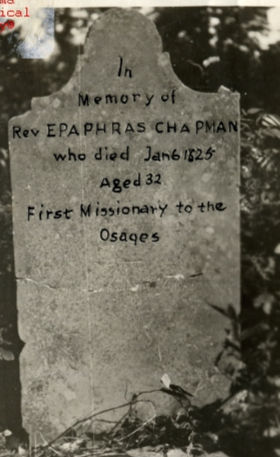
Chapman died on January 7, 1825, at the age of 32. He was buried in the mission cemetery.
His gravestone identifies him as the first missionary to the Osages and carries the inscription "Stay among the heathers, the Lord reigneth." A later monument placed on the outside of the tomb by Northeastern Teachers College in 1832 further marks his grave.
Hannah returned east after his death. She died on June 17, 1843, at age 43 and is buried in Southwick Cemetery in Southwick, Massachusetts.
Union Mission operated for more than a decade after Chapman's death. It served as an educational and religious center until it closed in the mid 1830s amid shifting tribal policies and the removal era. The associated cemetery, now known as Union Mission Cemetery, contains some of the oldest marked burials in northeastern Oklahoma.
I
ts location near the Verdigris and Neosho rivers places it in a historically significant area where Osage lands met early American missionary efforts. The site witnessed the first Protestant mission, the first school, and early recorded marriages in the region.
Today, the cemetery stands as a quiet record of those beginnings.
Chapman's grave remains its most prominent feature and serves as a direct link to the personal sacrifices of the missionaries and the broader history of cultural exchange and settlement in Indian Territory.
The modest markers and surrounding landscape preserve the memory of a short lived but foundational effort in Oklahoma's early 19th-century history.


