Stone Gardens : A quiet cemetery in the Graphic community hosts the final remains of an Illinois nurseryman


was born on a farm near Maeystown, Monroe County, Illinois, on November 8, 1861, while the Civil War was already tearing the country in two. The family called him Ike.
He was the son of John L. Anglen, a Virginia-born farmer whose people had crossed the mountains from the Tygart Valley, and Mary Elizabeth Erwin, an Illinois girl barely twenty when Ike was born.
The surname itself told a longer story. In the hills of what became West Virginia the family was Anglin.
When Samuel Anglen left Philippi for the bottomlands along the Mississippi, he took a new spelling with him. Nancy, who stayed behind, kept Anglin. Ike grew up on the Illinois side of that split.

The Anglen's had been on Monroe County soil since the late 1830s, when Ike’s grandfather Isaac bought land near Maeystown and put down a stone that still read, years later, that he had lived sixty-four years, four months, and fourteen days.
That older Isaac had married Lydia Cade in Randolph County, Virginia, in 1823 and followed his father Samuel west.
Samuel’s father William had kept a ferry and an ordinary on the Tygart. William’s father Adrian had arrived in Virginia in 1717 as an indentured servant and died an old constable in the Piedmont. Ike did not need the pedigree. He needed a living.
In 1870 the census taker found the household still in Monroe County. John was forty-one, Mary Elizabeth thirty. Harriet was thirteen. Ike was ten. Then came Cora, William, and little Mary.
A hired girl and a farmhand named William Irwin, almost certainly Mary’s brother, rounded out the place.
John’s will, written that October, named his wife and his sons Isaac Newton, William Thomas, and Joseph. It was the last quiet inventory of a life that would not last.
About 1874 John moved the family to Carrollton in Carroll County, Missouri, and died there at forty-five. No one later could say why they had gone or how he diied.
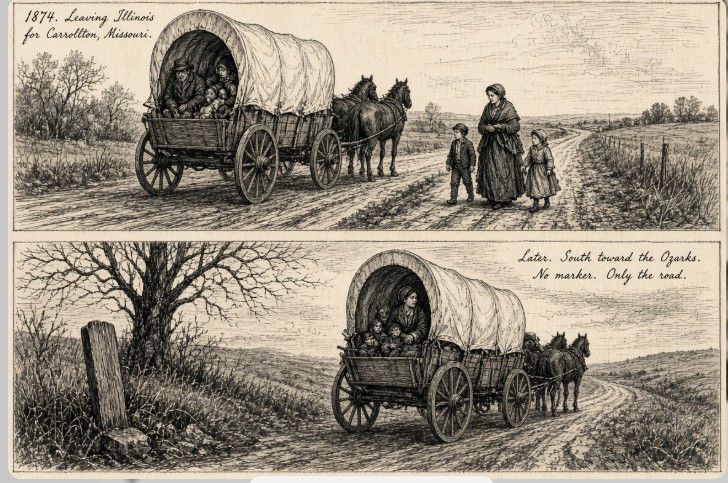
.His grave was never marked in a way the family could find. One child stayed in Missouri. Mary Elizabeth married Benjamin Rust and took the rest of the children south into Crawford County, Arkansas. Ike was a boy of twelve or fourteen when the Ozarks closed around him. His mother died in that county in 1885, the same year he married.
Margaret Jane Langston was eighteen, born in Izard County on January 2, 1867, and brought to Crawford County as a toddler. Her people were Samuel Langston and Mary Bostick. Ike called her Meg, and sometimes Dutch.

They were married on July 12, 1885.
She was short, fair, and blue-eyed. The yard she kept looked, the grandchildren said, like an English cottage garden, vines on the porch lattice and cakes and pies whenever children came. Ike worked as a nurseryman. That was the trade that fit the flowers.
They settled at Graphic and stayed. Seven children lived to grow up: Sarah Isadora, called Dora, in 1888; Samuel Rollie in 1889; Edith Lucinda in 1891; Ethel Mae in 1892; Geneva Edna in 1895; Earl Granville in 1896; and Isaac Newton Jr., called Mick, in 1903. Dora kept a Bible that recorded her grandfather John’s death.
Geneva’s people later wrote down the line so it would not scatter. The 1890 census burned. The later rolls would have shown a farmer and nurseryman, a wife, and a house emptying as the children married Simmons, Satterfield, Done, Parker, and the rest. Ethel Mae died in 1938. Meg died at Graphic on February 2, 1939, at seventy-two.

Ike never wore a uniform that anyone recorded. He was three when the Civil War ended, too old for the World War drafts of 1917 and 1918, and nothing in the family papers or the county lists ties him to the Spanish-American War. His war, if he had one, was weather, orchards, and the long work of keeping a place.
He lived four years as a widower.
On March 8, 1943, he died at Graphic at eighty-one. They buried him beside Margaret in Pope Cemetery, Row 32.
The stone is there still. The boy from Maeystown had crossed Illinois and a corner of Missouri and spent nearly seventy years in the same Arkansas hills, raising trees and children, and leaving a name spelled the Illinois way on an Ozark slope.


