Stone Gardens: A prisoner exchange brought a Johnson County man back from the War to live out his life on Woods Mountain



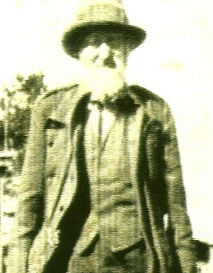
John Kilman "Crockett" Young was born November 4, 1837, in Bellefonte, Jackson County, Alabama.
He came of age on the moving edge of the cotton and livestock frontier, and by the time the country split, he was living in Arkansas, a young husband and father who would spend the rest of a very long life on the ridges of Johnson County.
Family memory and the stone at Woods Mountain Cemetery remember him as a lieutenant in Confederate service from Arkansas.
They also remember the name that stuck to him after one winter fight in the Ozarks.
A fellow officer, watching him in the crush along Telegraph Road, said he" fought like Ol’ Davy Crockett. From that day he was "Crockett" Young.
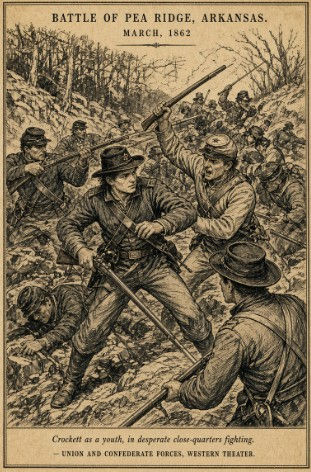
The Battle of Pea Ridge opened on March 7, 1862, in Benton County, in snow, mud, and timber. Major General Earl Van Dorn had pushed the Army of the West north in a night march meant to get behind Brigadier General Samuel Curtis and cut the Union line of supply on the old Wire Road, the Telegraph Road that ran past Elkhorn Tavern and down through Cross Timber Hollow toward Missouri.
Van Dorn split his force. Brigadier General Benjamin McCulloch’s division, Arkansas, Texas, Louisiana, and Indian Territory troops, moved on the western approach near Leetown.
Major General Sterling Price’s Missourians came down the Telegraph Road itself toward the tavern. McCulloch and Brigadier General James McIntosh were both killed on the first day. Command on that wing came apart in the woods.

Price’s column, hungry and strung out, still drove hard enough by late afternoon and evening to shove Federal troops back onto the high ground around Elkhorn Tavern and to seize the junction of Telegraph and Ford Roads.
That was the ground of the nickname. Telegraph Road was not a parade avenue. It was a rutted trace through brush, fence lines, and rocky slopes, the same corridor the Butterfield stages had used a few years earlier. When the lines closed, men fought with muskets clubbed, bayonets, and whatever came to hand.

Family account places Young in that press, a lieutenant in the melee rather than a name on a printed order of battle that has survived in easy public indexes. The Army of the West that day included Hébert’s Arkansas infantry, the 4th, 14th, 15th, 16th, and 17th Arkansas, the dismounted 1st and 2nd Arkansas Mounted Rifles, Texas cavalry and batteries, and Price’s Missouri brigades.
Johnson County had already sent companies into several of those Arkansas organizations. Whether Young’s exact company letter is lost in the scatter of Trans-Mississippi paper or simply never made the compiled service cards that genealogists now search, the local story has never wavered. He was there. He fought close. Someone who saw it reached for Davy Crockett to describe him.

The second day, March 8, Curtis massed artillery on open ground and drove the Confederates off the ridge. Van Dorn withdrew. Missouri stayed in Union hands. Most of the Army of the West was soon ordered east of the Mississippi. Family tradition says Young was later captured in Mississippi and came home in a prisoner exchange. That pattern was common enough in 1862 and 1863.
Men taken in the western theater were marched to camps, listed on rolls, and swapped when the cartels still functioned. He returned to the ranks long enough to finish the war as a Confederate lieutenant and then went back to the mountains.
By then he already had sons. William Thomas Young was born in 1860. John Price Young was born in 1862, a war baby. Albert Lewis Young followed in 1866 and Allen LaFatte Young in 1868.
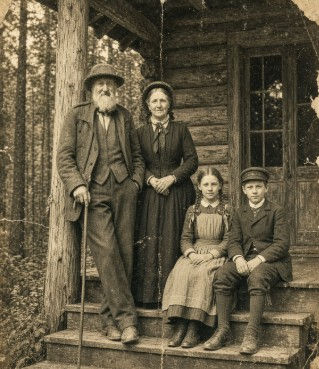
Those four names are the ones cut into the public record of his household.
He settled on Woods Mountain in Johnson County and held 160 acres there, a homestead high enough that the cemetery where he lies sits near 1,730 feet. Clarksville, the county seat, lay about eleven miles to the southwest.
The country around Hagarville and Ozone was timber, small clearings, and steep roads. He lived on that mountain into great age.
John Kilman Young died January 27, 1929, in Clarksville, at ninety-one. They carried him back up the mountain to Woods Mountain Cemetery, a small rural burying ground in the woods of Johnson County, a short way from the summit that gave it its name.
The old photograph that belongs to that stone shows an elderly man in a hat and worn suit, white beard, cane in hand, standing in a dirt yard with a wooden fence and pines behind him. It is the face of the lieutenant after the nickname had become ordinary, after the 160 acres had been walked for decades, after the four sons had grown.
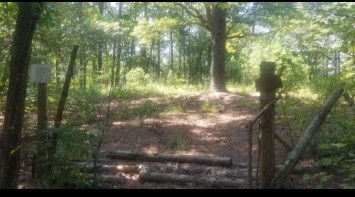
Woods Mountain Cemetery is not a landscaped city plot. It is a mountain graveyard, family stones among trees, the kind of place that keeps a county’s memory without much ceremony.
Young’s children lived long lives of their own. William Thomas died in 1938, John Price in 1940, Albert Lewis in 1941, Allen LaFatte in 1951.
The line stayed in Arkansas. The story that traveled with it was simple and specific. A boy from Bellefonte became an Arkansas lieutenant. At Pea Ridge, on Telegraph Road, in the hand-to-hand fighting of March 1862, a comrade reached for the name of Davy Crockett. He was taken later in Mississippi and exchanged. He came home, raised sons, worked 160 acres on Woods Mountain, and was buried there in January 1929.
" The photograph and the stone are what remain in plain sight. The rest lives in the way a family says the name "Crockett" Young.


