Stone Gardens : A pioneer Franklin County family lost a son on the banks of the Moselle River on September 13, 1944


In the folds of the Boston Mountains above the Arkansas River valley, Shores Township was a scatter of farms, kin, and a family burying ground that already held more Johnsons and Shores than any one household would wish to count.
Owen Johnson was born there on April 27, 1919, the last child of Thomas Jefferson Johnson and Elizabeth Shores Johnson. His father, born on October 14, 1856, was sixty-two when Owen arrived. His mother, born on April 13, 1871, near Ozark, was forty-eight.
They had already raised a houseful. Andrew Claud came in 1889, James Henry on September 6, 1891, Millie Martha in 1893, Alfred Wallace in 1895, William Riley on January 6, 1898, Effie Eula in 1900, and John Wesley in 1902.
Two little sisters, Linnie Mae and Edna, died as children. Edna was born on July 26, 1906, and died on August 2, 1907. Rosa, born on June 2, 1908, died on May 29, 1927, at nineteen.
Owen grew up in the long shadow of that older generation, a late son on land that had belonged to the Shores family before it belonged to the Johnsons.The e Shores line is the one that named the ground. Elizabeth Shores Johnson was the daughter of Alfred Wallace “Alf” Shores and Millie A. Wilson. Alf, born on February 13, 1849, in Washington County, Arkansas, married Millie in Franklin County on September 13, 1868.
He later married again, but he was buried at Shores Cemetery beside his first two wives after he died on May 10, 1933.

Alf’s parents were William Dahl Shores, born on May 12, 1804, in Surry County, North Carolina, and Elizabeth Hutchens Shores, born on October 23, 1812.
They came into the Hurricane Creek country around 1857 or 1858, took up hundreds of acres, ran a store, a mill, and, for a time, a post office called Vineland, and set aside land for a church, a school, and a graveyard.
Elizabeth Hutchens Shores, who died on May 28, 1860, is remembered as the first burial there. William D. Shores died in 1885. A later marker at the gate states that the land was donated by the families of William D. Shores and Alf W. Shores.
Owen’s mother was Alf’s daughter. When Owen came home from France, he was a great grandson of the North Carolina couple who opened the yard, and a grandson of the man whose name still sits on the stones beside the lake.

The cemetery is unlike most Ozark family yards. It sits at about 636 feet, just off Highway 215 north of Mulberry and beyond Fern, hard against Shores Lake. Hurricane Creek once ran beside the graves.
In the early twentieth century, the government took much of the old Shores timberland and dammed the valley, flooding the house site and making the reservoir that campers and swimmers still use. Engineers left the cemetery and built a rock wall along one side so the water would not take the stones.
The swimming area and campground lie only yards away. Visitors still find the names clustered: Tommy and Elizabeth, the infants, Rosa, William Riley, James Henry, Alf and Millie, and Owen.
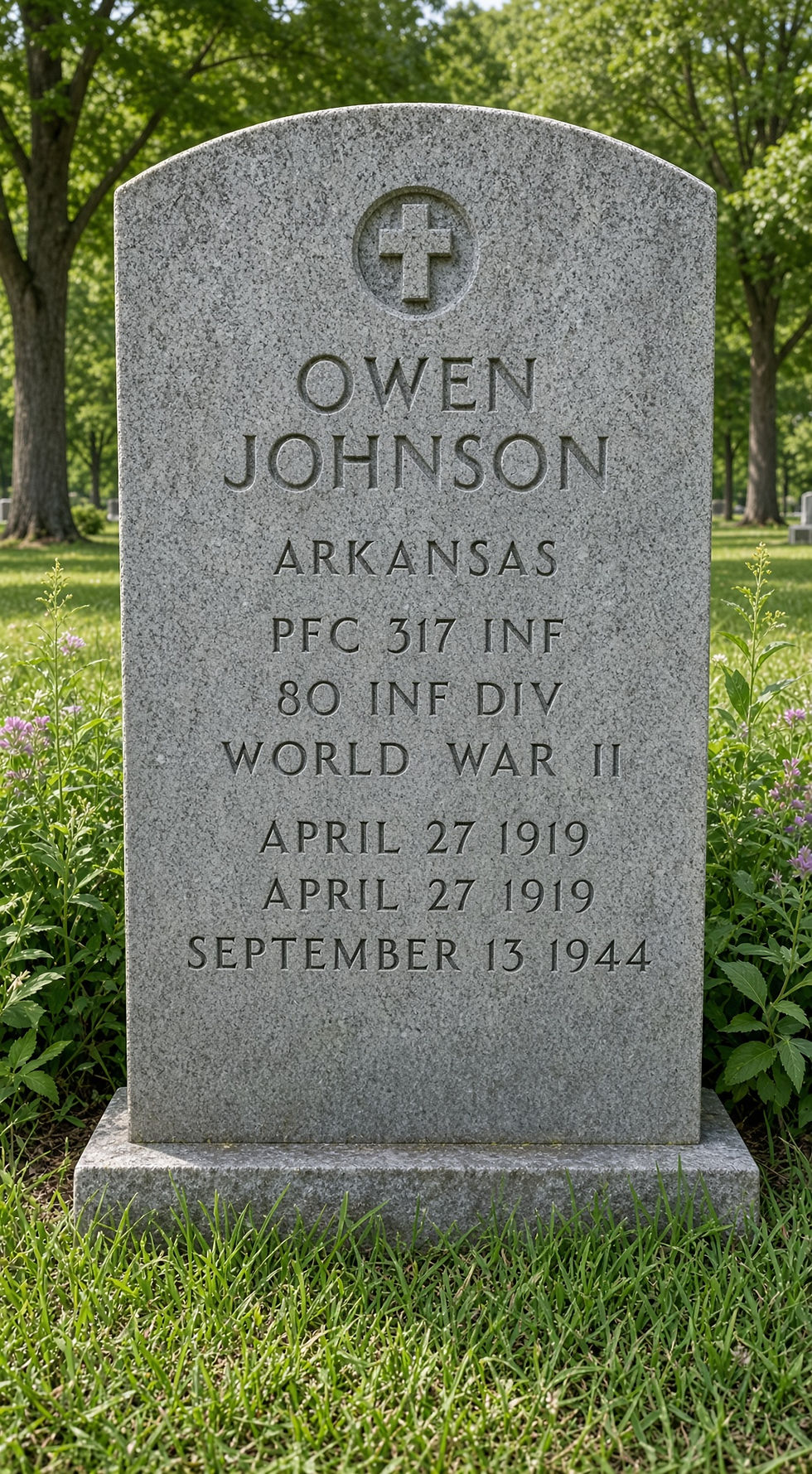
A survey taken in May 1989 caught the military line on his stone, “Ark. PFC. 80 Inf. Div. WWII,” with the dates April 27, 1919, and September 13, 1944. A later monument at the entrance names all who rest there and singles out Owen Johnson, who gave his life for his country in the Second World War.
Thomas Jefferson Johnson died on March 14, 1929, when Owen was about ten. Elizabeth stayed on in Shores Township and lived until January 13, 1960. Census records keep the boy and then the young man in that township for roughly twenty years
. The country around Cass and the lake was timber, small fields, and hard seasons. Cass itself lies a few miles east.
When the war came, Owen entered the Army of the United States and rose to private first class in the 317th Infantry Regiment of the 80th Infantry Division, the Blue Ridge Division.

After the breakout from Normandy, the division served in XII Corps of Lieutenant General George S. Patton’s Third Army. In early September 1944 the barrier in front of them was the Moselle River. First attempts near Pont à Mousson failed.
The Corps then put the 317th across at Dieulouard before dawn on September 12, 1944. The regiment forded canals and the river, took the first heights toward Sainte Geneviève, Bezaumont, and Landremont, and dug in while bridges went in behind them.
About one o’clock on the morning of September 13, 1944, the Germans struck the shallow bridgehead with infantry, assault guns, and artillery. Outposts were driven in. Other companies held Hill 382 and Landremont through the night and counterattacked at dawn.

That same day, September 13, 1944, Private First Class Owen Johnson was killed in action. Family records give the place as Mamey, in Meurthe et Moselle, in the same pocket of hills where the 317th was fighting to keep the lodgment from being thrown back into the river. He was twenty five. The 80th Division later counted 2,851 casualties for September, 437 of them killed.
No individually named valor decoration, such as a Distinguished Service Cross or Silver Star, appears in the public award lists under this Owen Johnson of Franklin County and the 317th Infantry.

What the record does show is death in combat against the enemy. Under Army practice of the time, a soldier killed in action was entitled to the Purple Heart, issued posthumously to the next of kin. Infantrymen who served in ground combat were also customarily authorized the Combat Infantryman Badge.
Those two honors, the wound medal and the infantry badge, are the awards the circumstances support. His mother Elizabeth, still living at Cass, would have been the natural recipient of any papers and medal that followed the telegram.
His body was recovered and sent home. Many men of the 80th remain in American cemeteries in Europe. The Johnsons chose the wall above Shores Lake. The stone does not tell the crossing or the night of September 12 and September 13, 1944. It tells only that a Franklin County farm boy, last of a long household and great-grandson of William D. and Elizabeth Shores, went to France with the 317th Infantry and came back to the ground those Shores had set apart before the creek became a lake.
Elizabeth outlived him by sixteen years. Brothers who had been grown men when he was a child lived on into the 1970s and 1980s.
The grave coordinates rest near 35.64035 north, 93.95763 west, among the names that map one Ozark family from the North Carolina migration of 1858 to a September morning in Lorraine.


