Stone Gardens: A family cemetery south of Vinita in Craig County holds the mortal remains of an Italian Rebel


Most people still picture the Civil War as a single American quarrel drawn along the Mason Dixon Line, Johnny Reb against Yankee, brother against brother, two native armies locked in a horror of ideology and soil.
That picture is not false. It is incomplete. A quieter truth sits in the muster rolls. Men born far from either capital also took a side and paid for it. Ireland sent the largest share of foreign born soldiers, tens of thousands in blue and a smaller host in gray. The German states sent another great wave into Union ranks. England, Scotland, and Canada added thousands more.
France, the Scandinavian countries, and Mexico contributed smaller companies and scattered privates. Italy’s numbers were modest beside the Irish and the Germans, yet they were real. Some Italians served in New York’s Garibaldi Guard. Others enlisted in Louisiana and the wider Confederacy.
A few, already living west of the Mississippi, found themselves not in an ethnic regiment at all but in a Cherokee mounted company on the Indian Territory frontier.

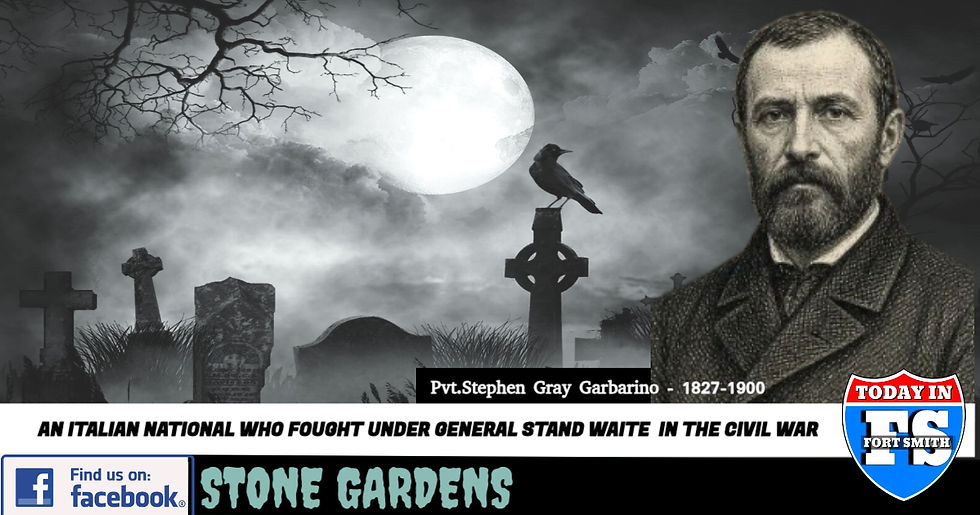
Stephen Gray Garbarino was one of those men. He was born September 8, 1827, at Montebruno in the upper Trebbia Valley of Liguria, then part of the Kingdom of Sardinia. Family notes later rendered the place as Monte Bruno in Torilio or Turelia County, almost certainly a memory of Torriglia, the neighboring market town that served as the administrative seat for the mountain communes around it.
The country he left was poor ridge land of potatoes, forage, and stock, already pushing sons toward Genoa long before the great Italian crossing of the 1880s. No passenger list with his name has come to light. What the Cherokee record does show is that by September 9, 1860, he stood in the Delaware District of the Cherokee Nation and married Sarah Abigail Hopkins.

Sarah was born January 27, 1839, in Indian Territory, months after her people finished the Removal from the East. She was the daughter of Daniel Hopkins, a white man, and Elizabeth Hair, a Cherokee woman listed with her children on the 1852 Drennen Roll in the Delaware District. Compiled Cherokee lineages carry Elizabeth’s line through Hair Conrad.
Sarah herself was later recorded as one quarter Cherokee. Their marriage made Stephen an adopted white citizen of the Nation. On the 1880 Cherokee census, his surname appears as Gobiner. By 1890 it is Garbarino again. He farmed. She kept the household. Five children followed: Mary Elizabeth, born April 8, 1863; Martha Louisa, born September 27, 1865; Catherine Isabelle, born in 1868; a son, Daniel, whose later trace thins in the public record; and Sarah Josephine, born February 7, 1874.
War reached them almost as soon as the first child did. In 1863 Stephen enlisted as a private in Company E of the First Cherokee Mounted Volunteer Rifles, Captain Joseph Franklin Thompson’s company, under Colonel Stand Watie.
Thompson was a Delaware District Cherokee who had studied for the ministry in Tennessee, come home, and risen from captain to major and then lieutenant colonel. The regiment belonged to the Confederate service in the Trans Mississippi. It fought across Indian Territory, Arkansas, and the border country in set battles and in the long guerrilla war that split the Nation.
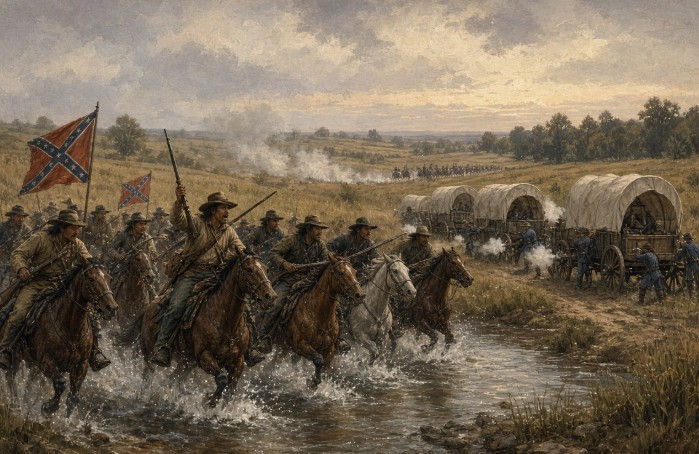
Watie’s men were at Elkhorn Tavern, Old Fort Wayne, Prairie Grove, Honey Springs, and the Cabin Creek captures. Watie became the only Native American Confederate brigadier and the last Confederate general to surrender, on June 23, 1865.
How many of those fields the Ligurian private saw is not written on a surviving individual jacket in the open indexes. The company, the captain, the colonel, and the year of enlistment remain.
After the war, the Delaware District filled again with farms. Stephen and Sarah appear together on the 1880 and 1890 Cherokee censuses, he listed as a farmer. Their daughters married into families already rooted in the same hills. Mary became a Mantooth. Catherine Isabelle became a Landrum and died in 1906. Sarah Josephine became a Clevenger. Martha Louisa remained a Garbarino on the Dawes rolls and lived until 1959
. Sarah Abigail enrolled with the Dawes Commission as a Cherokee by blood on card 3772 and died January 28, 1903, at Vinita.

Stephen died April 24, 1900, in Craig County, aged seventy two. He was buried in the small family ground that still bears his name, Garbarino Cemetery, Township 24 North, Range 20 East, Section 10, south of Vinita.
County surveyors later counted about twenty two visible graves there, fourteen identified, the rest taken by grass. It is not a town cemetery and not the larger Landrum ground nearby, though at least one burial was moved from Landrum to Garbarino.
The naming follows an older pattern of the Nation and of early Oklahoma. A household field becomes a family acre. The acre keeps the surname. The surname outlives the man who crossed an ocean, married into a people not his own, rode with Watie, and came home to farm.
The stones south of Vinita do not argue ideology. They mark a place where an Italian private and a Cherokee wife made a single household, and where the war that most Americans still imagine as a brothers’ quarrel also held room for a stranger from Montebruno.


