Stone Gardeens : Award-winning artist was born in the small Madison County community of Kingston in 1917


Geraldine Mattie Hamilton was born on December 1, 1917, in Kingston, (Madison County) to African American parents Hugh H. Hamilton and Esther P. Duke Hamilton. Her maternal grandfather, Jesse C. Duke, was a Mason and newspaper publisher who had debated Booker T. Washington, and her uncle Charles S. Duke, a Harvard graduate and prominent Chicago architect, encouraged the family to leave the South.
Her mother, a teacher who had graduated from Barber-Scotia College in North Carolina, and her father, a farmer, raised her with an emphasis on education and perseverance. When she was about three years old, the family moved to Chicago, settling on the South Side, where she grew up visiting the Field Museum and absorbing the cultural life of the city.
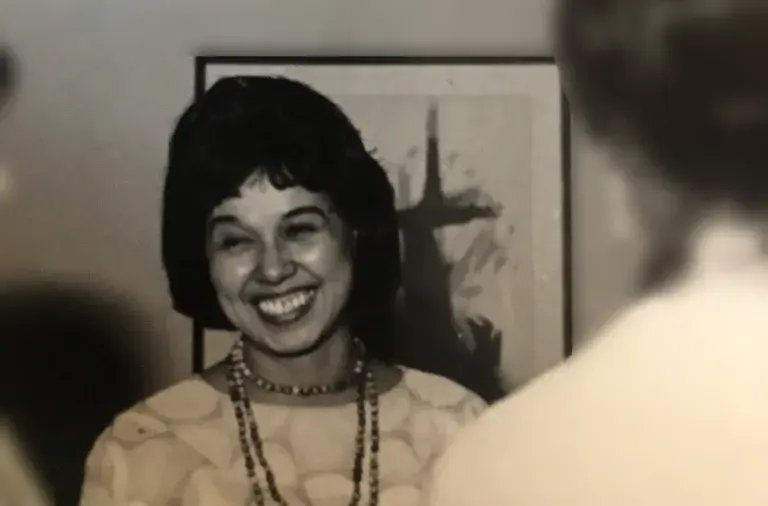
She graduated from Hyde Park High School and, supported by the John D. Steinbecker Scholarship along with other awards, entered the School of the Art Institute of Chicago.
There she earned a bachelor of arts degree in 1948 and a master of arts in art education in 1955, initially focusing on painting and figure work while receiving recognition for excellence.
In 1939 she married Lester Wilder McCullough Sr., a welder by trade. The couple had one son, Lester “Skip” McCullough Jr. Early in their marriage they lived in Maywood, Illinois, where Lester worked various jobs including as a garbage collector and later as a welder at a steel mill, while Geraldine taught in Chicago public schools.

For roughly fifteen years she taught art at Wendell Phillips High School on the South Side, building a reputation as both educator and painter whose work appeared in national exhibitions. In the early 1960s, intrigued by her husband’s welding skills, she asked him to teach her the craft. That introduction transformed her practice. S
he began creating large-scale abstract metal sculptures from welded steel, copper, brass, and related materials, often fusing scrap or sheet metal into forms that carried movement, texture, and spiritual presence. Her first welded piece appeared in 1963 at the Century of Negro Progress Exposition in Chicago.

The following year her 250-pound welded steel and copper sculpture titled Phoenix received the George D. Widener Gold Medal for Sculpture from the Pennsylvania Academy of the Fine Arts, the highest honor in American sculpture at the time and a breakthrough that brought her national attention, including coverage in Time magazine.
From the mid-1960s until her retirement around 1989 she served on the faculty of Rosary College (now Dominican University) in River Forest, Illinois, rising to chair of the art department for twelve years. Upon retirement, the university awarded her an honorary doctorate.

During these decades, she produced major public works, among them two large bronze representations of the Reverend Martin Luther King Jr.: Our King, Dr. Martin Luther King, Jr. (1973) in Chicago and a second sculpture installed in 1988 at Freedom Corner near the Illinois State Capitol in Springfield.
Oher commissions include Phoenix Rising (1977) at Maywood Civic Plaza, The Spirit of Du Sable (1977) in the sculpture garden of the DuSable Museum of African American History, Millflower (1979) in Geneva, Illinois, and Pathfinder (1982), the towering copper and bronze piece she gifted to Oak Park that stands outside Village Hall.

Her style blended abstract forms with figurative resonance, drawing on African ritual art, European expressionism, and modern American sculpture; critics noted the expressive intensity and inner vitality of the work. She exhibited widely, participated in landmark shows of African American women artists, traveled internationally under a cultural exchange program, and received further honors including the Oak Park Area Arts Council’s Joseph Randall Shapiro Award in 2000, for which she designed the trophy.
In the mid-1970s she and her husband purchased and renovated an abandoned early-twentieth-century CTA power station on Lombard Avenue in Oak Park, converting the three-story structure into both family home and studio large enough for her monumental pieces.
They had moved to Oak Park around 1968, navigating housing discrimination before the local fair-housing ordinance took effect. Lester died in 1988. Geraldine continued working in the Lombard studio for the rest of her life, mentoring younger artists and remaining active in community organizations such as The Links and Delta Sigma Theta.

She died of heart failure on December 15, 2008, at the age of 91, quietly in her Oak Park home and studio. Services were held on December 22 at Grace Episcopal Church in Oak Park. She is buried at Sunset Memorial Lawns, also known as Sunset Memorial Gardens, in Northbrook, Cook County, Illinois.
This is the same cemetery where her husband, Lester Wilder McCullough Sr., was interred in Section 2 following his death in 1988. She was survived by her son Lester “Skip” McCullough Jr. and his wife Mary, grandchildren Scott and Kimberly, sisters Hazel Collymore and Gladys Davis, brothers Charles and Nathaniel Hamilton, and many nieces and nephews.
Her life and work continue to be commemorated through the sculptures that remain in public spaces across Illinois and in museum and private collections nationwide.


