Srone Gardens: An early farmer in south Sebastian County is buried in a large cemetery that bears the family name


Less than a quarter mile off US Highway 71 on Bonanza Road, the Douglass Cemetery has over 600 verified burials dating back to the early 19th century.
Nestled in the quiet countryside near Jenny Lind in Sebastian County, Arkansas, the grounds hold generations of pioneer families who carved farms and communities from the timber and rolling hills near Jenny Lind.
Matthew Guthrie McNabb is recognized as one of the earliest documented interments in Douglass Cemetery, having died in 1876 after moving from his birthplace in McMinn County, Tennessee, to Jenny Lind. ,
His presence, along with that of his wife Sarah J. McNabb, reflects the Tennessee origins of many of the families who settled the community and established this early burial ground. But another Tennessean lent his name to the cemetery that now sits on what would have been the southern quadrant of the Douglass family farm

Among the stones is that of Moses Scruggs Douglass, born October 26, 1826, in McMinn County, Tennessee. He lived out his final years in the same Arkansas county where he was laid to rest on January 19, 1892, at the age of 65.
Moses grew up in the hills of East Tennessee during a period of rapid settlement following the removal of Cherokee people and the opening of new lands. McMinn County sat along the routes that carried families westward, and the Douglass name appears among early settlers in the region.
Little survives of his childhood beyond the basic fact of his birthplace, but like many sons of small farmers in that era he would have learned the rhythms of planting, livestock, and the hard work of clearing ground. By the early 1850s he had made his way into neighboring Monroe County, where he met and married Julia Ann Reagan in 1854.
Julia had been born in 1835 in Monroe County, Tennessee, and she was roughly nine years his junior.
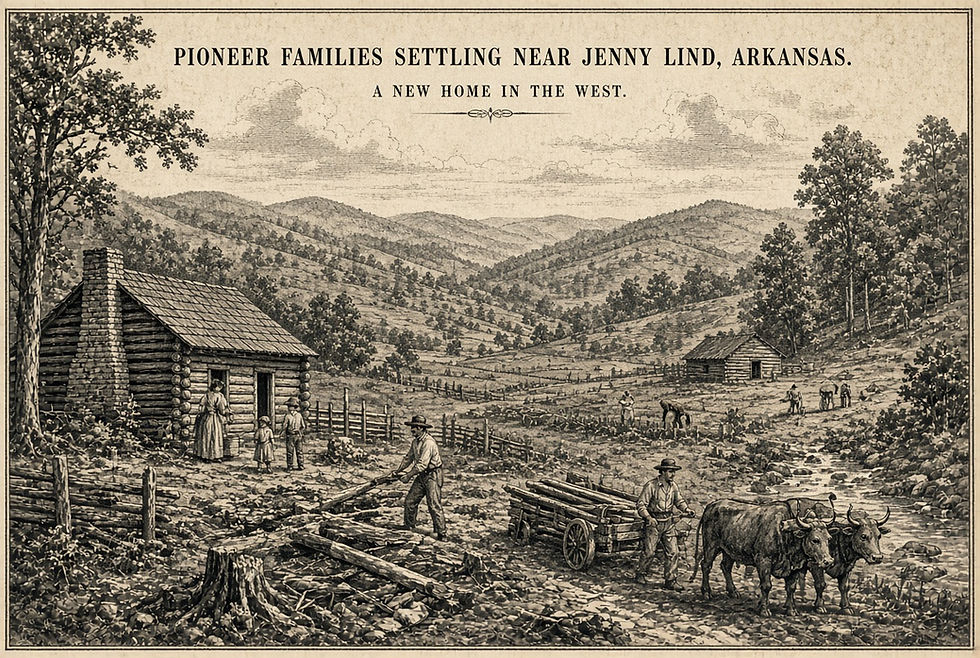
The couple began their family while still in Tennessee. Their son Franklin P. Douglass arrived in 1858. Two years later, in 1860, they welcomed Emmons R. Douglass. Sometime between the mid-1850s and the early 1860s the family left Tennessee and joined the stream of settlers heading into the Arkansas River Valley.
Sebastian County was still a young county when they arrived, its post offices and small communities taking shape around timber, small farms, and the emerging coal seams. Julia died on March 26, 1864, at Saw Mill in Sebastian County at about 29 years of age. She was buried in what became the Douglass Cemetery. The two young sons also died young. Emmons lived only until 1861, and Franklin followed in 1866. Both rest in the same burying ground.

Moses remarried in 1866. His second wife, Charlotte Tennessee Tatum, had been born in 1841 and was about fifteen years younger than her new husband. Charlotte brought her own family connections into the household; the Tatum name was already present in the Jenny Lind area, and a nearby family cemetery carries the Tatum name.
Together Moses and Charlotte raised a larger family amid the post-war rebuilding of Sebastian County. Their children included Arphaxed Tatum Douglass, born in 1867 and living until 1943; Thaddeus Douglass, born in 1872 and dying the following year; Darius Cincinnatus Douglass, born in 1874 and dying in 1899; Victor Alvin Douglass, born in 1877 and dying in 1894; and a namesake son, Moses Scruggs Douglass, born in 1879 and living until 1962.
Several of these children and later descendants also lie in the Douglass Cemetery, tying the family name firmly to the landscape.

No clear record of military service for Moses Scruggs Douglass has surfaced in the available accounts of the period. The Civil War years brought fighting and occupation to parts of Arkansas, and many men of his age and background either enlisted or were drawn into local defense, yet nothing in the surviving memorials or family notes links him to a specific regiment or company.
He appears to have spent the bulk of those years as a civilian settler, raising children and establishing a place in the county while the conflict ran its course.
In his later life, Moses remained in Sebastian County. The 1870s and 1880s saw the growth of small towns and the expansion of farming and mining in the region, and the Douglass household continued amid those changes.
He died on January 19, 1892, and was buried in the family cemetery at Jenny Lind. Charlotte survived him by eight years, dying on October 8, 1900, also in Sebastian County, and was laid to rest beside him.
The cemetery that bears the family name continues to hold the record of their lives and those of the generations that followed, a quiet marker of the migration that carried East Tennessee families into the hills of western Arkansas and the enduring ties of kinship that kept them there.


