Small graveyard in Van Buren, founded by Quakers in 1850, is final resting place for farmer Martin Van Buren Beals
- Dennis McCaslin

- Jun 10, 2025
- 3 min read

I


In the fertile fields of Crawford County, Martin Van Buren Beals (1848–1928) lived a life of quiet faith and steadfast resolution , deeply rooted in his Quaker beliefs.
Born on August 11, 1848, in Wayne County, Ohio, Beals carried the values of the Religious Society of Friends to Van Buren, where he became a farmer and family man against the backdrop of a growing American frontier.
His story, pieced together from genealogical records and historical accounts, reflects the Quaker principles of simplicity, community, and perseverance.
Beals’ Quaker faith shaped his life as he settled in Van Buren, a vibrant river town incorporated in 1845. Named for the eighth U.S. president, Van Buren thrived as a steamboat hub and later a railroad junction after 1873, supporting the region’s agricultural economy.
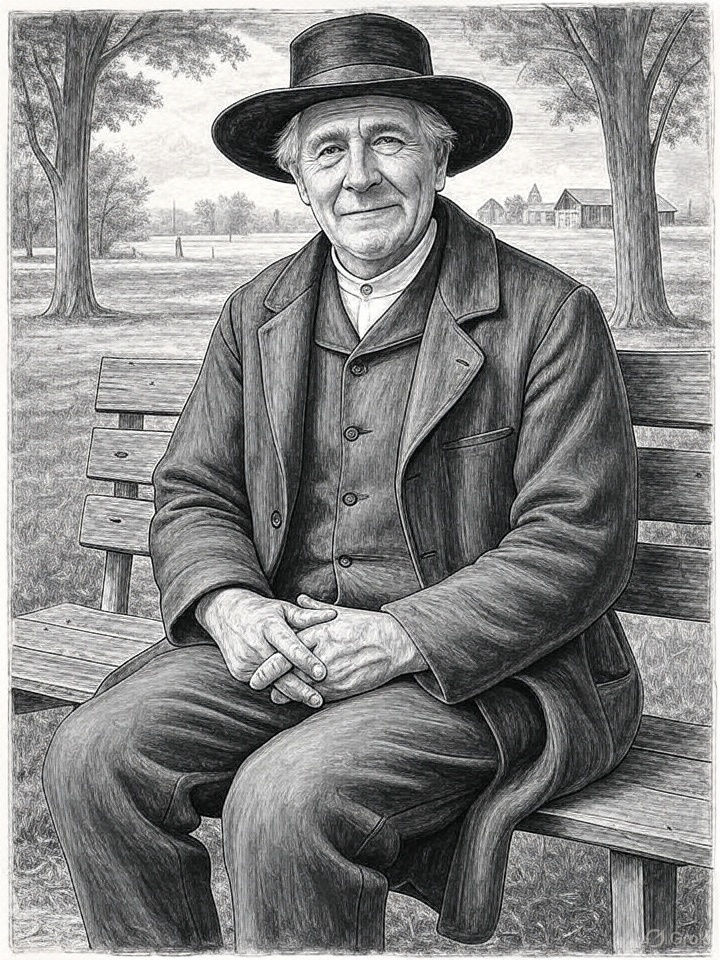
Beals farmed 3.5 miles north of town, as noted in the 1880 and 1900 U.S. Federal Censuses, embodying the Quaker ideal of living simply and working the land with integrity. His labor contributed to Crawford County’s agricultural backbone, where farmers like Beals sustained communities through honest toil.
The Quaker emphasis on peace and community likely guided Beals’ interactions in Van Buren, a town shaped by its proximity to Indian Territory and the Trail of Tears. His connection to the Quaker Indian Mission, which founded Antioch Cemetery in 1850, underscores his ties to the Society of Friends’ outreach efforts.
The mission, though sparsely documented, aimed to engage with Native American communities, reflecting Quaker values of compassion and education.

Beals’ personal life, marked by love, loss, and faith, mirrored the trials faced by many Quakers of the era. In 1867, he married America J. Hicks, with whom he had two sons, James David (1868–1941) and John William (1869–1943). Her death in 1869, possibly from childbirth complications, tested Beal, but his Quaker faith provided strength as he raised his young sons.
In the 1870s, he wed Eliza Jane Thompson, and they had daughters Sarah Dell Beals Butcher (1880–1967), Maggie Delene Beals Franklin (1882–1978), and Eliza Jane Beals Dugger (1893–1916). Eliza’s passing in 1895 was another loss, yet Beals’ commitment to family endured.
His third marriage, to Della Franklin after 1895, brought more children: Nancy Delene Beals Scott (1899–1983), Willie Van Buren Beals (1906–1963), Charles Newton Beals (1911–1997), and Logan Cornelious “Shorty” Beals (1912–1996). Della outlived him, passing away in Los Angeles in 1964.
Through these marriages, Beals built a large family, reflecting the Quaker value of community and the strength drawn from shared bonds.

Beals’ life story culminated at Antioch Cemetery on Oliver Springs Road in Van Buren, where he was buried on August 25, 1928, at age 80, with Fentress Mortuary handling arrangements.
The cemetery, established in 1850 by pioneers tied to the Quaker Indian Mission, held deep significance for the local Quaker community.The Quaker Indian Mission, linked to efforts to support Native Americans in the wake of the Trail of Tears, reflects the Society of Friends’ commitment to peace and outreach, values Beals likely upheld.
While Antioch Cemetery lists 47 burials on Find a Grave, specific records of its earliest interments--likely from 1850 and involving pioneers born in the early 1800s--are limited. Beals’ burial there ties him to this early Quaker history, his grave a testament to a life lived in service to faith and family.

Martin Van Buren Beals’ life was not one of fame, but of quiet impact grounded in Quaker principles. His work as a farmer sustained his family and contributed to Van Buren’s growth during a transformative era. His survival through personal losses and his dedication to raising a large family reflect the Quaker values of perseverance and community.
The Quaker Indian Mission’s influence, seen in the founding of Antioch Cemetery, connects Beals to a broader legacy of compassion and engagement with Native American communities.
Today, Antioch Cemetery remains a touchstone for descendants and researchers, e exploring Beals’ story and the region’s Quaker heritage.
As Van Buren preserves its Victorian charm and agricultural roots, Beals’ life stands as a powerful reminder of the quiet strength of faith and family in shaping America’s heartland.


