Our Arklahoma Heritage: William Henry Balentine Sr. was an early leader in Cherokee educational efforts
- Dennis McCaslin

- Jun 30
- 3 min read
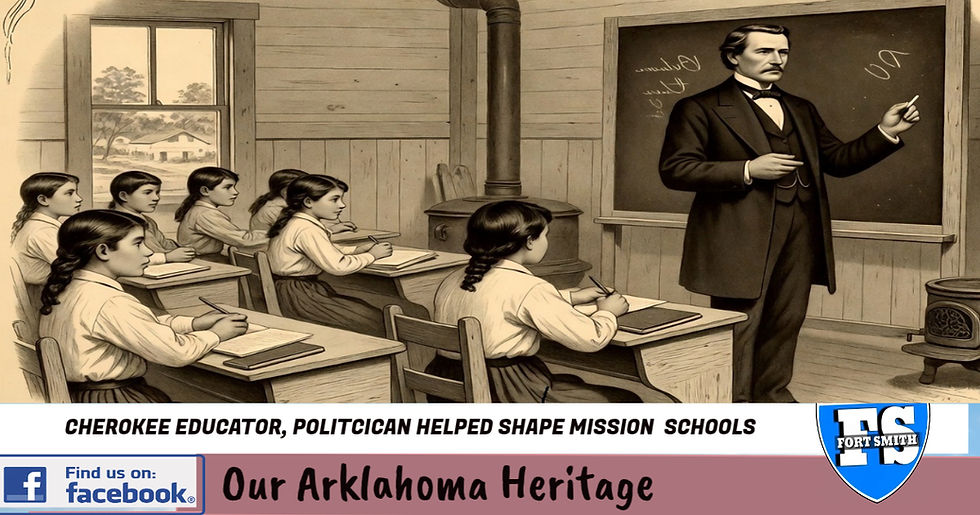


William Henry Balentine Sr. was born on July 6, 1854, in the Cherokee Nation, Indian Territory, and passed away on July 3, 1933, in Oklahoma. H
e became a respected educator, public servant, farmer, and community figure in what is now Cherokee County, Oklahoma, with regional connections extending into Muskogee County through broader territorial history.
As the son of Rev. Alexander Hamilton Balentine, a Presbyterian missionary from Pennsylvania educated at Princeton who served among the Creek, Choctaw, Chickasaw, and Cherokee nations starting in the 1840s, and Nancy Ann “Anna” Hoyt, granddaughter of Cherokee Second Chief George Lowrey,

William grew up immersed in mission schools and cultural transitions. His father taught at various sites, including Tallahassee and Coweta Missions, Spencer Academy, Wapanucka, and later in Cherokee territory before dying of pneumonia in Vinita in 1876 while serving as superintendent of the Cherokee Female Seminary.
William absorbed much of his early education through travel with his father across these missions. He later attended Highland University for two years and Westminster College in Fulton, Missouri, though his father’s death prevented graduation.

In 1876 he began a long career in teaching at schools such as Woodhall near Tahlequah, continuing at locations including Durdeen, White Oak, Pheasant Hill, Menard where he taught for seven sessions, Garfield, and Eureka. By 1881 he had been appointed to teach at the National Male Seminary.

Beyond education, William held several roles in Cherokee Nation governance. He served as clerk of Senate committees in the National Council starting in 1879 and received reappointments over roughly a decade. He also worked as secretary for a judge who superintended the Female Seminary and spent two years on the board of trustees for the Insane Asylum.
In 1876 he toured parts of the United States, visiting the Centennial Exposition, the national capital, Niagara Falls, and other sites. He owned and managed farmland--about 160 acres near Tahlequah and 50 acres near Fort Gibson—--along with livestock including cattle, horses, mules, and hogs, balancing public service with practical agriculture.

In 1878 William married Fannie Keys, daughter of the late Chief Justice Riley Keys, a longtime judge and national delegate. Their three children were Fannie Minerva, William Henry Jr., and Annie MaY.
Fannie died in 1885. In 1890 he married Mary jOHNSON , identified in the sketch as the daughter of Andrew Johnson, a prominent man in the Flint District. Family connections through the Hoyt, Lowrey, and Keys lines tied the Balentines deeply into Cherokee leadership and missionary networks
. His brother Hamilton Balentine lived in Vinita and built a reputation as a successful businessman before his death around 1901.

The children continued the family’s presence in eastern Oklahoma. Fannie Minerva Balentine, born around 1879, later married and was buried in Stilwell Cemetery in Adair County after passing in 1939. William Henry Balentine Jr., born in 1882, married Olive B. Antoine in 1905; their descendants included Bernice Ollie Balentine, and he was laid to rest in Tahlequah Cemetery after his death in 1962. Annie May Balentine, born around 1885, married William Ross and died in 1919.
William Henry Balentine Sr. died just short of his 79th birthday and was buried in Ross Cemetery at Park Hill in Cherokee County., a site connected to his family’s missionary roots.
He lived through the profound changes from Cherokee Nation governance to Oklahoma statehood, maintaining a reputation for intellectual depth and community service as an educator and official.


