Our Arklahoma Heritage: When you go looking for a cemetery and find a "booger story from 30 years ago...
- Dennis McCaslin

- 1 day ago
- 6 min read


I received a phone call this week from a new Today in Fort Smith follower with information on an old family cemetery a few miles north of Charleston over in Franklin County. So Wednesday, after a stop at the Sonic for my $7 meal deal, I headed down U.S. Highway 22 to meet a local who said he knew the easiest way into the graveyard.
The plot we needed sat not far from the intersection of state Highways 60 and 217. Getting there meant a quarter-mile hike into the woods. Thankfully, my benefactor chose the “easiest” route, because between the heat, the chiggers, the ankle-biting briars, and the simple fact that I am no longer young, I was already beginning to reconsider the whole outing.

Then my new friend--knowing my soft spot for history and the untraditiona--mentioned the Franklin County Creeper.
I got an education on a decades-old legend I had never heard a word about, and by the time we reached the Singleton Family Cemetery I was more intrigued by the Creeper than by the stones we had come to find.
My host was about eleven years old in the fall of 1989 when the unusual activity began on his family’s place. His father saw the thing at least three times. One of those times the boy was with him, riding the tractor through the bottom lands near the Mulberry River.

It was a spring morning, the kind when the air still holds a little cool and the trees along the river stand in thick, early leaf. They were working the low ground when the animal appeared among the trees for only a few seconds--long enough for a fleeting glance, nothing more.
The father later described it the way others would: bigger than a bobcat, tawny and mottled, with an oversized canine head, long mule-like ears tipped with hair, a thick neck, and that strange sloping back. It did not lope. It sprang.

“I don’t know what it actually was or where it came from,” my host told me, “but the only difference between our booger and that one down in Fouke is no one ever made a bad movie about our deal.”
That single quiet sentence opened the door to a whole stretch of research on this Franklin County anomaly. Newspaper accounts from the era lent a lot of credibility to thes tory.
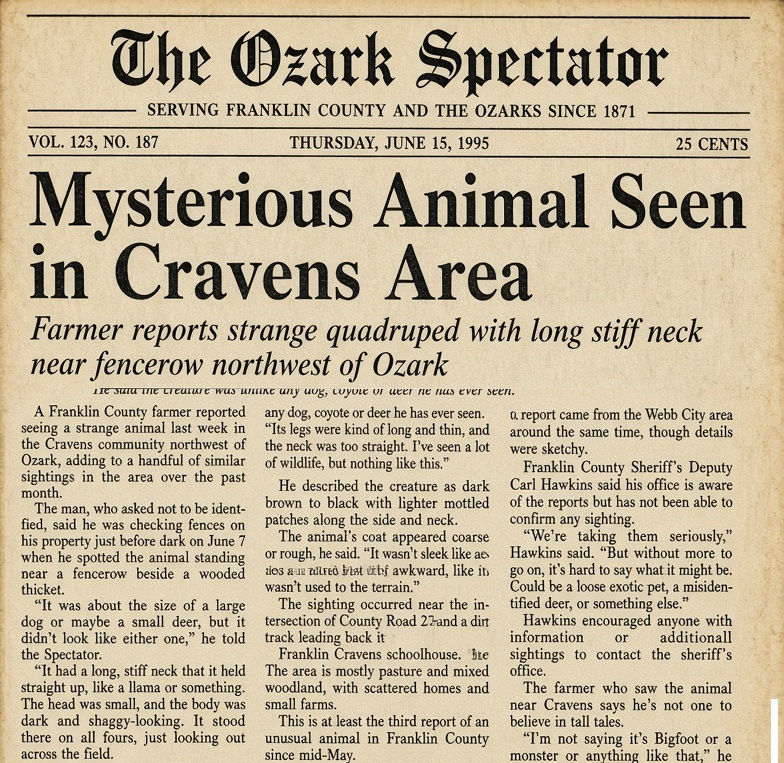
And you know me. I love a good story. And the Ozark Spectator and Charleston Express both got in on this one.
Harley Edgin, a cattle farmer who lived northeast of Ozark on the north side of Highway 352, saw them more than once. In the fall of 1991, he and a friend spotted two of the animals sitting on their haunches in a pasture, watching the truck. At first, they took them for coyotes. Edgin had spent a lifetime among the wildlife of the county and could not place them.

Through binoculars the larger one stood roughly three feet at the shoulder, bobcat-colored, with that same oversized head and the long-tufted ears. After several minutes, the pair spun, ran a hundred yards to a barbed-wire fence, stood briefly, then slipped under it and vanished into the timber.
Edgin saw them again south of Watalula toward the Highway 219 junction. Once he tried to close the distance in his truck and got within twenty feet before the animal slipped away. A passenger with him said quietly, “There ain’t nothing right about that thing.”
Tracks later found in a cedar glade showed front paws round like a cat’s, about three inches across and set twelve to fourteen inches apart side to side, the rear prints smaller and closer together.
In 1996 or 1997 one crossed Highway 219 in front of Edgin’s truck just north of Interstate 40. He never saw another after that, but others did.
In the spring of 1991 Ruby Tolton and a relative were cleaning up at Belt Cemetery north of Ozark when a deer broke from cover and an unidentified animal gave chase. It was not a dog, not a coyote, not a bobcat or mountain lion.
The description matched what Edgin had seen.

A utility worker later watched a similar creature cross the same stretch of Highway 219, pause a hundred yards out, then bolt across a creek and scale a steep bluff with surprising agility before disappearing into the woods.
In the Cravens area northwest of Ozark, residents reported the same kind of quadruped, sometimes with a longer neck held stiff and awkward. Lucile Elder, who wrote the Barnes News column for The Spectator, published her own family’s account on September 15, 2004.
She and relatives had watched a creature that seemed to defy easy description. Her son saw it at night on two occasions, noting the thick neck and fat head, the animal standing about three feet to the top of its skull.

One of the more unsettling encounters belonged to Geraldine Wyers. In the mid-1990s she was on Edgin’s property helping to tear out a beaver dam. She left her truck door open, walked the short distance to the dam, finished the work, and returned for a .22 rifle she had brought along.
A bird-like call sounded, then a loud moaning like an animal in pain. Across a branch less than ten yards away, a crouched form waited. The head was massive. Upper canines hung two or three inches long and carried blood. The animal showed no fear of her or the rifle. Wyers backed toward the truck inch by inch, eyes locked on the creature. She stepped inside, pulled her leg clear, and slammed the door.
The moment the latch clicked, she felt and heard the impact as the animal slammed into the driver’s door hard enough to leave a dent and rock the vehicle. She drove straight to Edgin’s place, shaken.
“There ain’t nothing right about that thing” was the phrase that stayed with her and with others who heard the story.

An Ozark businessman later told of sitting in his pickup at a highway intersection north of the interstate when one of the animals walked past the driver’s side, circled the front of the truck, and paused at the rear in the glow of the taillights. It stood there for nearly a minute, watching him in the mirror, shielding its eyes from passing headlights.
The head sat below the bottom of the window. The jaws were wide and powerful, canines visible outside the mouth. He judged the animal heavier than the others, closer to five hundred pounds, and felt a fear that stayed with him long after it moved on.
Tal Branco, an investigator with years of experience looking into anomalous animal reports across the South, drove into Franklin County after Elder’s column appeared. Over three days he spoke with Edgin, Tolton, Wyers, and others.
He published what he learned in the Charleston Express on January 10, 2006. The accounts were consistent in the core features yet varied enough in neck length, overall size, and exact proportions that Branco wondered whether more than one type might be present, or whether the animals changed as they matured.
. Similar reports, he noted, had surfaced in neighboring Johnson County and farther afield in Montgomery County and across the line into southeastern Oklahoma. No one claimed the creatures were supernatural. They simply did not match anything known to local hunters, farmers, or wildlife officers.
The country itself offered little in the way of easy explanation. The northern forests give cover.
The southern pastures and the river bottoms provided food and water. Bobcats, coyotes, and the occasional mountain lion already lived there. Yet the witnesses were people who knew those animals on sight. They were not tourists or outsiders. They were neighbors who worked the same ground year after year.
Some, like the father of the TIFS reader taking me on a tour of Booger Counry on Wednesday, kept quiet for fear of ridicule. Others spoke only after someone else had already broken the silence in the local paper. The sightings clustered in the 1980s and 1990s, thinned afterward, and never produced a body, a clear photograph, or an official confirmation.

The Fouke Monster of Miller County farther south became a national curiosity and the subject of a movie. The Franklin County Creepers stayed home, a private unease shared among people who still drive the same highways and still glance twice at anything that moves at the edge of a field at dusk.
What remains is the weight of the testimony. A farmer who spent his life outdoors cannot name the animal that watched him from a pasture. A woman feels a truck rock under the force of something that left a dent in the door. A boy on a tractor catches only a fleeting glance among the trees near the Mulberry, yet the memory stays.
A passenger utters the same plain judgment more than once: there ain’t nothing right about that thing.
In a county bisected by a river, half forest and half farm, the ordinary and the anomalous still share the same roads. The tallgrass of Cherokee Prairie bends in the wind. Mulberry River keeps its quiet course.
And somewhere in the timber or along the fencerows, the memory of those springing, oversized shapes continues to walk, whether the animals themselves are still out there or not.
As for the Singleton Family Cemetery--I did find it.
More on that later.


